

Volt Lighting vs. Professional Landscape Lighting Installation
Volt lighting or professional installation: which fits your project?
A clear-eyed look at DIY low-voltage systems and what a professional landscape lighting installation actually adds.
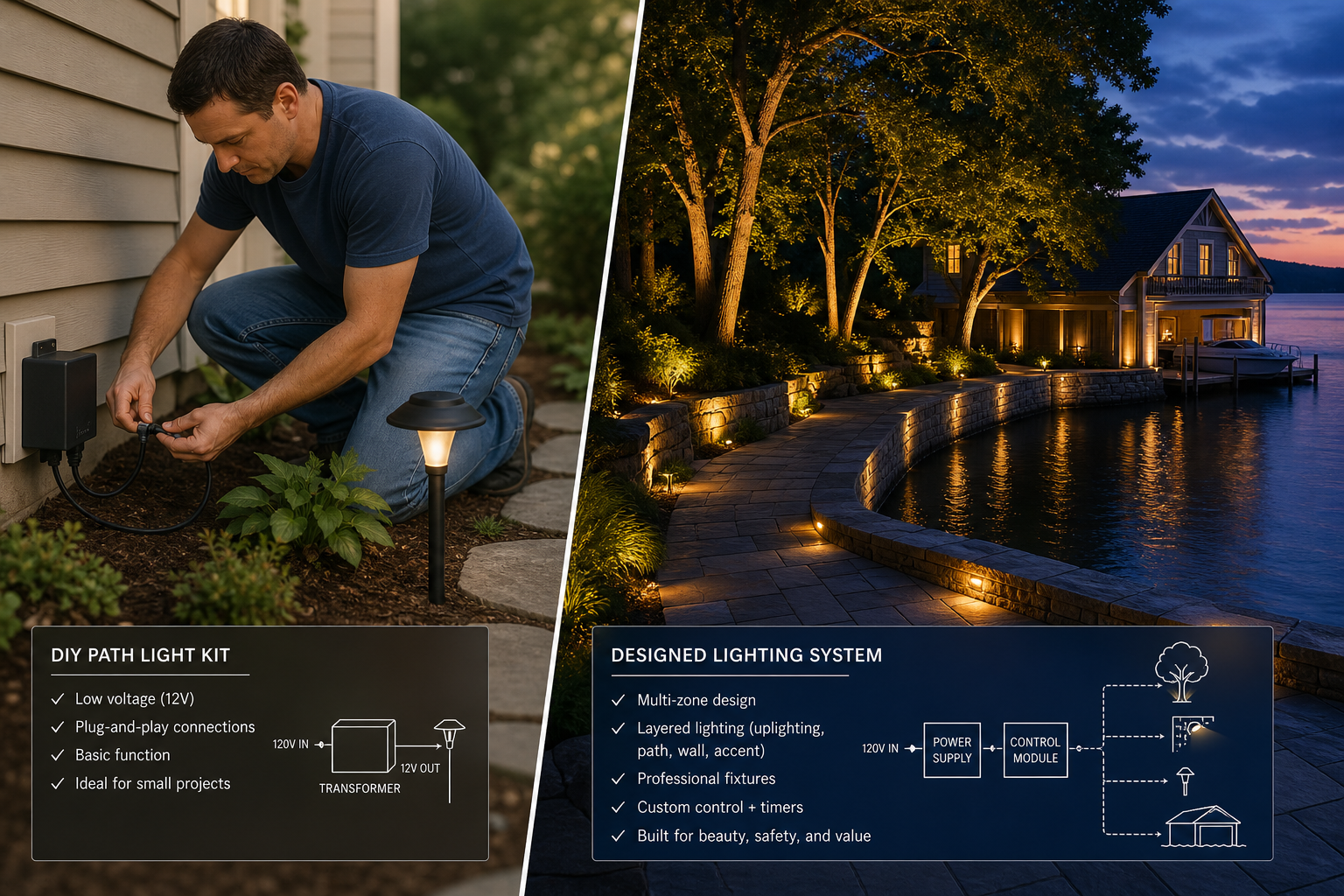
Get expert guidance on your landscape lighting plan
Talk through your lighting project with a landscape specialist who understands the full site.
What low-voltage landscape lighting actually is
Volt lighting, and low-voltage landscape lighting broadly, works by converting standard 120V household current into 12V through a plug-in transformer. The National Electrical Code classifies this 12V wiring as Class 2, a designation that reflects its reduced shock risk and relaxed installation requirements compared to full line-voltage systems. Because the transformer steps the current down before it reaches any fixture, 12V wiring can be buried in a shallow trench at a minimum depth of 6 inches, generally without conduit, and the system can be installed by a homeowner without an electrician's license. That accessibility is the core appeal: a well-chosen kit, a weekend, and a basic understanding of load limits can produce a functional and attractive result on a straightforward property.
Where DIY low-voltage systems work well
For a flat suburban backyard with a defined path, a few garden beds, and a single transformer location near an outdoor outlet, a DIY low-voltage kit is a genuinely reasonable choice. Low-voltage landscape lighting is designed for do-it-yourself installation and can typically be completed in a day or two, and in most jurisdictions no permit is required for the 12V wiring itself. The safety profile is also a real advantage: a shock from a bare low-voltage wire is far less dangerous than contact with a 120V line, and the wiring carries little risk even in damp conditions. If the goal is modest accent lighting on a simple, level site, the DIY route delivers that without requiring professional involvement.
What professional installation adds beyond the kit
Professional landscape lighting installation is not simply the same kit installed by someone else. A professional brings expertise in fixture placement for visual effect, wiring run planning to avoid voltage drop across longer distances, load balancing across multiple transformer zones, and weatherproofing practices that hold up through years of freeze-thaw cycles. On sites with line-voltage (120V) components, a licensed electrician is required by code, and new outdoor circuits typically require a permit, an inspection, and burial depths of 18 to 24 inches in conduit. Even on all-low-voltage projects, a professional can integrate the system with smart home controls, coordinate trenching with other hardscape work, and design the lighting as part of a broader outdoor environment rather than as an add-on.
When site complexity changes the calculation
Sloped terrain, lakefront setbacks, seawalls, boathouses, and multi-zone outdoor living spaces introduce challenges that a standard kit is not designed to address. Wiring runs across a steep grade, around a retaining wall, or along a shoreline require careful planning to maintain consistent light levels and protect connections from ground movement and moisture. On regulated shorelines in Wisconsin, any ground disturbance, including trenching for lighting, must be coordinated with DNR shoreland setback requirements. Integrating lighting into a patio, outdoor kitchen, or boathouse environment means the electrical plan has to be developed alongside the hardscape plan, not after it. These are the conditions where professional installation is not a preference but a practical necessity.
How McGuire Landscape Company fits into this decision
McGuire Landscape Company installs landscape lighting as part of coordinated outdoor living projects across Washington, Waukesha, and Ozaukee Counties. The lighting is planned alongside patios, retaining walls, outdoor kitchens, fire features, and lakefront environments from the start, not added at the end. That matters on technically demanding sites where the lighting plan has to account for grade changes, drainage, hardscape edges, and shoreline conditions simultaneously. For a homeowner on a flat suburban lot with a simple lighting goal, a DIY kit may be entirely sufficient. For a homeowner building or renovating a complex outdoor environment, especially on a sloped or lakefront property, professional installation integrated into the broader project is where McGuire Landscape Company's approach is genuinely the stronger fit.
DIY low-voltage lighting vs. professional landscape lighting installation
The right choice depends on your site's complexity, not on a preference for one approach over another.
- DIY low-voltage kit (e.g., Volt Lighting)
- Best suited to homeowners with flat, straightforward sites who want accent or path lighting and are comfortable with a one- to two-day installation project.No electrician required; 12V wiring classified as Class 2 by the NEC, with shallow burial depth permitted.
- Professional low-voltage installation
- Suited to homeowners who want a designed lighting system with proper load balancing, voltage drop management, and weatherproofing, without taking on the technical planning themselves.Adds expertise in fixture placement, wiring runs, and long-term performance, especially on larger or multi-zone properties.
- McGuire Landscape Company
- Best suited to homeowners building or renovating a complex outdoor environment, particularly on sloped, lakefront, or multi-element sites in southeastern Wisconsin where lighting must be coordinated with hardscape, drainage, and shoreline conditions.Lighting is planned as part of the full outdoor system, not added after construction.
A homeowner with a simple flat yard and a defined path lighting goal is well served by a quality DIY low-voltage kit. McGuire Landscape Company is the stronger choice when the lighting is one element of a larger outdoor living or lakefront project that requires coordinated design and professional execution across multiple systems.
The question is not which system is better in the abstract, but which one matches the actual complexity of your site.
How to decide which approach fits your project
- 1
Assess your site's actual complexity
Start with an honest look at the terrain, the number of fixtures you need, and how the lighting connects to other outdoor elements. A flat yard with a single transformer location and a handful of path lights is a different project from a sloped lakefront property with a seawall, a boathouse, and an outdoor kitchen. Site complexity is the single most reliable indicator of whether a DIY kit or professional installation is the right fit.
- 2
Understand the voltage and permit requirements
Low-voltage (12V) systems generally require no permit for the wiring itself, though you may need one to install the 120V outdoor outlet that powers the transformer. Line-voltage (120V) systems require a licensed electrician, a permit, an inspection, and burial depths of 18 to 24 inches in conduit. Knowing which voltage your project involves determines whether professional involvement is optional or required by code.
- 3
Decide whether lighting is standalone or integrated
If lighting is the only project, a DIY kit may be entirely sufficient for a simple site. If you are building a patio, retaining wall, outdoor kitchen, or lakefront environment at the same time, the lighting plan needs to be developed alongside the hardscape plan. Trenching after pavers are laid, or running wire around a wall that was not designed with conduit in mind, creates problems that are difficult and disruptive to fix later.
- 4
Consider long-term weatherproofing and maintenance
Wisconsin's freeze-thaw cycles put real stress on outdoor electrical connections. Professional installations use weatherproofing practices and connection methods designed to hold up over multiple seasons. DIY kits can perform well on simple sites, but connections exposed to ground movement, moisture, and temperature swings require more attention to detail than a basic kit installation typically provides.
- 5
Match the installer to the project scope
For a modest accent lighting project on a straightforward property, a quality DIY low-voltage system is a legitimate and practical choice. For a project that involves multiple lighting zones, integration with smart controls, coordination with other trades, or a regulated shoreline, a professional with experience in complex outdoor environments is the appropriate choice. McGuire Landscape Company works specifically on projects where those conditions apply.
Benefits
Low-voltage safety profile
The 12V classification means very little risk of electrical shock, even in wet conditions, making DIY installation genuinely safer than working with line-voltage systems.
No electrician required for 12V
Low-voltage landscape lighting does not require a licensed electrician and in most jurisdictions needs no permit for the wiring itself, reducing the barriers to a basic installation.
Shallow burial depth for low-voltage wire
12V wire can be directly buried at a minimum depth of 6 inches, without conduit, compared to the 18 to 24 inches required for line-voltage outdoor wiring.
Professional integration on complex sites
When lighting is part of a larger outdoor project, professional installation ensures the electrical plan is coordinated with hardscape, drainage, and structural work from the start, avoiding costly retrofits.
Weatherproofing for Wisconsin conditions
Professional installations apply connection and burial practices designed to hold up through freeze-thaw cycles, ground movement, and seasonal moisture, which matter more on complex or lakefront sites.
Situations where each approach makes sense
Suburban homeowner lighting a simple garden path
A homeowner with a level backyard, a few garden beds, and a clear path to light is working in exactly the conditions DIY low-voltage systems are designed for. The transformer plugs into an existing outdoor outlet, the 12V wire runs in a shallow trench, and the project can realistically be completed in a day or two. This is the scenario where a quality low-voltage kit performs well and professional installation adds less incremental value.
Lakefront property with a seawall and boathouse
A lakefront homeowner building out an entertainment space around a boathouse, with lighting needed along the seawall, on the upper deck, and integrated into the patio and outdoor kitchen, is dealing with a project that a DIY kit cannot address. The wiring runs are long, the terrain is uneven, and the lighting has to be coordinated with hardscape construction and Wisconsin DNR shoreland requirements. McGuire Landscape Company's approach of planning lighting as part of the full outdoor system is directly suited to this situation.
Sloped backyard with retaining walls and a fire feature
On a steeply graded property with retaining walls, a fire feature, and a patio at multiple levels, the lighting plan has to account for grade changes, wall faces, and the visual relationship between zones. Running wire after the walls are built is difficult; integrating conduit and connection points during hardscape construction is the professional approach that produces a cleaner and more reliable result. This is a project where professional installation is the practical choice regardless of voltage.
Homeowner adding lighting to an existing simple patio
A homeowner with an existing flat patio and no plans for additional construction who wants to add path lights and a few accent fixtures is a reasonable candidate for a DIY low-voltage kit. The site is already finished, the scope is limited, and the 12V system's shallow burial depth means minimal disruption to existing landscaping. For this narrowly defined scope, the DIY route is genuinely appropriate, and a professional installation would not add proportionate value.
Common questions about Volt lighting vs. professional landscape lighting installation
Ready to plan lighting as part of your full outdoor project
If your outdoor lighting project is part of a larger renovation, a lakefront build, or a site with real terrain challenges, it deserves to be planned as part of the whole. McGuire Landscape Company works with homeowners across Washington, Waukesha, and Ozaukee Counties on exactly these kinds of coordinated projects. Reach out to talk through what your site actually needs.
Talk to a landscape specialist