

Fire features in Ozaukee
Fire features designed to keep the evening going
Integrated fire pits and propane features built for Ozaukee properties, drainage and all.
Design a fire feature that fits your Ozaukee property
Talk to us about your property and we'll help you figure out what a fire feature actually takes to do right here.
Why fire features here aren't a weekend project
Ozaukee County properties aren't blank slates. A lot of the lots people are working with have grade changes, drainage patterns that cut across exactly where a fire feature looks best, or they sit within 1,000 feet of a navigable lake or flowage-which pulls the county's shoreland ordinance into the conversation immediately. That ordinance controls filling and grading to limit erosion and runoff, so even earth-moving to level a pad for a fire pit can require coordination before a shovel goes in the ground.
The drainage piece matters just as much. Wisconsin's freeze-thaw cycles will heave a poorly prepared base in one winter. A fire feature without a properly excavated, compacted, and drained base isn't a permanent installation-it's a problem deferred. We design the drainage before we design the feature, so water moves away from the structure instead of pooling under it and cracking it apart by March.
How an integrated fire feature actually gets designed
A fire pit dropped into an existing patio as an afterthought rarely looks right and almost never performs right. The feature needs to be sized and positioned relative to the surrounding hardscape, the prevailing wind patterns on the site, and the seating arrangement that makes the space actually usable. That means thinking about seat walls, lighting, and surface materials at the same time, not in sequence.
For propane features specifically, gas fire pits are typically exempt from Wisconsin DNR seasonal burn bans, which makes them the practical choice for homeowners who want to use the space from early spring through late fall without checking a restrictions calendar. We spec the gas supply, the burner sizing, and the surround material together so the feature drafts correctly and holds up through Wisconsin winters. For wood-burning pits, clearances, airflow, and base construction get the same level of attention. Either way, the feature is planned as part of the outdoor living system, not bolted on after the fact.
What coordination looks like before construction starts
For lakefront properties in Ozaukee County, the 75-foot minimum setback from the ordinary high water mark applies to most structures, and patios within the shoreland setback area face a maximum total floor area of 200 square feet to qualify for the exemption. Knowing where your fire feature can legally sit-and how it relates to any existing hardscape square footage-is something we work through in planning, not something you discover mid-build.
For sloped suburban lots, the question is usually about retaining walls and whether a terraced gathering space is structurally sound before a fire feature is placed on it. We coordinate all of that planning before construction begins. If you're also considering an outdoor kitchen or want to understand how retaining walls factor into creating a level pad, those conversations happen at the design stage so nothing gets undone later.
Ozaukee County sits along Lake Michigan's western shore and includes a significant number of inland lakes and navigable waterways, which means a large share of the county's residential properties fall within regulated shoreland zones. The county's shoreland ordinance applies to lands within 1,000 feet of navigable lakes and flowages, and it governs filling, grading, impervious surface limits, and structural setbacks. For homeowners planning a fire feature, that regulatory layer is real-and it's one of the things that makes Ozaukee projects different from a standard suburban backyard job.
- Ozaukee County's shoreland ordinance applies to lands within 1,000 feet of navigable lakes, ponds, and flowages.
- A 75-foot minimum setback from the ordinary high water mark applies to most structures in the shoreland zone.
- Patios within the shoreland setback area must meet a maximum total floor area of 200 square feet to qualify for the county's exemption.
- The county controls filling and grading to prevent soil erosion and limit impervious surface runoff.
- Gas fire pits are typically exempt from Wisconsin DNR seasonal burn bans.
Benefits
Extended use into fall evenings
A properly sized and positioned fire feature pulls people outside well past sunset and into October. Homeowners with permanent hardscape fire features consistently report using their outdoor space more and later into the season, which is the whole point of building it right.
Structural tie-in from day one
When the fire feature is designed alongside the patio and seat walls rather than added later, the materials, levels, and load paths align. Retrofitting a fire feature into existing hardscape almost always means compromising something-either the aesthetic or the structural prep underneath.
Drainage that protects the investment
Every fire feature we build sits on a base engineered to move water away before it can freeze underneath. Freeze-thaw heave is the most common reason fire feature installations fail prematurely in Wisconsin, and it's entirely preventable with correct excavation and drainage design from the start.
Permit confidence on shoreline properties
For Ozaukee lakefront homeowners, knowing what the county's shoreland ordinance allows-and what triggers a permit-before breaking ground is the difference between a smooth project and a costly stop-work situation. We coordinate Wisconsin DNR permit requirements and county setback rules as part of planning, not as an afterthought.
Fire feature scenarios in Ozaukee County
Lakefront homeowner within the shoreland setback
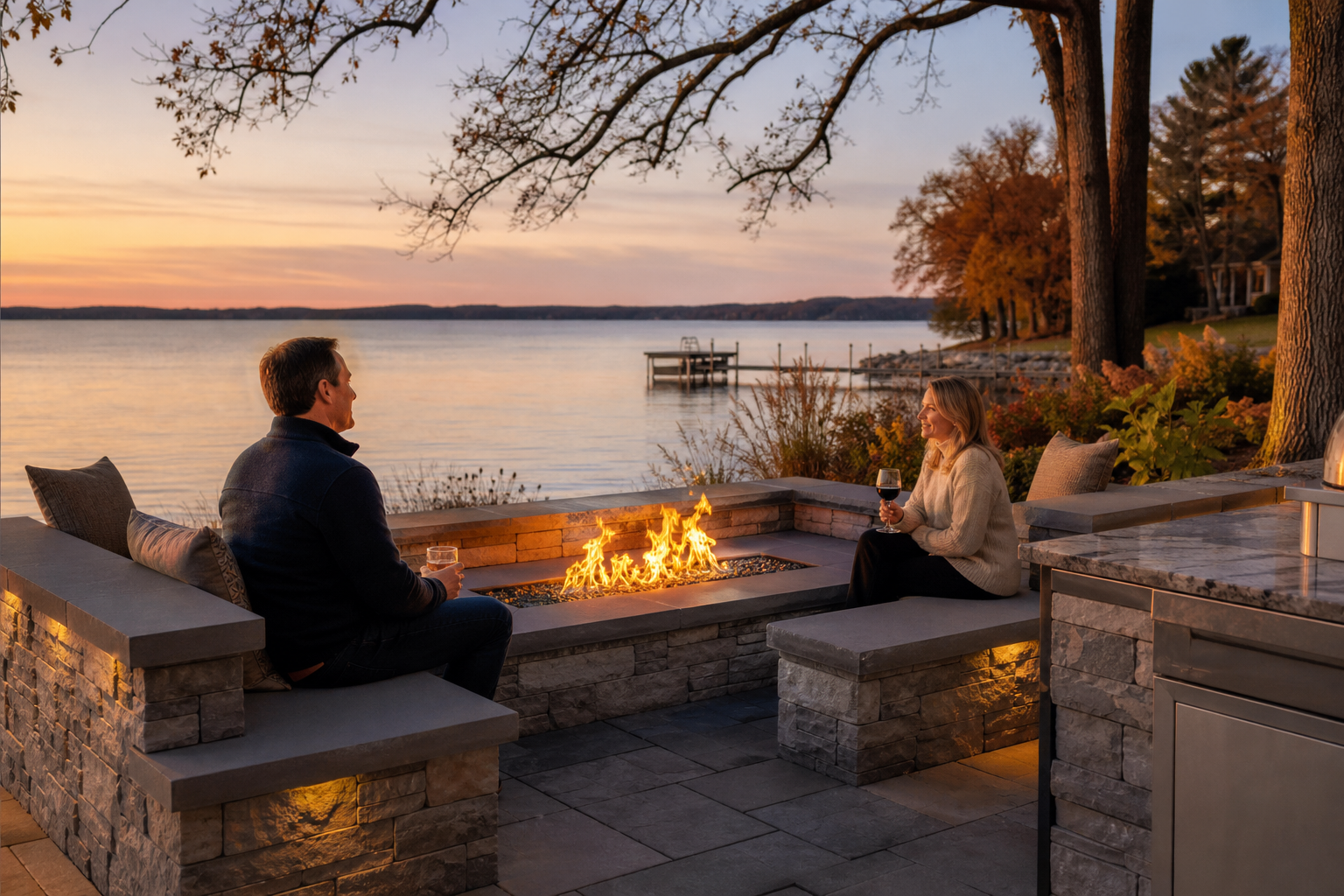
A homeowner on one of Ozaukee County's lake properties wanted a fire gathering space close to the water but had no idea where the 75-foot setback line fell on their lot or how much hardscape area they could add before triggering additional review. We mapped the setback, confirmed the available square footage under the county's exemption, and designed a propane fire feature positioned to maximize the water view while staying fully within what the ordinance allows. The result was a compliant, permanent feature that the homeowner didn't have to second-guess every time a neighbor mentioned permits.
Sloped suburban lot turned into a tiered gathering space
A homeowner in inland Ozaukee County had a backyard that dropped sharply from the house, making the lower portion essentially unusable for entertaining. We designed a series of retaining walls that created a level terrace at the base of the slope, then built a fire pit into the terrace as the natural anchor for the space. The terraced design gave the homeowner two distinct outdoor zones-a dining area near the house and a fire gathering space below-where previously there was just unusable grade.
Existing patio owner adding a coordinated fire and kitchen zone
A homeowner with an established patio wanted to add a fire feature and an outdoor kitchen without the additions looking like afterthoughts. Rather than dropping a standalone fire pit in an open corner, we redesigned the patio edge to incorporate a propane fire feature with a seat wall surround and coordinated the kitchen placement so both features share a logical flow. The drainage under the new sections was tied into the existing system so the whole hardscape performs as one installation through Wisconsin winters, not two separate ones that age at different rates.
Common questions about fire features in Ozaukee
Get a clear picture of what your fire feature project involves
If your backyard has the potential for a fire feature and you're not sure what it actually takes to do it right on an Ozaukee property, that's exactly the conversation to have before anything else. We'll look at your site, your existing hardscape, and what the county's rules allow, and give you a clear picture of what's involved.
Talk about your property