

Fire features in Waukesha
Fire features built into your yard, not dropped onto it
Waukesha backyards that actually get used after dark, through every season.
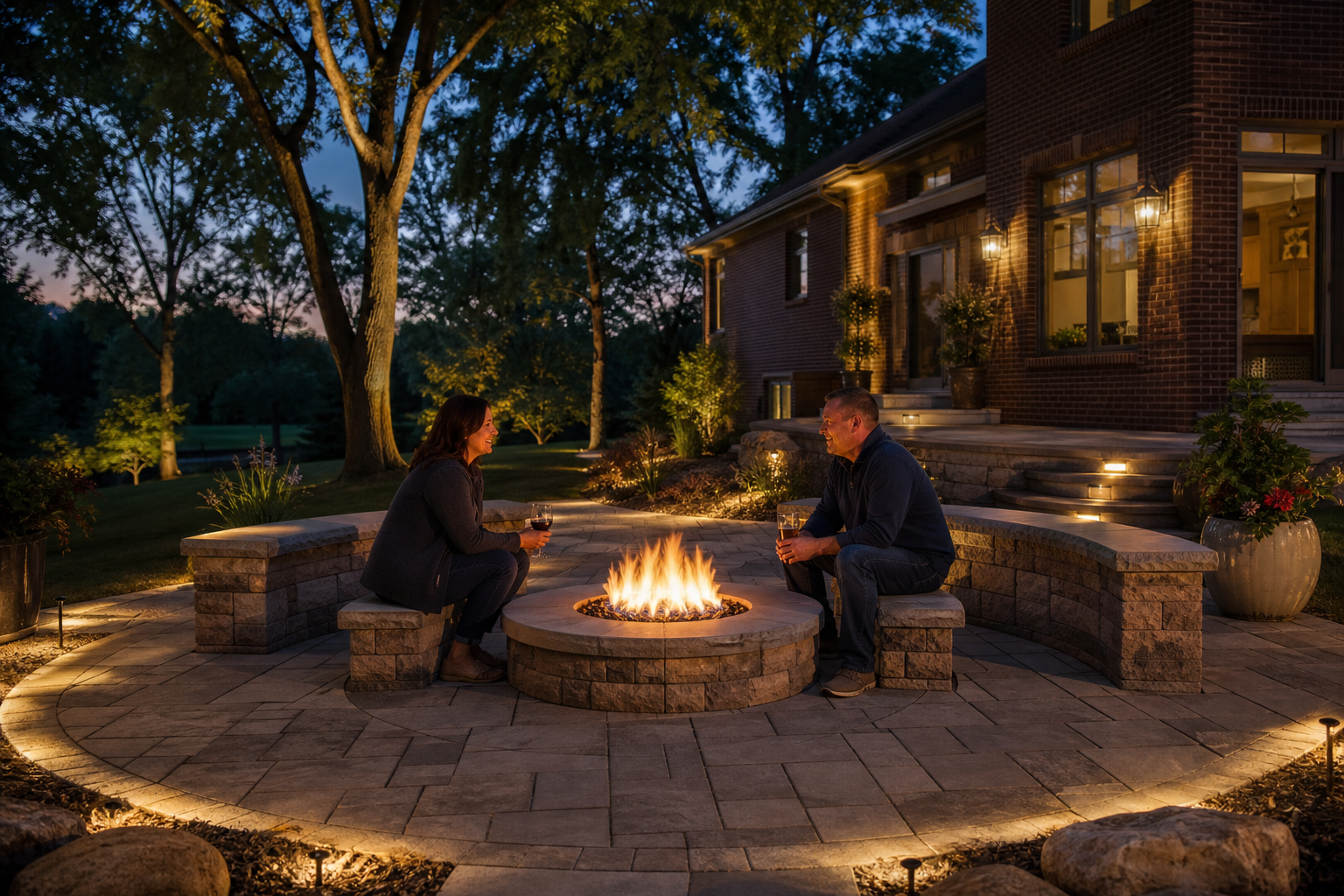
Plan a fire feature that fits your yard from day one
Talk to us about your backyard and what a fire feature could look like as part of the full picture.
Adding a fire feature last is the most expensive mistake
Most backyard regrets start the same way: a patio gets built, then a year or two later someone wants a fire feature, and suddenly there's nowhere logical to put it. The grade is wrong, the drainage runs the wrong direction, the lighting has no anchor point, and the whole thing ends up looking like an afterthought because it was one. A fire feature planned from the start shapes where the patio sits, how seating wraps around it, where drainage routes, and how lighting ties the space together after dark. That sequencing is not a luxury. It's how you get a yard that works as a single thing rather than a collection of projects that never quite fit each other. If you're also thinking about an outdoor kitchen in Waukesha, the same principle applies: the earlier these elements enter the design, the better the result.
What we actually build, and why the base matters most
We design and build fire pits and propane fire features sized and positioned for the specific yard, not pulled from a catalog and placed wherever there's room. The visible part of a fire feature is the easy part. What determines whether it lasts is what happens below grade. Wisconsin's frost line runs around 48 inches in southern Wisconsin, and a fire feature base that doesn't account for that will move. We build over compacted gravel bases deep enough to resist frost heave, and we use materials rated for the combination of high-heat firebox exposure and exterior freeze-thaw cycling, because standard mortar is not rated for both conditions simultaneously. The fire feature connects structurally to the surrounding patio hardscape, so the whole surface moves and settles as a system rather than pulling apart at the seams.
Drainage and setback are not afterthoughts here
Two things sink fire feature projects that aren't planned carefully: drainage and placement. Clay soils are common across Waukesha County, and without proper grading and subsurface drainage, the area around a fire feature becomes a mud pit after spring rains or a heavy storm. We route drainage into the design from the beginning so water moves away from the gathering space, not toward it. Placement is equally non-negotiable. Fire features must sit at least 25 feet from any building, structure, fence, deck, or combustible surface, and that constraint has to be worked into the design before anything is built, not measured after the fact. If your yard has a slope or a tight footprint, that's exactly the kind of constraint we plan around. For yards where grade is the main challenge, our retaining wall work in Waukesha often runs alongside fire feature projects to create the level platform the installation requires.
Waukesha County winters average around 38 inches of snowfall and January lows that sit near 24°F, with the freeze-thaw cycling that follows doing real damage to anything built without the right foundation underneath. A fire feature that looks great in September and heaves out of the ground by April is a common outcome when installation skips the groundwork. The yards we work on here demand more than a casual approach.
- Waukesha County averages 38.1 inches of snowfall per year and January lows near 24°F
- Clay soils and heavy spring rains are common across Waukesha County, creating drainage challenges
- Wisconsin's frost line in southern Wisconsin runs around 48 inches deep
How a fire feature project comes together
- 1
Site visit and yard assessment
We start by walking the yard with you. Grade, drainage patterns, soil conditions, proximity to structures, and how you actually use the space all shape what's possible and what will work. This visit is where the real constraints surface, and it's what separates a plan that holds from one that looks good on paper and fails in the ground.
- 2
Design that ties the full system together
The fire feature doesn't get designed in isolation. It gets positioned relative to the patio surface, the seating layout, the lighting plan, and the drainage routing, all at once. If a future outdoor kitchen or phase-two element is on your radar, we account for it now so nothing has to be undone later. The design is the coordination, and that's where most of the value is built.
- 3
Material and fuel-type selection
We work through the specifics with you: fire pit or propane fire feature, concrete pavers or natural stone for the surrounding hardscape, seating wall or open surround. Each choice connects to the others, and we'll tell you plainly what holds up in Waukesha County's climate and what doesn't, so you're not guessing.
- 4
Build and finish
Construction follows the design, with the base work done to the depth and compaction the Wisconsin frost line demands. The fire feature, surrounding hardscape, and any lighting or drainage elements are built as a single coordinated installation. You end up with a finished space, not a fire feature sitting in a half-finished yard waiting for the next phase.
Benefits
Evenings that actually happen
A fire feature sized and positioned for your yard changes how you use the space. Gathering around a fire extends the outdoor season on both ends, pulling evenings outside in May when it's still cool and keeping people out in September when the air turns.
A base built for Wisconsin winters
The freeze-thaw cycle in Waukesha County is hard on anything installed without the right foundation. We build over compacted gravel bases engineered to resist frost heave, using materials rated for both high heat and exterior temperature swings, so the feature holds its position year after year.
No mud, no pooling, no mess
Clay soils and heavy spring rains are a real combination here. Drainage is designed into the gathering space from the start, routing water away from the seating area so the ground around the fire feature stays firm and usable, not a seasonal swamp.
One yard, one coherent plan
The fire feature, patio, lighting, and plantings are designed together, not assembled one project at a time. Visual and structural cohesion across the whole yard is only possible when every element enters the design at the same time, not when each one gets bolted on later.
Fire features in Waukesha: common questions
Another summer without a fire feature is just a decision not to call
If you've been thinking about this for a season or two already, the conversation is the fastest way to find out what's actually possible in your yard. We'll walk the site, talk through the design, and give you a clear picture of what a fire feature built into your outdoor space would look like.
Talk about your backyard