

Landscape lighting in Washington
Your outdoor space, lit from the ground up
Landscape lighting planned into every Washington County project before the first paver goes down.
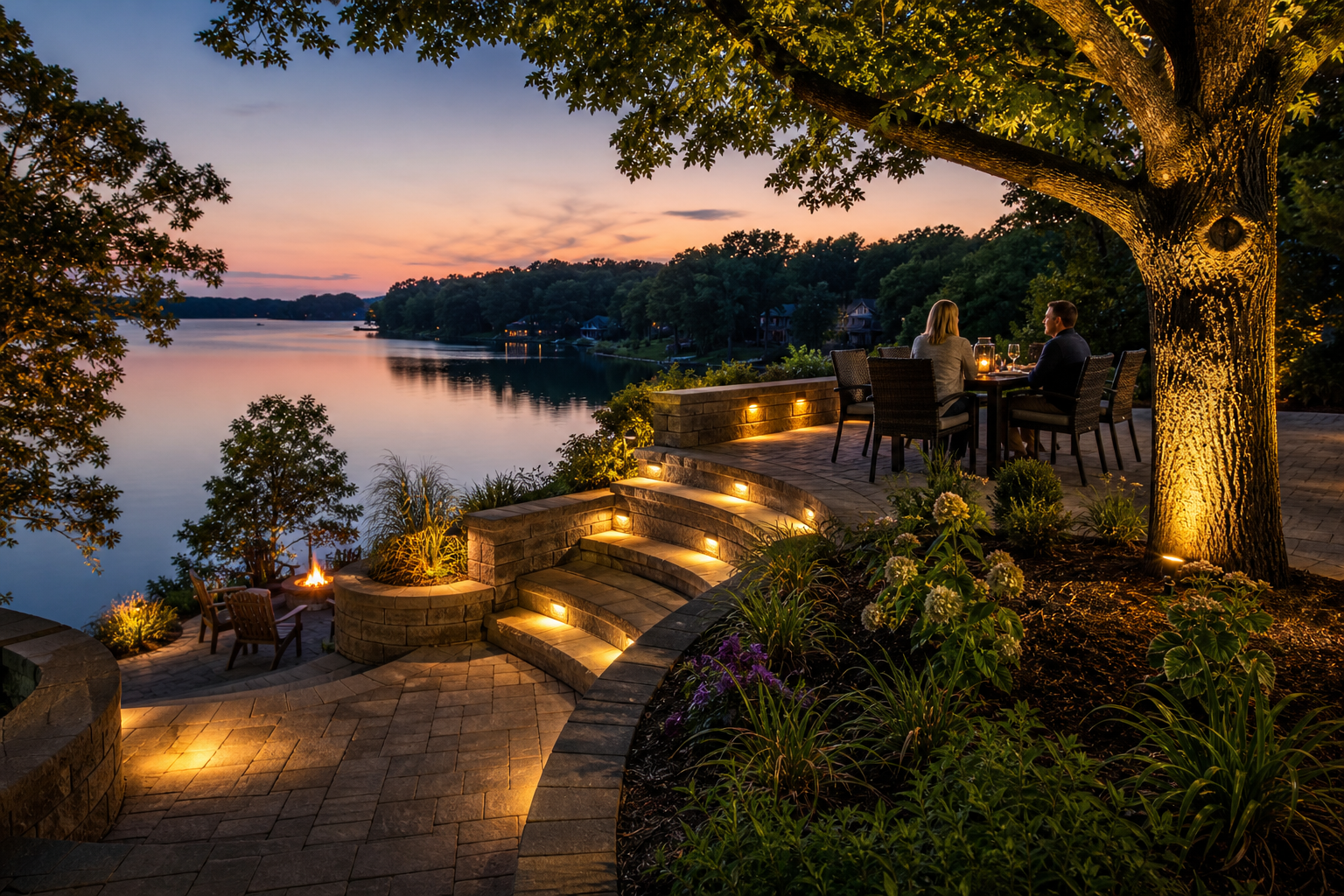
Plan landscape lighting into your Washington County project from day one
Talk to McGuire about landscape lighting for your Washington County property, designed in from the start, not added on afterward.
Retrofit lighting costs more and delivers less
The moment a patio is set and a retaining wall is backfilled, the easy path for conduit is gone. Running wire after the fact means cutting through finished hardscape, disturbing compacted base material, or settling for surface-mounted runs that look like an afterthought. On the sloped, glacially shaped lots common across Washington County, where grade changes are real and drainage systems are doing actual work beneath the surface, that kind of disruption matters. Conduit routes, junction box locations, and transformer placement all need to be decided alongside grading and hardscape layout, before any material is placed. That is how McGuire approaches every patio and hardscape project: lighting is part of the system plan, not a line item added at the end.
What integrated landscape lighting actually includes
McGuire installs landscape lighting as a coordinated component of the broader outdoor living system. That covers path and step lighting along grade transitions and stair treads, uplighting for trees and architectural features, accent lighting along retaining walls, and functional task lighting at outdoor kitchens and fire feature areas. For lakefront properties on Washington County's lakes, including the larger shoreline properties along Big Cedar Lake, fixture placement accounts for shoreland setback context and the Wisconsin DNR's provisions for low-voltage accent lighting near berthing structures. Low-voltage systems running at 12 volts keep installation safer and give the system flexibility as the property evolves. Every fixture spec is chosen with Wisconsin's freeze-thaw cycles and seasonal snow loads in mind.
Lighting that holds through every Wisconsin season
Washington County winters are not gentle on outdoor systems. Fixtures that are not rated for sustained freeze-thaw cycling, heavy snow accumulation, and the humidity that comes with proximity to 52 county lakes will fail within a few seasons. McGuire specifies fixtures built for those conditions and installs them in positions that account for seasonal canopy changes and snow depth, so coverage stays consistent from a July evening on the patio to a February night when the driveway needs to be navigable. The same site knowledge that informs retaining wall design and drainage planning directly shapes lighting decisions: a contractor who understands how water moves across your lot in spring understands where a ground fixture cannot safely sit.
Washington County sits in southeastern Wisconsin, a landscape shaped by glacial activity, with rolling terrain, inland lakes, and the kind of lot conditions that make outdoor construction genuinely demanding. The county's 52 lakes, including Big Cedar Lake with over 900 acres of surface and more than 10 miles of shoreline, mean a significant share of the properties McGuire works on are lakefront sites where lighting decisions intersect with shoreland regulations and proximity to water.
- Washington County contains 52 lakes, including Big Cedar Lake at over 900 acres.
- Big Cedar Lake has 10.2 miles of shoreline and reaches 105 feet deep.
- Washington County covers 436 square miles of rolling glacial terrain in southeastern Wisconsin.
- The county sits about 25 miles northwest of Milwaukee in the Kettle Moraine region.
Benefits
Extended usable hours after dark
A well-lit patio, outdoor kitchen, or lakefront deck does not stop being useful at sunset. Planned lighting extends the functional hours of your outdoor space across the full Wisconsin warm season, from early spring evenings through late-summer nights on the water.
Safer grade changes and stair treads
Washington County lots often involve real elevation changes, and unlit steps and retaining wall transitions are a genuine hazard after dark. Integrated step and path lighting built into the hardscape layout addresses that risk without surface-mounted fixtures that can shift or be damaged by snow removal.
No post-construction trenching or cutting
When conduit is planned before pavers are set, there is no need to cut finished hardscape or disturb compacted base material later. Conduit and junction boxes placed during construction protect the integrity of the base system and eliminate the cost and disruption of retrofit installation.
Cohesive look with hardscape and plantings
Lighting added after construction rarely looks like it belongs. When fixture placement is coordinated with paver layout, wall caps, and planting beds from the design stage, the finished result reads as a single composed outdoor environment, not a collection of separately sourced elements.
Long-term reliability through Wisconsin winters
Fixtures specified for freeze-thaw cycling, snow load, and lakefront humidity last significantly longer than general-purpose outdoor lighting. Seasonal canopy changes and snow depth are factored into the design, so coverage stays consistent year-round without annual adjustments.
Landscape lighting scenarios in Washington County
Lakefront patio and seawall with shoreline lighting
A homeowner on one of Washington County's larger inland lakes wanted a finished patio and seawall that would be as usable after dark as it is in the afternoon. McGuire coordinated low-voltage accent lighting along the seawall cap and path lighting from the house to the water's edge as part of the same construction plan that addressed shoreline stabilization and grade. Fixture placement respected shoreland setback context and the DNR's provisions for low-voltage lighting near the water. The result is a lakefront environment that works as a single system from the retaining structure to the patio surface to the lighting layer above it. See how McGuire approaches lakefront hardscape and patio work for more on how these systems connect.
Sloped backyard with lit retaining walls and stair treads
On a Washington County lot with a significant grade drop from the house to the rear of the property, a homeowner needed both usable outdoor space and safe after-dark access across multiple level changes. McGuire designed retaining walls and stair treads as a coordinated system, with conduit routed during wall construction and step lighting integrated into the riser faces. No surface-mounted fixtures, no post-construction trenching: the lighting is part of the wall, not attached to it. The finished space is navigable at night and visually coherent, with uplighting on the upper wall face extending the sense of depth after dark.
Outdoor kitchen and fire feature with task and accent lighting
A homeowner planning a full outdoor kitchen and fire feature wanted lighting that served both functional and atmospheric purposes: enough task light at the cooking surface to work comfortably after dark, and accent lighting that made the fire feature the visual anchor of the space without washing it out. McGuire planned fixture types and placement alongside the hardscape layout, locating dedicated task lighting at the kitchen counter zone and low-level accent lighting along the surrounding patio perimeter. Because conduit was run before pavers were set, the system is clean, the base is intact, and the lighting reads as part of the design rather than an addition to it.
Landscape lighting questions for Washington County homeowners
Bring landscape lighting into your Washington County project from the start
McGuire designs and builds outdoor living spaces across Washington County with lighting planned in from the start. If you have a project in mind, whether it is a lakefront patio, a sloped backyard, or a full outdoor kitchen and fire feature, reach out to start a conversation about how lighting fits into the system.
Talk to McGuire about lighting