
What a Failed Paver Patio Really Costs (And Why We Only Install Clear Stone Now)
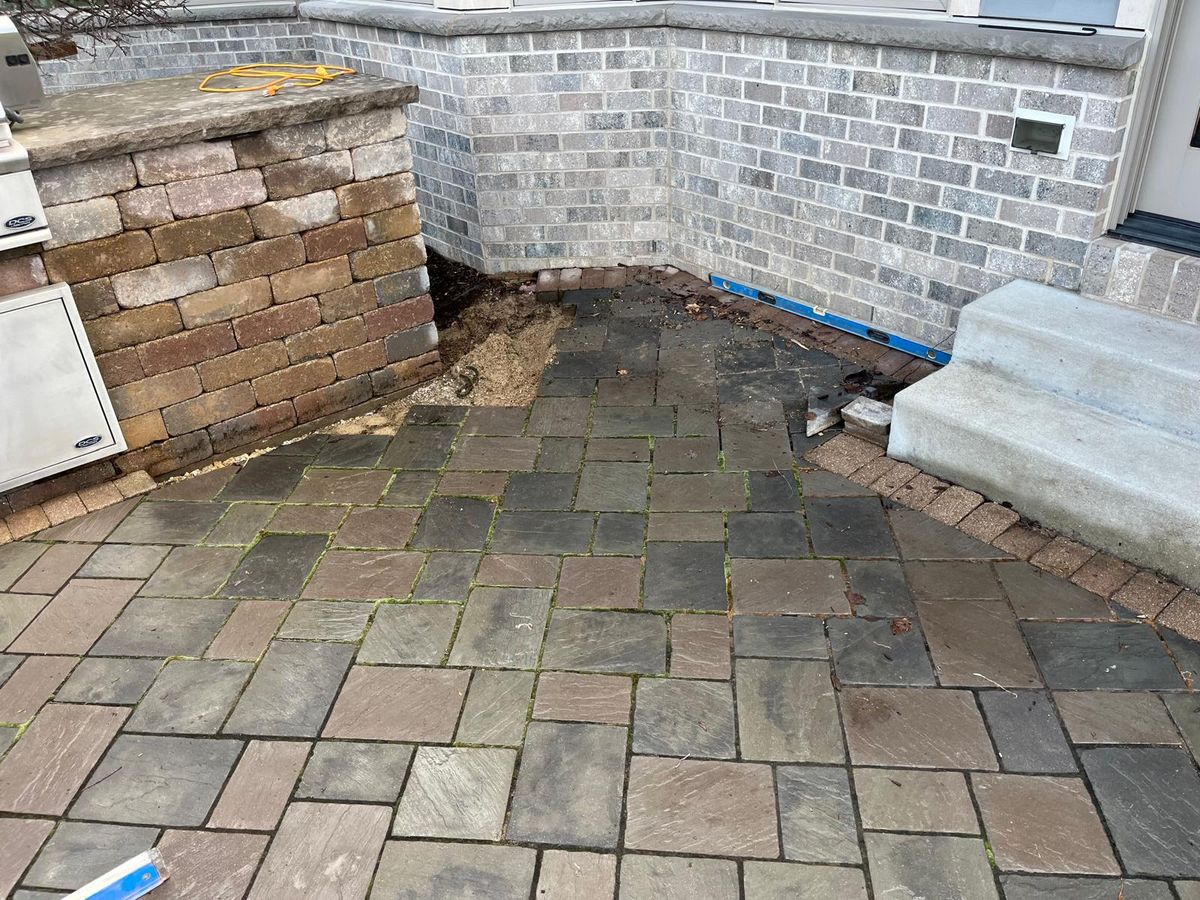
Three to five inches.
That is how far the pavers had settled at the far corner of a patio we recently restored in Lake Country. The homeowner had watched it get worse for several seasons. Water pooling where it used to run off. A corner that started catching toes. The kind of damage that looks cosmetic until it starts changing how you actually use the space.
They had done what most Lake Country homeowners do when something goes wrong outside. Lived with it through a winter to see if it got worse. It did. Called the original installer, who had moved on from the business. Got a quote for a patch, which they declined because patching a settled patio is putting paint over a crack. By the time we got the call, the problem was five years deep.
What we found when we pulled the first pavers
The base told the whole story. Three-quarter inch traffic bond underneath. Sand used as the bedding layer on top. The soil beneath had never been properly excavated or graded. Three mistakes stacked on top of each other. Any one of them alone would have cut the patio's lifespan in half. Together they made failure inevitable.
Why those material choices led to a patio that moved
To understand why a patio settles three inches, you have to understand how fines behave. Fines are the small particles within any crushed stone or sand material. Think of them as the dust and broken-down fragments mixed in with the larger stones. They look like nothing in the pile. Under a patio that carries weight and sees seasonal rain and freeze, they decide whether the base holds or moves.
Traffic bond has fines in it. Over Wisconsin's freeze-thaw cycles, those fines break down further and compact unevenly. What looks like a stable base the first October is no longer stable by the following April. Sand has an even higher fines content. Under load and water, sand fines wash out and redistribute. The pavers sitting on top of sand start reporting that movement back to the homeowner within a few seasons.
Water is the real enemy of any paver base in Wisconsin. Every material choice either gives water a path to drain or traps it in a bed of particles that will eventually shift. Traffic bond and sand both trap water. That is why they fail together.
The fix: clear stone throughout
We pulled the affected pavers, hauled out every cubic yard of the old sand and traffic bond, and started over from the subgrade. The new base went in as three-quarter inch fractured clear stone. The bedding layer went in as quarter-inch clear stone chips in place of sand.
Clear stone is what it sounds like. Crushed stone with no fines in it. The particles are roughly the same size and nothing smaller. There is nothing in the material to settle, break down, or wash out. Water passes through it cleanly rather than pooling on top or eroding the layer underneath.
The installation took a couple of days. Most of it happened in Wisconsin rain, which is its own kind of quality test. When the weather forces you to work, the water gives immediate feedback on whether the base is doing its job.
What a project like this actually costs
This is the question most homeowners want answered before they pick up the phone, and it deserves a direct answer.
A restoration like this one is not a cheap job. The work involves removing the existing pavers, hauling away every bit of the failed base, bringing in and compacting new material, and resetting the surface at the correct pitch. For a patio of average residential size, the cost typically falls in a range that sits between a light landscape refresh and a new build. The exact number depends on square footage, site access, how much base needs to come out, and whether any of the original pavers need to be replaced.
There are two honest ways to think about cost on a project like this. The first is the sticker price of the restoration itself. The second, the one that matters more, is the total cost of the original installation plus the restoration, compared to what it would have cost to do it right the first time.
A paver patio built with proper base preparation and clear stone throughout costs more upfront than the traffic bond and sand alternative. Materials are more expensive. The installation is slightly more involved. The percentage difference is real but not dramatic.
What you get in return is a base that does not need to be torn out and rebuilt six or seven years later. The homeowner on this project paid twice. Once for the original install that failed, and once for the restoration. Done right the first time, the total would have been less than what they ended up spending across both jobs combined.
That is the real cost comparison on a paver patio. Not what it costs this month. What it costs across twenty years.
What holds now
The new surface is stable. Drainage runs the way it should. No standing water, no pooling at the low corners, no movement to monitor. The pavers sit on a base that will perform the same way ten winters from now as it does today.
The homeowner has their space back.
Why we only use clear stone now
The industry still has plenty of contractors installing with traffic bond and sand because that is what their crews learned to do twenty years ago. We moved to clear stone throughout a while back and we do not go back. Every McGuire patio now goes in with three-quarter inch fractured clear stone for the base and quarter-inch chips for the bedding. The reasoning is the same in every case. Water is the enemy. Fines trap water. Clear stone does not have fines. So clear stone is what goes under patios we build.
If you are watching your pavers move or pool water and you are not sure whether it is cosmetic or structural, message us. We will walk the property and tell you straight. The conversation is worth having before another freeze-thaw season does more damage to a base that was already going to fail.
Planning a patio, fire feature, or outdoor kitchen? See how we approach Outdoor Living Spaces