
Paver Patio Cost in Wisconsin: What You Are Paying For Below the Surface
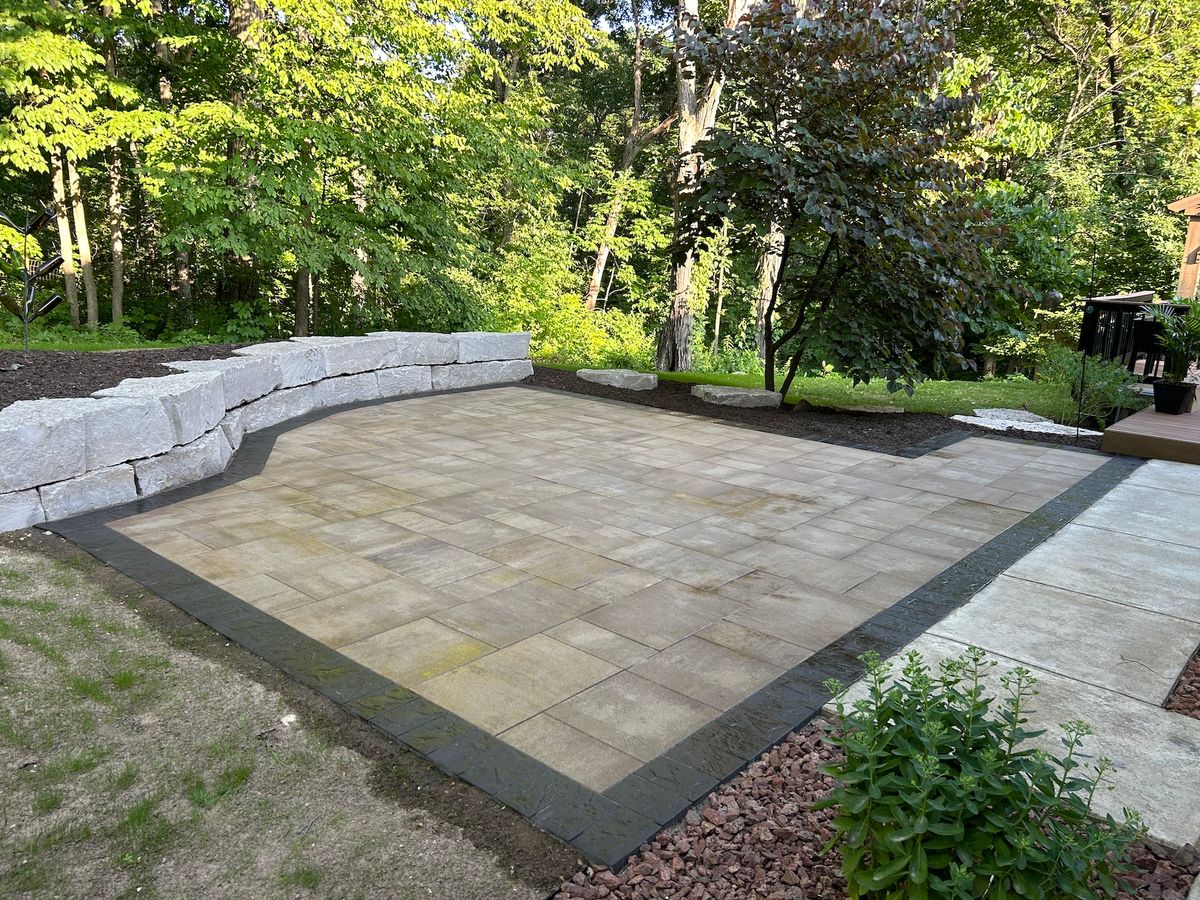
Most of what you pay for in a paver patio is buried. Excavation, base material, compaction, drainage slope, and edge restraint make up the part nobody sees once the pavers are down, and in Wisconsin that hidden layer decides whether the surface stays flat through freeze-thaw cycles or starts moving by the third spring.
That is why two quotes for what looks like the same patio can land far apart. Paver patio cost has less to do with the pavers you pick out of a catalog and more to do with what goes under them, what the site demands, and how the patio fits into the rest of the yard. This guide walks through the factors that move the number, so the conversation at a site visit starts from the right place.
Why paver patio cost has no honest single number
Every patio we build is priced from the site up. Square footage matters, but it is only one input. The same 400 square feet can be a straightforward install on a flat, open backyard or a multi-day excavation on a sloped lot where equipment has to come through a side yard and water already pools against the foundation.
What we can give you is a clear picture of what drives the price, roughly in order of how much each one tends to move it.
The base: the biggest paver patio cost factor most quotes skip
On a Wisconsin patio, the base does the structural work. The pavers are the finish.
A proper base starts with excavation deep enough to get below topsoil and organic material, followed by a stone base built up and compacted in layers, a bedding layer, and a surface pitched so water runs away from the house. Every McGuire patio goes in with three-quarter inch fractured clear stone for the base and quarter-inch clear chips for the bedding, because clear stone has no fines to hold water or break down under freeze-thaw. We explain why we made that switch in what a failed paver patio really costs.
Base depth and material affect cost in three ways:
- Excavation volume. Deeper excavation means more soil to dig, load, and haul away.
- Material. Clear stone costs more than traffic bond or sand, and more stone goes in on soft or wet soils.
- Labor. Compacting in proper lifts takes longer than spreading and leveling in one pass.
This is also where the cheapest bids usually save money. A thinner base or a sand bedding layer looks identical on day one. The difference shows up after a few winters, when corners settle and water starts pooling.
Site conditions
The site often moves the cost more than the patio design does.
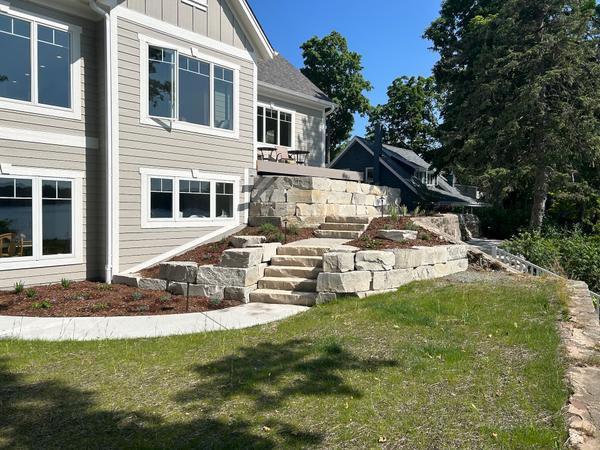
Grade. A flat yard needs little more than excavation. A sloped yard may need cut and fill, a retaining wall to create a level area, or steps between levels. Once a wall is involved, the project becomes partly structural, and our retaining wall cost guide covers what that adds.
Soils. Heavy clay holds water and moves with frost, so it usually calls for a deeper base and more attention to drainage. Fill soils around newer homes can be loose and need extra compaction.
Access. If a skid steer can drive straight to the patio area, work moves quickly. If every load of stone has to come through a narrow gate, around a deck, or down a slope, labor time goes up.
Demolition. Removing an old patio, a slab, a deck, or overgrown plantings adds time and disposal.
Drainage. If water already collects where the patio will go, that has to be solved first with grading, drain tile, or a dry well. Building a new patio on top of an existing drainage problem is the fastest way to a failed one. Our backyard drainage solutions guide covers the most common fixes.
Paver and material choices
Material matters, though usually less than people expect compared to the base and the site.
Concrete pavers cover a wide range, from standard shapes and colors to large-format and textured premium lines. As a Belgard Authorized Contractor, we work with a broad Belgard lineup, and the choice between a standard and a premium line is one of the clearest levers on material cost.
Large-format pavers look clean and modern, but they need tighter base tolerances. Any dip in the base shows up as a rocking stone or a visible lip, so screeding and compaction take longer.
Natural stone such as bluestone or flagstone costs more in material and takes more skilled labor to cut and fit. We compare the two in concrete vs. bluestone patio.
Pattern and borders. A simple running bond is fastest to lay. Herringbone, multi-size patterns, inlays, and double or triple borders all add cutting time.
Permeable pavers use open joints and a deeper, engineered stone base so water drains through the surface. They cost more to build, but on lakefront lots they can help with impervious surface limits under shoreland zoning.
Shape, size, and layout
Square footage sets the baseline, and shape adjusts it. Curves, angles, and cut-ins around trees or the house add cutting and edge work. A patio with several connected zones and steps between them involves more transitions than a single rectangle of the same area.
Larger patios usually cost less per square foot than small ones, because setup, equipment delivery, and site prep are spread across more area. A very small patio still carries most of the same fixed costs.
What gets built alongside the patio
Few patios stand alone. Many projects include one or more of:
- Seat walls or retaining walls
- A fire pit or fire feature
- Steps connecting the patio to the house or a lower level
- Landscape lighting, including under-cap lights on walls
- Sleeves or conduit for future gas, power, or lighting runs
- Plantings to soften the edges
Each of these adds to the total, and some are much cheaper to plan now than to add later. Running conduit under a patio before the pavers go down costs very little. Cutting into a finished patio to add it later costs far more. Our phased backyard renovation guide explains how to build in stages without tearing work out.
Where cutting cost backfires
There are smart ways to manage a patio budget: a simpler shape, a standard paver line, fewer borders, or building the patio now and adding the fire feature or kitchen later.
There are also cuts that cost more in the long run:
- A thinner base. It saves money once and costs money every spring after.
- Sand or traffic bond bedding. Both trap water and move with freeze-thaw.
- Skipping drainage corrections. Water finds the patio either way.
- Skipping edge restraint. Pavers creep outward without it, and joints open.
A patio built correctly is meant to hold for decades. A patio built cheaply is often a restoration project inside ten years, and the homeowner pays twice.
What happens at the site visit
The real number comes from walking the property. At a site visit we look at grade, soils, drainage, access, and how you want to use the space, then talk through materials, layout, and timeline. From there you get a quote built for your yard rather than a national average.
When the base is right, the patio becomes the part of the yard you stop thinking about. Weeknight dinners move outside. The chairs stay out from May to October. The surface looks the same in year ten as it did the first summer.
If you are planning a patio, walk the property with us and we will show you exactly where the money goes.
Planning a patio, fire feature, or outdoor kitchen? See how we approach Outdoor Living Spaces