

Erosion control
Erosion control built into the structure of your property
Engineered solutions for hillside slopes, lakefronts, and shorelines that are actively losing ground.
Get a structural assessment of your erosion problem
Tell us what you're dealing with and we'll assess whether your site needs a structural fix, not another surface treatment.
Surface treatments fail because erosion is a structural problem
Landscaping fabric, seed mats, and a few well-placed plants can slow surface runoff on a gentle slope. On a steep grade or an active shoreline, they don't address what's actually happening: water moving through the soil, undercutting root systems, and destabilizing the ground from below. Once that process starts, it compounds. Each rain event removes more material, exposes more root structure, and widens the failure zone. The fix has to go deeper than the surface. Engineered structural systems -- boulder reinforcement, properly graded retaining walls, and integrated drainage -- address the cause of soil loss, not just the symptom. That's the difference between a repair that holds and one you revisit every spring.
Lakefront and hillside sites require different thinking
A hillside erosion problem and a shoreline erosion problem look similar from a distance but have different causes and different regulatory contexts. Steep-grade backyard slopes lose soil primarily through surface runoff and subsurface water movement. Lakefront shorelines face wave action, freeze-thaw cycles, and Wisconsin DNR shoreland regulations that govern what you can build and how close to the water. McGuire works across both site types, designing boulder reinforcement, seawalls, and living shoreline integration for lakefront properties, and retaining walls, grading corrections, and native planting buffers for hillside sites. Knowing which system fits your site -- and what permits it requires -- is part of the work, not an afterthought. If your property also has drainage challenges, see our drainage solutions for how we address subsurface water movement as part of the same project.
Living shorelines hold ground without hardening the entire bank
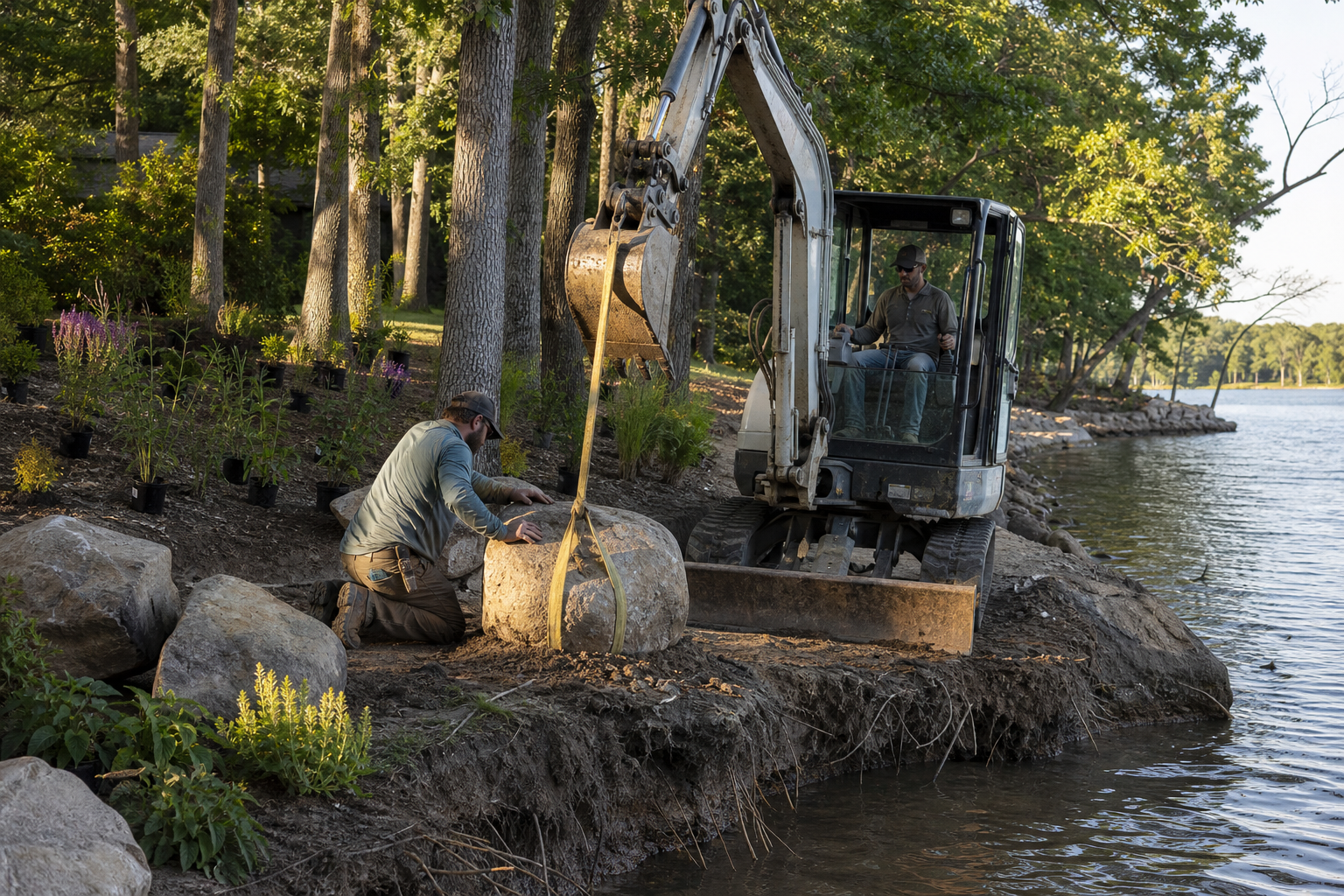
Not every lakefront erosion problem calls for a seawall. In many cases, living shoreline integration -- native plantings with deep root systems, combined with strategic boulder placement -- stabilizes the bank while maintaining the natural character of the shoreline. Native plants adapted to Wisconsin's water margins anchor soil through root density that turf grass can't match, and they do it year-round, including during the freeze-thaw cycles that do the most damage. Where wave action or ice pressure requires harder infrastructure, boulder reinforcement or a seawall provides the structural backbone, with plantings integrated to reduce ongoing maintenance and satisfy DNR shoreland requirements. The goal is a system that works with the site's hydrology rather than against it.
Regulatory compliance is part of the engineering, not a separate hurdle
Wisconsin DNR shoreland permits and setback requirements aren't paperwork you deal with after the design is done -- they shape what's possible and what's required. McGuire coordinates permit requirements as part of the planning process, so the structural solution we design is one that can actually be built. For hillside properties in Washington, Waukesha, and Ozaukee Counties, local grading and drainage ordinances apply similarly. Getting this right at the planning stage avoids redesigns, delays, and the compliance notices that often send property owners searching for help in the first place. Once the erosion system is in place, many clients extend the project to include lake access stairs, walkways, or a broader backyard renovation that takes full advantage of the stabilized terrain.
A property that was losing ground becomes one you can actually invest in -- but only after the structural cause of the loss is addressed, not papered over.
Highlights
- Engineered erosion control for steep hillside slopes and active lakefront shorelines
- Living shoreline integration using native plantings and boulder reinforcement
- Wisconsin DNR shoreland permit coordination handled as part of the design process
- Belgard Authorized Contractor designation and Hardscape Hero Award recognition
- Serves Washington, Waukesha, and Ozaukee Counties in southeastern Wisconsin
How erosion control works on a complex site
- 1
Assess the site and identify the failure mechanism
We start by understanding what's actually driving the erosion on your specific property: surface runoff, subsurface water movement, wave action, or a combination. Slope grade, soil composition, proximity to water, and existing infrastructure all factor into this assessment. Knowing the failure mechanism determines whether the solution is structural, vegetative, or both.
- 2
Determine permit and regulatory requirements
For lakefront properties, we identify applicable Wisconsin DNR shoreland permits and setback requirements before the design is finalized. For hillside sites, we review local grading and drainage ordinances. This step runs parallel to design, not after it, so the plan we bring you is one that can be built. If your site has both shoreline and drainage challenges, we address those together.
- 3
Design the structural system for your terrain
The design phase produces a coordinated plan: boulder placement, retaining wall specifications, grading corrections, drainage integration, and native planting buffers, all sized and positioned for your specific site. We treat these as a single engineered system, not a list of separately added elements. The design accounts for Wisconsin's seasonal conditions, including freeze-thaw cycles and spring runoff loads.
- 4
Build and install with structural integrity as the standard
Installation follows the design sequence: structural elements first, drainage integrated within the build, plantings installed in the correct relationship to hardscape. Work on steep grades and shorelines requires equipment access planning and sequencing that general landscaping crews aren't set up for. Complex terrain access is a routine part of how we work, not a complication we figure out on site.
- 5
Integrate the stabilized site with the broader property
Once the erosion system is in place and the site is stable, many clients move into the next phase: lake access stairs, a backyard renovation, or landscape lighting that makes the stabilized space usable after dark. A property that was losing ground becomes one you can actually invest in. We plan for this sequence from the start so the erosion work sets up the next phase rather than complicating it.
Benefits
Structural systems, not surface patches
Boulder reinforcement, engineered retaining walls, and integrated drainage address the mechanism of soil loss. Treating the structural cause means the repair doesn't need to be revisited every season after heavy rain or snowmelt.
DNR permit coordination included in planning
For lakefront and shoreline sites, Wisconsin DNR shoreland permits and setback requirements are worked into the design from the start. Permit coordination as part of planning means the solution we design is one that can legally be built, without redesigns or delays.
Living shoreline integration where appropriate
Native plantings with deep root systems stabilize lakefront banks through year-round root density that turf grass can't provide, including during the freeze-thaw cycles that cause the most cumulative damage.
Designed for Wisconsin's seasonal demands
Freeze-thaw cycles, spring runoff, and ice pressure on shorelines are factored into every structural specification. A system that holds through a Wisconsin winter is built differently than one designed for milder climates, and seasonal load engineering is standard, not optional.
Erosion control scenarios we work on
Lakefront homeowner with active shoreline loss
A lakefront property owner in Washington County had watched their bank retreat several feet over a few seasons, with exposed tree roots and a sinking lawn edge marking the damage. Landscaping plantings installed previously hadn't held against wave action and ice movement. The solution combined boulder reinforcement along the waterline with native shoreline plantings selected for root depth and DNR compliance, stabilizing the bank without a full seawall. The property also required coordination of Wisconsin DNR shoreland permits before any work could begin.
Hillside backyard with slope erosion and drainage failure
A homeowner in Waukesha County had a steeply graded backyard where every heavy rain washed soil across the patio and into the lower yard. A retaining wall had been installed years earlier but wasn't properly integrated with the site's drainage, so water was building up behind it and accelerating the problem. The fix required regrading, a new retaining wall system built to handle the actual load, and a drainage solution that redirected subsurface water before it reached the slope. The stabilized yard was then usable for a backyard renovation the homeowner had been postponing for years.
Ozaukee County shoreline property navigating DNR requirements
A shoreline property owner needed erosion control but had received conflicting information about what Wisconsin DNR regulations permitted within their setback zone. Living shoreline integration -- native plantings with strategic boulder placement -- fit within the regulatory framework while addressing the active bank erosion. McGuire handled permit coordination as part of the project scope, so the homeowner wasn't navigating the DNR process independently while also trying to stop active soil loss.
Erosion control questions we hear often
Stop the cycle of seasonal damage and repairs
If your property is actively losing ground, the right time to address it is before another season of damage compounds the problem. Contact McGuire to describe your site and we'll tell you honestly what kind of solution it needs.
Talk about your erosion problem