

Seawall construction
Built to hold: seawall construction for Wisconsin lake properties
Shoreline protection designed for erosion, hydrostatic pressure, and the regulatory realities of Wisconsin lakefront ownership.
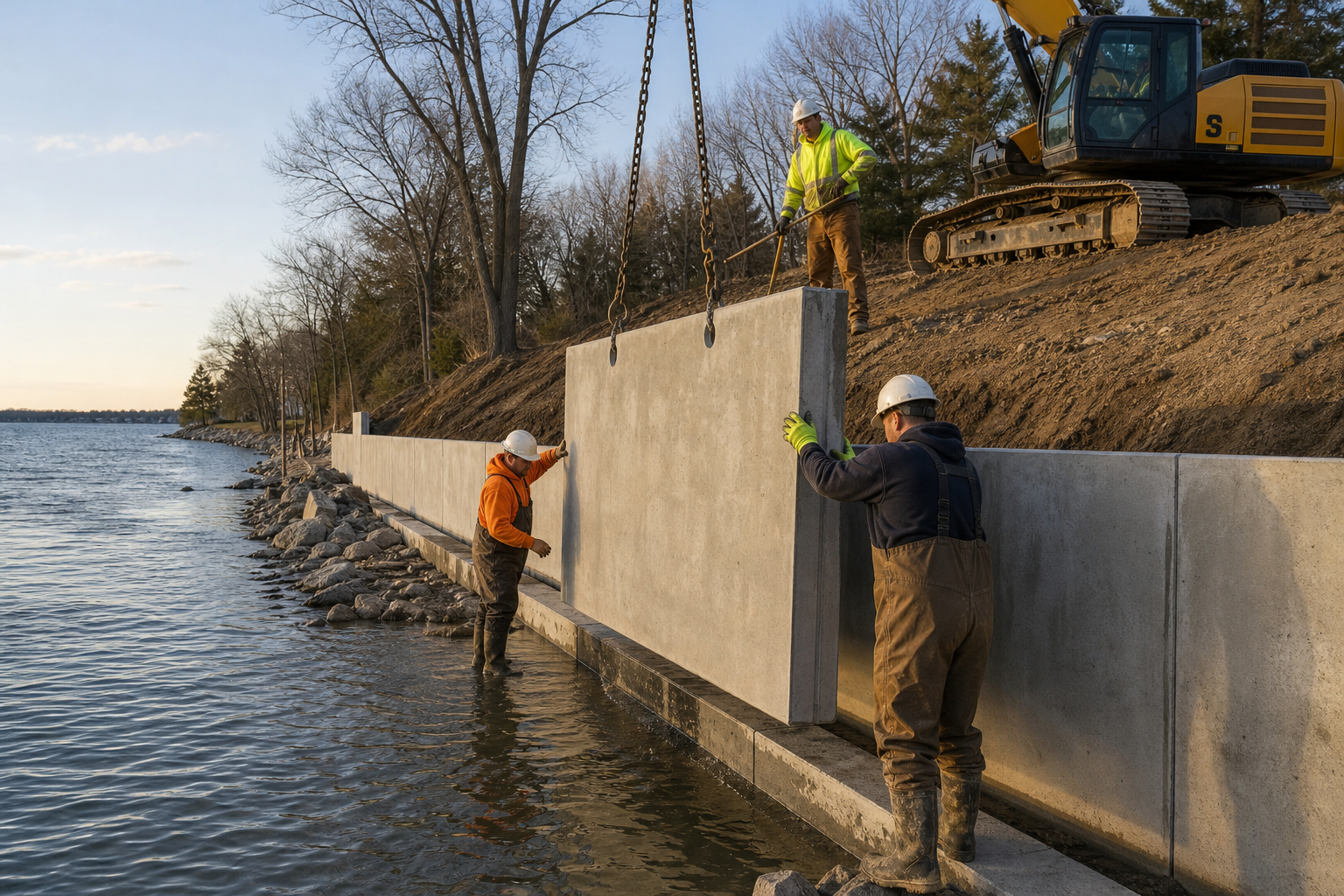
Protect your shoreline with a seawall built to last
Talk to us about your shoreline before erosion sets the timeline for you.
Erosion doesn't wait for a convenient season
On Wisconsin lakes, the shoreline takes a beating year-round: wave action in summer, ice push in winter, and the slow creep of hydrostatic pressure behind the wall itself. By the time erosion becomes obvious, it has usually been working for years. A seawall built to address all three forces is not the same as one built to look right at the water's edge. The structural demands are specific to your site, your soil conditions, and your lake's behavior, which is why we treat every seawall project as an engineering problem before it becomes a construction project.
Wisconsin DNR permits shape what gets built and where
Shoreline work in Wisconsin is regulated. The DNR's shoreland setback requirements and permitting process determine what can be built, how far from the water, and what mitigation may be required. We coordinate that permitting process as part of the project, not as an afterthought. That means your seawall is designed within the regulatory envelope from the start, rather than revised after the fact. For lakefront homeowners navigating this for the first time, having that coordination handled in-house makes a meaningful difference in how smoothly the project moves. You can also explore how we approach related drainage solutions that often tie directly into shoreline planning.
The seawall is one part of a larger shoreline system
A seawall installed without attention to what sits behind it or beside it tends to create new problems. Water that can't move through the bank builds pressure. Unprotected sections of shoreline erode faster once adjacent areas are stabilized. We design the seawall as part of a broader shoreline protection system, which may include boulder reinforcement, living shoreline integration, lake access stairs, and walkways, depending on the site. The goal is a shoreline that holds structurally and functions as a usable part of the property, not just a barrier at the water's edge.
Coordination with the broader lakefront environment
Lakefront properties are more than their shoreline. Once the seawall and structural work are resolved, the property can be designed as a complete outdoor environment: grading behind the wall, access paths down to the water, and the broader backyard renovation that ties the lake view into how the property actually lives. We work across all of those elements rather than handing off between separate contractors, which matters on sites where the grade, the access, and the shoreline are all connected problems.
A seawall installed without attention to what sits behind it or beside it tends to create new problems, and those problems show up within seasons, not decades.
Highlights
- Wisconsin DNR permit coordination handled as part of every shoreline project
- Seawall design addresses erosion, hydrostatic pressure, and ice push as integrated structural demands
- Shoreline work coordinated with lake access stairs, boulder reinforcement, and living shoreline integration
- Belgard Authorized Contractor designation and Hardscape Hero Award recognition
- Specialists in technically demanding sites including steep grades, regulated shorelines, and restricted access
How a seawall project comes together
- 1
Assess the site and shoreline conditions
We start with a site visit to understand what's actually happening at the water's edge: the type and degree of erosion, soil and bank conditions, ice push exposure, and any existing structures. This is the information that drives every decision that follows. No two shorelines present the same set of problems, and the assessment reflects that.
- 2
Design within DNR permit requirements
Once we understand the site, we develop a seawall design that meets Wisconsin DNR shoreland setback requirements and permit conditions. We coordinate the permitting process as part of our scope, so you're not managing that separately. The design addresses hydrostatic pressure, wave action, and ice load as integrated structural considerations, not as add-ons.
- 3
Plan the full shoreline system
The seawall design is developed alongside any adjacent elements: boulder reinforcement, living shoreline integration, lake access stairs, and walkways. This planning happens before construction begins so that each element is coordinated with the others. If the project includes drainage solutions behind the wall, those are planned at this stage as well.
- 4
Build with structural integrity as the baseline
Construction is executed with Wisconsin's seasonal conditions in mind, including freeze-thaw cycles and the long-term movement that affects shoreline structures over time. Structural integrity is the baseline, not a selling point. The finished seawall is built to hold under the conditions your specific lake and site will actually produce.
- 5
Integrate with the broader lakefront property
After the shoreline structure is complete, we coordinate the surrounding environment: grading, access paths, and any broader outdoor living elements that connect the property to the water. This might include landscape lighting along access paths or stairs, or planning for future phases of the lakefront environment.
Benefits
Permitting handled as part of the project
Wisconsin DNR shoreland permits and setback requirements are coordinated in-house from the start. Permitting is part of our scope, not a separate process you manage while construction planning sits on hold.
Designed for Wisconsin's seasonal forces
Seawalls on Wisconsin lakes face ice push, freeze-thaw cycling, and hydrostatic pressure across every season. The structural design accounts for all three forces, not just the most visible one.
Integrated with the full shoreline system
Boulder reinforcement, living shoreline integration, lake access stairs, and drainage behind the wall are planned together rather than added later. A coordinated shoreline system holds better and functions better than a wall installed in isolation.
Technically demanding sites are our focus
McGuire Landscape Company specializes in sites that present complex challenges, including steep grades, regulated shorelines, and restricted access. Technically demanding lakefront sites are not an exception to our process; they are the core of it.
Seawall construction scenarios we work through
Lakefront homeowner with active shoreline erosion
A lakefront property owner watching their bank retreat season after season needs more than a wall placed at the water's edge. The project starts with understanding what's driving the erosion, then designing a seawall that addresses hydrostatic pressure and wave action together. Permitting is coordinated from the start, and the finished structure is integrated with the grading and access that make the shoreline usable again, not just stable.
Property with failing or aging shoreline structure
An existing seawall that is cracking, tilting, or showing signs of pressure failure presents a more complex problem than new construction. We assess what failed and why before designing the replacement, so the new structure doesn't repeat the same vulnerabilities. The project may also include drainage solutions behind the wall that were missing from the original installation, and coordination with any lake access stairs or walkways that need to be rebuilt alongside it.
New lakefront build integrating seawall and boathouse environment
When a lakefront property is being developed or significantly renovated, the seawall, boathouse environment, and broader outdoor living areas can all be planned as a single coordinated system. Designing these elements together avoids the conflicts that arise when they're added sequentially by separate contractors. The result is a property where the shoreline, the access, and the outdoor living environment all work as one.
Common questions about seawall construction
Stop letting your shoreline lose ground every season
If your shoreline is showing signs of erosion or your existing structure is under stress, the right time to plan is before the next season adds to the damage. Talk to us about what's happening at the water's edge and what a coordinated shoreline system would look like for your property.
Talk about your shoreline