

Shoreline restoration
Shoreline restoration built to outlast Wisconsin winters
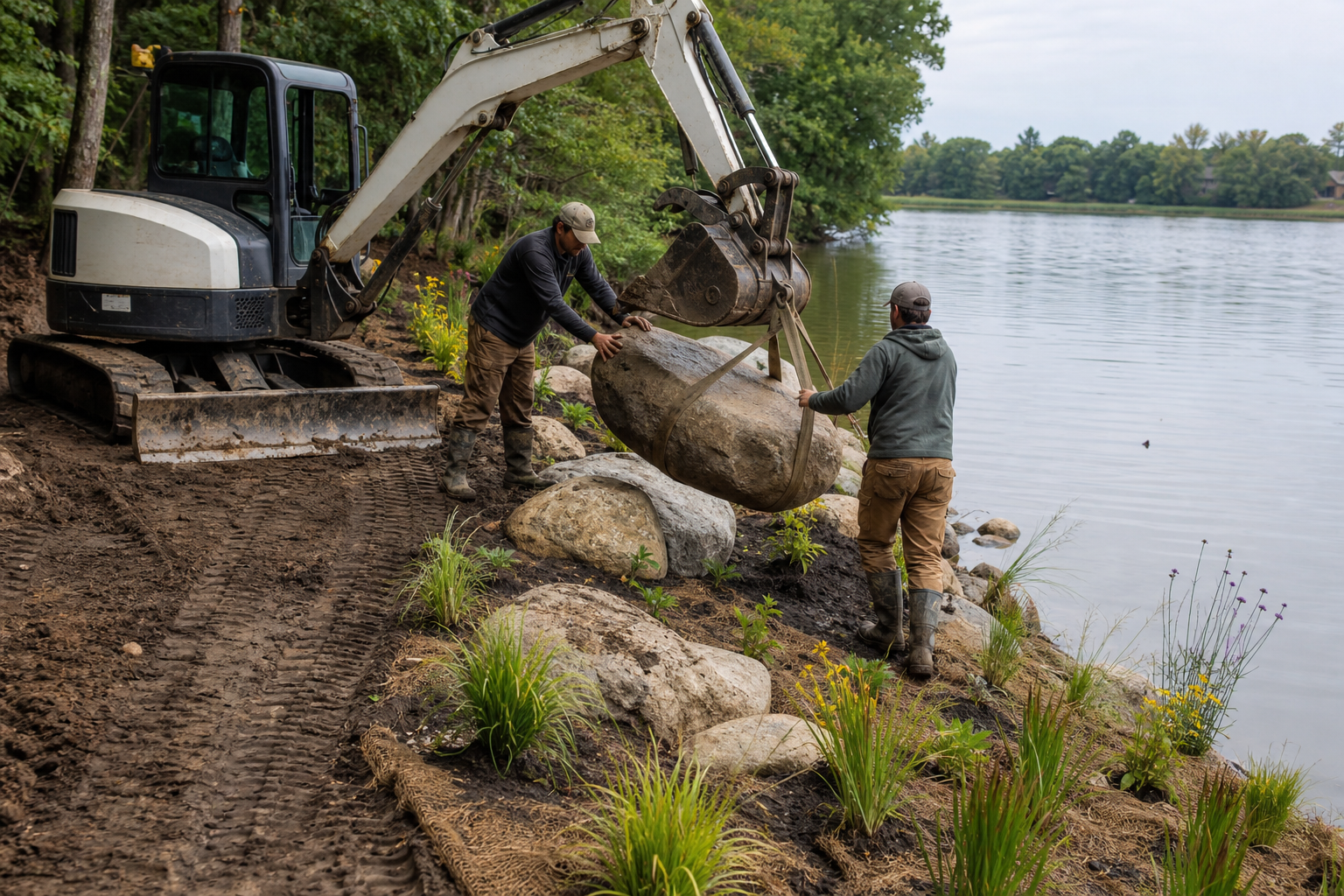
Living shoreline integration, boulder reinforcement, and engineered walls, planned within DNR permit requirements from the first site visit.
Get a shoreline assessment before the next season takes more ground
Schedule a site consultation and get a clear picture of what your shoreline needs before erosion takes more of your property.
What eroding shorelines actually cost you
A few inches of lost bank each season sounds manageable until it isn't. Shoreline erosion compounds: wave action undercuts the bank, freeze-thaw cycles crack whatever's left, and seasonal water fluctuation does the rest. Once the root structure is gone, the slope accelerates. What starts as a soft edge becomes a crumbling drop, and the land behind it, including lawns, walkways, and any structure near the water, follows. Beyond the physical loss, a degraded shoreline affects property value and can trigger regulatory scrutiny if disturbed improperly. The time to address it is before the damage reaches the upland area, not after.
A restoration toolkit matched to the site
No two shorelines fail the same way, which is why the approach here isn't a single product applied uniformly. Living shoreline integration combines native planting buffers with structural reinforcement, so the bank holds through physical means while root systems rebuild long-term stability. Boulder reinforcement anchors the toe of the slope where wave energy is highest. Where conditions call for it, engineered wall systems provide the structural backbone. These elements work together as a system, not as separate fixes layered on top of each other. For properties where erosion control extends beyond the waterline into the upland area, that work is coordinated as part of the same plan. Wisconsin DNR shoreland setback requirements and permit conditions are built into the design from the start, not addressed as an afterthought.
What holds up through freeze-thaw and water fluctuation
Wisconsin's seasonal conditions are the real test of any shoreline restoration. Ice push in late winter exerts significant lateral force on anything at the water's edge. Spring thaw saturates soils and raises lake levels quickly. A restoration that performs in September may fail by April if the materials and installation aren't specified for those conditions. Material selection, anchoring depth, and drainage all matter here, and they're decisions made at the design stage, not corrected after the fact. Native plantings selected for this region establish root depth suited to local soil and climate, adding biological reinforcement that synthetic materials alone can't replicate. If drainage solutions are needed to manage upland water before it reaches the bank, that's part of the scope.
Highlights
- Belgard Authorized Contractor designation, reflecting verified installation standards for structural hardscape and wall systems.
- Hardscape Hero Award recipient, recognizing project execution quality.
- Serving lakefront and suburban homeowners across Washington, Waukesha, and Ozaukee Counties in southeastern Wisconsin.
How a shoreline restoration comes together
- 1
Initial site assessment
The process starts with a thorough look at the existing shoreline: the degree and type of erosion, soil conditions, slope geometry, wave exposure, and proximity to any existing structures or plantings. What's failing and why gets documented before any solution is proposed. This assessment also identifies what DNR permit categories apply to the site.
- 2
DNR permit coordination
Wisconsin DNR shoreland and waterway permits govern what can be done at the water's edge, including setback distances, allowable materials, and construction timing windows. Permit requirements are identified and filed early, so the project isn't delayed by regulatory surprises mid-construction. This is one of the more time-consuming parts of the process, and handling it upfront protects the project schedule.
- 3
Restoration design
With permit parameters in hand, the restoration design specifies the combination of living shoreline elements, native planting buffers, boulder placement, and engineered wall systems appropriate to the site. Every element is sized and positioned for Wisconsin's freeze-thaw and water fluctuation cycles. Where the upland area also needs attention, coordination with drainage solutions or erosion control work is built into the plan.
- 4
Phased construction
Construction sequences the work from the water's edge upward, stabilizing the toe of the slope before addressing the bank face and upland transition. Structural elements are installed before plantings, so the root systems establish into a stable substrate. For larger properties, work can be phased across seasons where the permit and site conditions allow.
- 5
Post-installation monitoring
Native plantings take time to establish, and the first freeze-thaw season after installation is the real proof of the structural work. Monitoring the site after installation identifies any adjustments needed before minor issues become larger ones. The goal is a shoreline that performs without ongoing intervention, not one that requires repeated patching.
Benefits
Structural longevity through seasonal cycles
The restoration is designed specifically for Wisconsin's freeze-thaw reality, with material selection, anchoring depth, and drainage details specified to handle ice push, spring thaw, and water level fluctuation. A shoreline engineered for these conditions holds without repeated intervention.
Permit compliance from day one
Wisconsin DNR shoreland permits and setback requirements are identified and coordinated before design is finalized, not discovered mid-project. Permit conditions shape the design, which means no costly redesigns, no stop-work orders, and no regulatory exposure after construction.
Property value protection
An eroding shoreline actively reduces the usable land area and the appeal of a lakefront property. A properly restored and stabilized bank stops the loss of land and lake access that would otherwise continue season after season.
Ecological integration, not just structure
Living shoreline integration with native planting buffers adds biological reinforcement that grows stronger over time, supports local ecology, and is generally viewed favorably in DNR permitting, as opposed to hardscape-only solutions that can shift erosion pressure to adjacent properties.
Shoreline restoration questions, answered honestly
Stop letting each season take more of your shoreline
A site consultation gives you a clear picture of what your shoreline actually needs, what the permitting involves, and what a restoration built for Wisconsin conditions looks like. The sooner the assessment happens, the more options remain on the table.
Schedule a site consultation