
Biostabilization vs. Seawalls in Wisconsin: Freeze-Thaw Performance
If you have spent any time researching shoreline stabilization for a Wisconsin lake, you have encountered the manufacturer brochures: Envirolok vegetated retaining systems, Flexamat articulated concrete blocks, ESP (Erosion Stabilization Products), and the traditional alternatives, vertical seawalls and quarried riprap. Every system claims to outperform the others.
What the brochures do not always address is how these systems behave under the specific load Wisconsin lakes apply: annual freeze-thaw cycling, winter ice push, spring high-water events, and the soils we actually have here. That is the only performance data that matters.
The Wisconsin Load Case
A shoreline in Lake Country has to survive:
- 30–60 freeze-thaw cycles per year along the waterline
- Lateral ice push from sheet ice expansion, often 1–3 inches of horizontal force per cycle
- Saturated bank soils in spring with rapidly fluctuating lake levels
- Wave fetch that varies enormously by lake, Big Cedar is not Lac La Belle
Vertical Seawalls (Steel, Concrete, Vinyl)
Vertical walls reflect wave energy back into the lake rather than dissipating it. Over time the reflected energy scours the bed at the toe. In Wisconsin the failure pattern is consistent: the toe scours, the wall loses its base support, frost heave cracks the cap, and ice push rotates the top of the wall lakeward over a series of winters. A 30-year design life is realistic if drainage is engineered behind the wall and the toe is armored. Without those, 10–15 years is more common.
Best fit: high-energy shores where setbacks make sloped armoring impossible, or properties where vertical access from boat to dock is non-negotiable.
Riprap
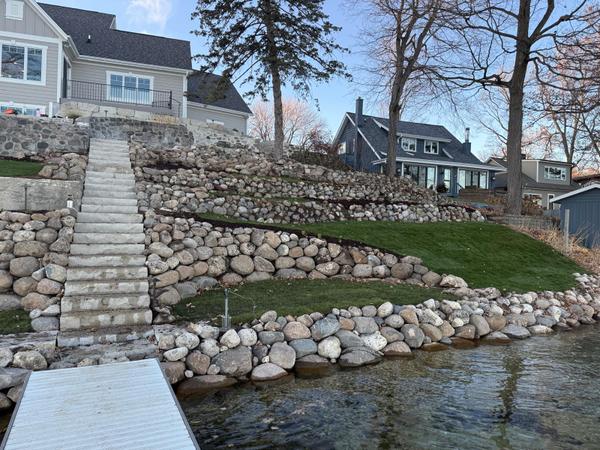
Properly sized angular stone on a 2H:1V slope is the most freeze-thaw tolerant treatment available. Ice rides up the slope and dissipates rather than pushing horizontally. Frost heave moves individual stones without compromising the system. Wave energy dissipates into the void space between stones. Maintenance is occasional repositioning after high-water years. Permitted under GP26 when the site qualifies.
Best fit: most Wisconsin inland lake shores. The default unless habitat goals or aesthetics drive a different choice.
Envirolok and Vegetated Bag Systems
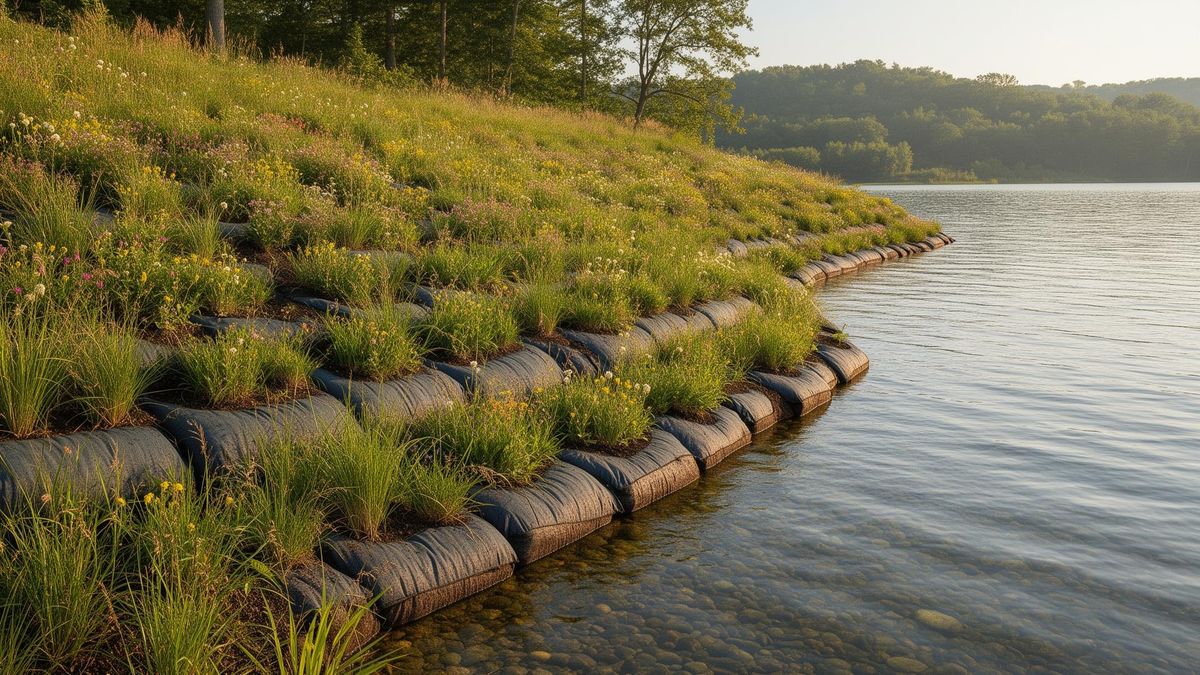
Envirolok is a stacked, vegetated geotextile bag system. Once vegetation establishes, the root mass binds the bags and the front face becomes a living shoreline. In Wisconsin, performance depends almost entirely on the establishment season. Bags installed in late spring with adequate irrigation through the first summer perform well. Bags installed late in the season or without irrigation can lose face vegetation in the first winter and shed material under ice push.
Best fit: moderate-energy shores, biological habitat goals, properties where homeowners want a soft, planted edge rather than stone.
Flexamat (Articulated Concrete Block Mat)
Flexamat is a flexible mat of concrete blocks tied with cable, vegetated through the openings. Performs well on flatter slopes and tolerates ice better than rigid concrete because it can flex with frost movement. Limitation in Wisconsin: the blocks themselves do not absorb wave energy as effectively as graded riprap, and on high-fetch lakes they can be undermined at the toe if the design does not extend deep enough.
Best fit: spillways, gentle slopes, applications where a uniform vegetated face is desired but living shoreline systems are not robust enough.
ESP and Engineered Soil Stabilization
ESP and similar engineered systems combine geogrid reinforcement with vegetated fill. Best performance in Wisconsin comes from hybrid designs, toe of riprap to handle wave energy and ice, ESP or vegetated mid-slope to handle bank stability and aesthetics. Hybrid systems consistently outperform any single-product approach on freeze-thaw lakes.
The Honest Comparison
For a typical southeastern Wisconsin lakefront with moderate fetch, mixed soils, and a homeowner who wants longevity: graded riprap with a vegetated upper bank is the most predictable performer over a 30-year horizon. Living systems work beautifully when the establishment season is right and the homeowner accepts a maintenance commitment. Vertical walls are the right answer in narrow circumstances and the wrong answer almost everywhere else.
For a deeper look at the design conversation, see living shoreline vs. retaining wall on a Wisconsin lake.
What We Recommend
Bring us out for a site visit before you commit to a system. We will measure fetch, look at toe scour history, evaluate soils, and give you a frank read on which approach will actually hold for the next 30 years on your specific shoreline.
Planning shoreline or lake access work? See how we approach Lakeside Living