
Steep Grade Lakeside Access: Building on 30–45° Lakefront Slopes
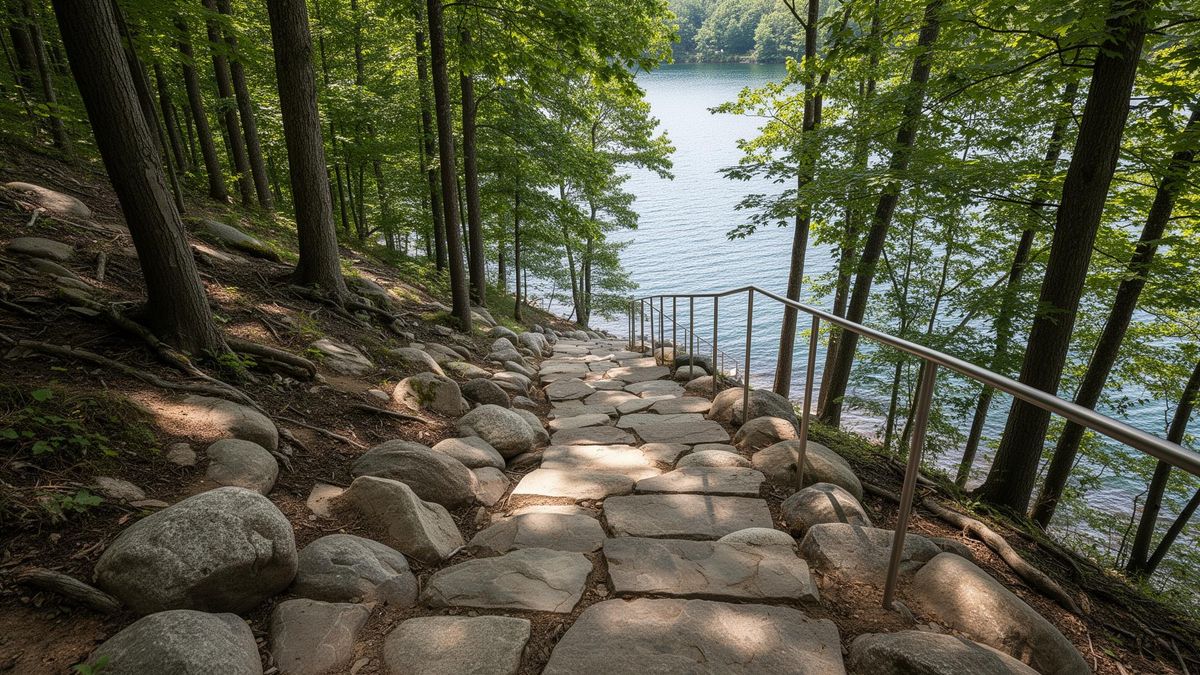
The most challenging lakefront properties in southeastern Wisconsin are not the ones with bad access, they are the ones with steep, restricted access. A 30–45 degree drop from the home to the water rules out virtually every standard construction sequence. The wrong machine destroys the bank. The wrong sequence buries the access path before the project finishes. The wrong structural system slides downhill in the first wet spring.
This post covers how we approach steep-grade lakefront construction in Lake Country, Washington County, and Ozaukee County, the machinery, the phasing, and the structural systems that hold.
What "Steep Grade" Actually Means
For shoreline construction we draw the line at:
- Under 20° slope: standard equipment, normal sequencing
- 20–30° slope: restricted equipment, but conventional staging usually works
- 30–45° slope: specialized equipment, mandatory phasing, structural systems required
- Above 45° slope: reinforced retention systems, engineered access, often crane-assisted material placement
Restricted-Access Machinery
On steep lakefronts we typically work with a combination of:
- Compact tracked carriers with low ground pressure and grade-tolerant drives, these can move stone and aggregate down a slope without skidding the surface
- Mini excavators in the 1.5–3 ton range, often walked downhill on temporary mat roads
- Material conveyors set across the bank for stone delivery without driving over it
- Crane placement from the top of the bank for boulders, stairs, and structural panels
The decision is rarely about what is biggest. It is about what gets work done without leaving the bank in worse condition than we found it.
Phased Sequencing
Steep lakefront projects fail when contractors try to build top-to-bottom in a single push. The construction traffic alone destroys the upper terraces by the time the lower work finishes. Our standard sequence:
Phase 1: Toe and Shoreline
Stabilize the shoreline first, riprap, biostabilization, or wall, using barge access or a single carefully built temporary haul road. The shoreline holds before any upper-slope work begins.
Phase 2: Mid-Slope Retention
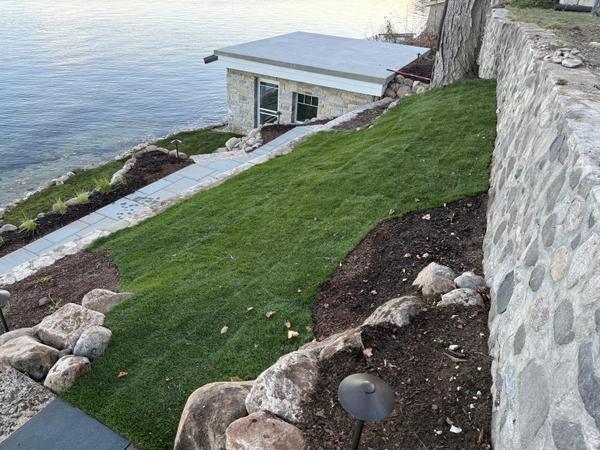
Install structural retaining at the mid-slope break. This usually means engineered modular block walls, large boulder walls, or hybrid systems with geogrid reinforcement. Drainage is built in at this stage, not added later.
Phase 3: Access Systems
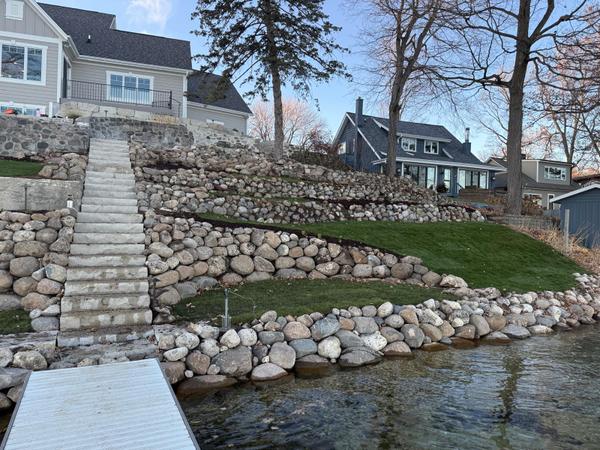
Lake access stairs, landings, and rest platforms install after the slope is structurally stable. Building stairs into an unstable slope is one of the most common mistakes on steep lakefronts.
Phase 4: Upper Bank and Restoration
Topsoil, planting, and final grading at the top of the slope happen last so construction traffic does not undo the establishment.
Structural Systems for Steep Lakefronts
- Engineered modular block walls with geogrid reinforcement, predictable, well-documented, code-friendly
- Large boulder walls with geogrid backing, appropriate when a more natural look is wanted and the geometry allows
- Soldier pile and lagging, used on the most difficult sites where a vertical face is unavoidable
- Hybrid riprap toe with terraced upper bank, common solution that handles waterline forces with stone and visual aesthetics with planted terraces
Engineered drainage is non-negotiable. A steep slope without a drainage plan is a slow-motion failure.
Permit and Regulatory Considerations
Steep-grade lakefront work almost always crosses multiple regulatory thresholds, county shoreland zoning, DNR waterway permits via form 3500-161, and sometimes erosion control plan review. The 75-foot setback applies regardless of slope, and grade changes within the setback receive extra scrutiny. We coordinate all of these before construction begins. See what can be built within the 75-foot setback for the regulatory framework.
What This Looks Like on the Schedule
A steep-grade lakefront project rarely finishes in a single season. A realistic schedule is:
- Months 1–3: design, engineering, permits
- Season 1: shoreline stabilization, mid-slope retention
- Season 2: access systems, upper bank, planting and establishment
Compressing this is what causes the most expensive failures we are called in to repair.
Why We Specialize Here
Most landscape contractors will not bid steep-grade lakefronts. The equipment is specialized, the sequencing has no margin for error, and the engineering is unforgiving. We have built our process around exactly these properties because they are the ones where a coordinated, infrastructure-first approach makes the largest difference.
If you own a steep lakefront and have been told the work is impossible, or quoted a number that seems impossibly low for what is involved, schedule a site visit. We will give you an honest read on the slope, the structural requirements, and a realistic phased plan.
Planning shoreline or lake access work? See how we approach Lakeside Living