

Backyard Patio Ideas With Pavers: Designs That Work for Real Wisconsin Yards
Paver patio designs built for Wisconsin's freeze-thaw reality
Practical backyard patio ideas with pavers that hold up through harsh winters, sloped lots, and clay-heavy soil.
Get a paver patio designed for your specific yard
Plan your paver patio with a team that understands Wisconsin soil, frost depth, and drainage demands.
Why pavers outperform poured concrete in Wisconsin
Poured concrete slabs and Wisconsin winters are a difficult combination. Water works its way into hairline cracks, freezes, and expands roughly 9 percent, widening those cracks season after season. Pavers sidestep this problem structurally: because they are individual units, the joints between them allow minor movement as soil shifts and temperatures swing. Instead of cracking across the surface, the patio adjusts. Water that infiltrates the joints drains through the base rather than pooling beneath a sealed slab, which is exactly what causes heaving.
The strength difference is significant. Poured concrete typically tests at 3,000 to 4,000 PSI, while concrete pavers commonly exceed 8,000 PSI, making them substantially more resistant to the mechanical stress of repeated freeze-thaw cycles. For homeowners across Washington, Waukesha, and Ozaukee Counties, that difference shows up in long-term surface condition. If you want a fuller side-by-side look at the two options, the concrete patio vs. pavers comparison covers performance, longevity, and other practical trade-offs.
Choosing the right paver material for cold climates
Not every paver performs equally well in a climate with hard freezes. Low water absorption is the key property to look for: the less moisture a paver absorbs, the less it is vulnerable to freeze-thaw damage from within the unit itself.
Porcelain pavers typically have water absorption below 0.5 percent, which makes them among the most cold-resistant options available. Concrete pavers with proper density and natural stones such as granite also perform well in cold climates. Limestone, by contrast, shows moderate absorption and carries higher freeze-thaw risk unless carefully selected and installed. Brick pavers are a durable middle-ground choice with a lifespan that can range from 25 to 100 years depending on quality and installation.
Beyond freeze-thaw performance, material choice affects the visual character of the patio. Concrete pavers come in a wide range of colors and profiles. Natural stone brings texture and variation that manufactured units cannot replicate. The right choice depends on the look you want, the site conditions, and how the patio connects visually to the home and surrounding landscape.
Base preparation is what makes or breaks a Wisconsin patio
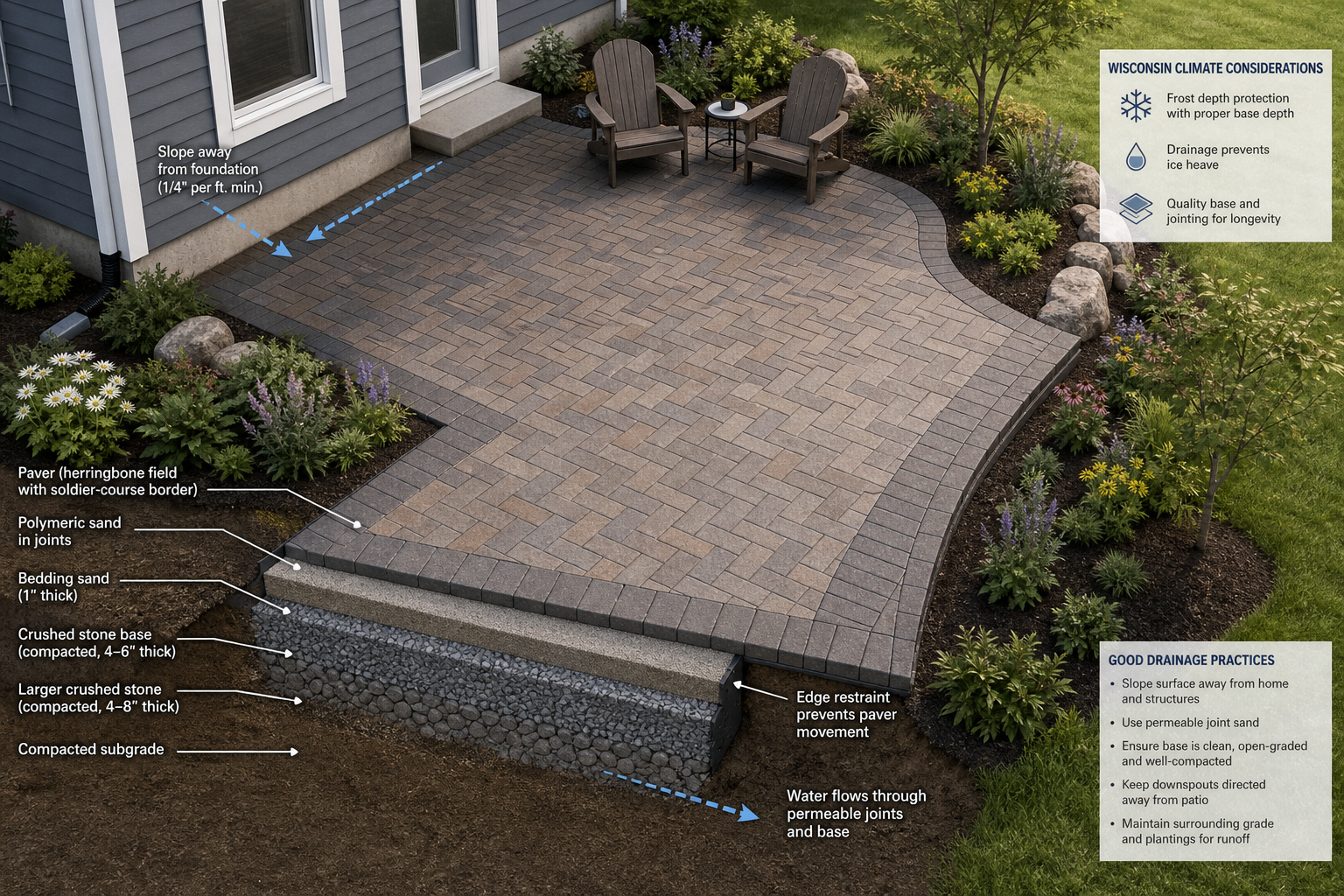
The paver surface itself gets most of the attention, but the base beneath it determines whether the patio stays flat over time. For pedestrian patios and walkways, a minimum of 4 to 6 inches of compacted gravel or crushed stone is the standard starting point. In frost-prone climates or on sites with clay soil, that increases to at least 6 inches, with ICPI guidance calling for an additional 2 to 4 inches in cold or wet conditions.
Clay soil is common across southeastern Wisconsin and is particularly susceptible to frost heave because it expands and contracts with moisture. On clay sites, adding 2 to 3 extra inches to the base depth is a practical precaution. The base material itself matters too: 3/4-inch minus crushed rock (road base) compacts into a dense, stable foundation because its mix of angular stone and fine particles locks together. Pea gravel or clean round rock does not compact the same way and should be avoided. The slope of the base layer, not just the surface, should direct water away from the home's foundation at roughly a quarter inch per foot.
Design patterns and layout options for backyard patios
Paver design patterns range from simple to complex, and the choice affects both the visual result and the amount of cutting required during installation. A running-bond pattern, where each row offsets by half a unit, is the most straightforward and works well for rectangular patios. Herringbone, where pavers are set at 45-degree angles to each other, adds visual interest and also provides excellent interlocking strength, which is why it is commonly used on driveways. Basketweave creates a woven look using pairs of pavers laid perpendicular to each other. Circular fan patterns work well as focal points around fire features or at the center of a larger patio.
Edge treatments matter as much as the field pattern. A soldier course (pavers laid end-to-end along the border) creates a clean, formal frame. Curved edges soften the look and work well on informal or naturalistic designs. For patios that include a fire feature, the hardscape layout can be designed to center the seating area around it. The fire pit paver ideas guide goes deeper on integrating fire features into the patio layout. If you are still working through the broader design, backyard patio design ideas and inspiration covers layout concepts across a range of yard types.
Drainage, slopes, and shaded lots in Wisconsin backyards
Many backyards in Washington, Waukesha, and Ozaukee Counties present site conditions that affect patio design before a single paver is laid. Sloped lots require grading decisions: whether to cut into the slope, build up with fill, or use retaining walls to create a level patio surface. Each approach has drainage implications. A patio carved into a slope needs a plan for water that runs off the hill behind it, often a French drain or channel drain at the uphill edge.
Shaded lots present a different challenge. Dense tree canopy keeps surfaces damp longer, which can encourage moss or algae growth on certain paver types. Lighter-colored concrete pavers or textured surfaces tend to perform better in these conditions than smooth, dark materials. Polymeric sand in the joints helps here too: it resists washout, inhibits weed growth, and is forgiving enough to flex with minor seasonal movement. A well-built patio with properly compacted base materials and solid edge restraints will typically show little or no damage through freeze-thaw cycles when these details are handled correctly. For yards where slope is the primary challenge, retaining walls and landscape stairs are often part of the same project scope.
Paver materials for Wisconsin patios
Material choice affects both freeze-thaw performance and visual character. Here is how the main options compare for cold-climate use.
- Concrete pavers
- Best all-around choice for most Wisconsin homeowners: high strength, wide color range, and good freeze-thaw resistance when density is specified correctly.
- Porcelain pavers
- Suited to homeowners who want maximum cold-climate durability and a refined, low-maintenance surface; absorption below 0.5% makes them highly frost-resistant.
- Granite
- Suited to homeowners who want natural stone with reliable freeze-thaw performance; dense and low-absorption by nature.
- Brick pavers
- A durable mid-range option with a long lifespan; quality varies, so freeze-thaw ratings should be confirmed before specifying.
- Limestone
- Higher freeze-thaw risk due to moderate water absorption; requires careful selection and should be confirmed as rated for cold climates before use.
For most Wisconsin backyards, high-density concrete pavers or porcelain offer the most reliable combination of performance, design flexibility, and long-term durability.
A patio that stays flat through a Wisconsin winter is not about the pavers you choose on the surface; it is about what you build underneath them.
How a paver patio project comes together
- 1
Assess the site before designing
Soil type, slope, drainage patterns, and shade conditions all shape what will work on a given lot. Clay-heavy soil, which is common across southeastern Wisconsin, requires deeper base preparation than sandy or loamy ground. Identifying these conditions at the start prevents design decisions that look good on paper but create problems after installation. Starting with a clear site assessment is the foundation of a patio that stays flat and functional for years.
- 2
Choose materials rated for cold climates
Select pavers with low water absorption and verified freeze-thaw ratings. Concrete pavers exceeding 8,000 PSI, dense porcelain, and granite are the most reliable choices for Wisconsin conditions. Avoid materials with moderate or high absorption, such as some limestones, unless the supplier can confirm they are rated for repeated freeze-thaw exposure. Material choice also determines color range, texture, and how the patio reads visually against the home.
- 3
Prepare the base to the correct depth
Excavate to a depth that accommodates the base layer, the bedding sand, and the paver thickness. For patios on clay soil or in frost-prone areas, a minimum of 6 inches of compacted crushed stone is the baseline, with additional depth on problem sites. Use 3/4-inch minus road base, not pea gravel. Compact in lifts rather than all at once to achieve a genuinely dense, stable foundation. The slope of the base layer should direct water away from the house at roughly a quarter inch per foot.
- 4
Set the pattern and install edge restraints
Lay pavers to the chosen pattern, starting from a fixed reference edge. Install rigid edge restraints along all exposed perimeter edges before filling joints; without them, the outer pavers will migrate over time and the pattern will open up. Edge restraints are one of the most skipped steps in DIY installations and one of the most consequential. For patios that incorporate a fire feature or outdoor kitchen, those elements should be coordinated in the layout before paving begins. See how fire pit patio designs work year-round for layout considerations.
- 5
Fill joints with polymeric sand
Once pavers are set, sweep polymeric sand into the joints and activate it with water. Polymeric sand binds as it cures, resisting washout from rain and inhibiting weed germination. It also has enough flexibility to accommodate minor movement from freeze-thaw cycles without cracking out of the joints. This is one of the details that separates a patio that looks the same after five Wisconsin winters from one that starts to show gaps and shifting within a couple of seasons.
- 6
Plan drainage as part of the finished system
Surface drainage should be confirmed after installation, not assumed. Check that water sheets away from the home's foundation and does not pool at low points. On sloped lots, a channel drain or French drain at the uphill edge of the patio may be necessary to intercept runoff before it reaches the surface. Drainage is a system, not an afterthought: the base layer, the surface slope, and any supplemental drainage components all need to work together. If your yard has persistent drainage challenges, erosion control and drainage solutions are often addressed alongside a patio project.
Benefits
Flexibility through freeze-thaw cycles
Individual paver units allow minor movement at the joints rather than cracking across the surface. Water that enters the joints drains through the base rather than becoming trapped beneath a sealed slab, which is the primary cause of heaving in poured concrete.
Strength that exceeds poured concrete
Concrete pavers commonly exceed 8,000 PSI, compared to 3,000 to 4,000 PSI for typical poured concrete slabs, giving them substantially more resistance to the mechanical stress of repeated freeze-thaw cycles.
Repairability without full replacement
If a paver settles or is damaged, individual units can be lifted, the base corrected, and the paver reset. A poured slab cannot be partially repaired in the same way; damage typically requires patching that is visible or, eventually, full replacement.
Design flexibility across yard types
Pavers work in running-bond, herringbone, basketweave, and circular fan patterns, and can be cut to fit curved edges or irregular shapes. This makes them adaptable to sloped lots, shaded yards, and sites where a rectangular layout does not fit the space.
Long service life with proper installation
Brick pavers can last 25 to 100 years depending on quality and installation. The base preparation, edge restraints, and joint material are the variables that most affect where in that range a given patio lands.
Paver patio situations Wisconsin homeowners actually face
Sloped backyard needing a level outdoor space
A homeowner on a lot that drops several feet from the back of the house to the rear property line has limited flat space for a patio. The practical solution usually involves cutting into the slope to create a level pad, using a retaining wall along the uphill edge to hold the grade, and designing drainage to carry water away from both the wall and the patio surface. The paver patio and the retaining wall become a single coordinated system rather than two separate projects. This is a common scenario across Washington and Waukesha Counties, where subdivisions were built on rolling terrain. A full backyard renovation often addresses the grade, the patio, and the planting in one planned sequence.
Replacing a cracked concrete slab with pavers
A poured concrete patio that has cracked and heaved after several Wisconsin winters is one of the most common starting points for a paver project. The old slab is removed, the subgrade is evaluated and corrected if needed, and a properly prepared base is installed before the new pavers go down. The base correction is as important as the new surface: if the subgrade conditions that caused the original slab to fail are not addressed, the same problems will recur. This is also an opportunity to reconsider the patio layout, size, and any features like an outdoor kitchen or fire element that were not part of the original design.
Adding a fire feature to an existing patio
A homeowner with a plain rectangular paver patio wants to add a fire pit or fireplace as a focal point. If the existing patio has enough square footage, the fire feature can be integrated with complementary paving around it, often using a circular or fan pattern to define the gathering area. If the patio is too small, an extension using matching or contrasting pavers can expand the usable space. Material continuity matters: using pavers that coordinate with the existing surface creates a cohesive result rather than a patched-together look. The fire pit paver ideas guide covers layout and material choices in detail.
Designing a patio on a shaded, clay-heavy lot
Lots with dense tree cover and clay soil present two compounding challenges: the clay requires a deeper, more carefully prepared base to resist frost heave, and the shade keeps the surface damp, which can promote moss growth on certain paver types. Lighter-colored concrete pavers with a textured surface tend to perform better in these conditions than smooth or dark materials. Polymeric sand in the joints is especially important on shaded patios because it resists washout and weed growth more effectively than standard jointing sand. Drainage planning also needs to account for tree roots, which can affect both the base and the long-term stability of the paved surface.
Backyard patio ideas with pavers: common questions answered
Ready to plan a paver patio that lasts through Wisconsin winters
A paver patio that holds up through Wisconsin winters starts with the right base, the right materials, and a design that accounts for your specific yard. If your lot has a slope, clay soil, drainage challenges, or a shaded corner that complicates the layout, those details are worth working through before construction begins. Reach out to discuss your site and what a well-built paver patio would take to do right.
Talk to a patio specialist