

Concrete Patio vs. Pavers: Comparing Performance, Cost, and Longevity
Which lasts longer: a concrete patio or pavers?
A side-by-side look at performance, cost, and longevity to help you choose the right surface for your outdoor space.
Get clarity on your patio material decision
Talk through your patio options with a hardscape specialist who works with both materials every season.
Two fundamentally different approaches to the same surface
A concrete patio and a paver patio can look similar at a glance, but they are built on entirely different structural logic. Poured concrete is a monolithic slab: one continuous pour that cures into a rigid surface. Pavers, whether concrete, brick, or natural stone, are individual units set on a compacted aggregate base and locked together by the system rather than by bonding. That distinction matters more than most homeowners realize before they build. The way each system responds to ground movement, moisture, and temperature swings determines how the surface behaves over years, not just on the day it is installed. Before committing to either, it helps to understand what shapes the full patio design, including grade, drainage, and how the surface connects to the rest of the yard.
Concrete costs less upfront but carries long-term trade-offs
The upfront cost difference between concrete and pavers is real. Plain concrete installs at a lower per-square-foot cost than pavers, and it goes in faster because there is no individual unit to set and level. For a homeowner working within a tight budget or building a utilitarian surface in a low-visibility area, concrete makes a rational choice. Stamped concrete can also approximate the look of stone or brick at a lower price than the real materials.
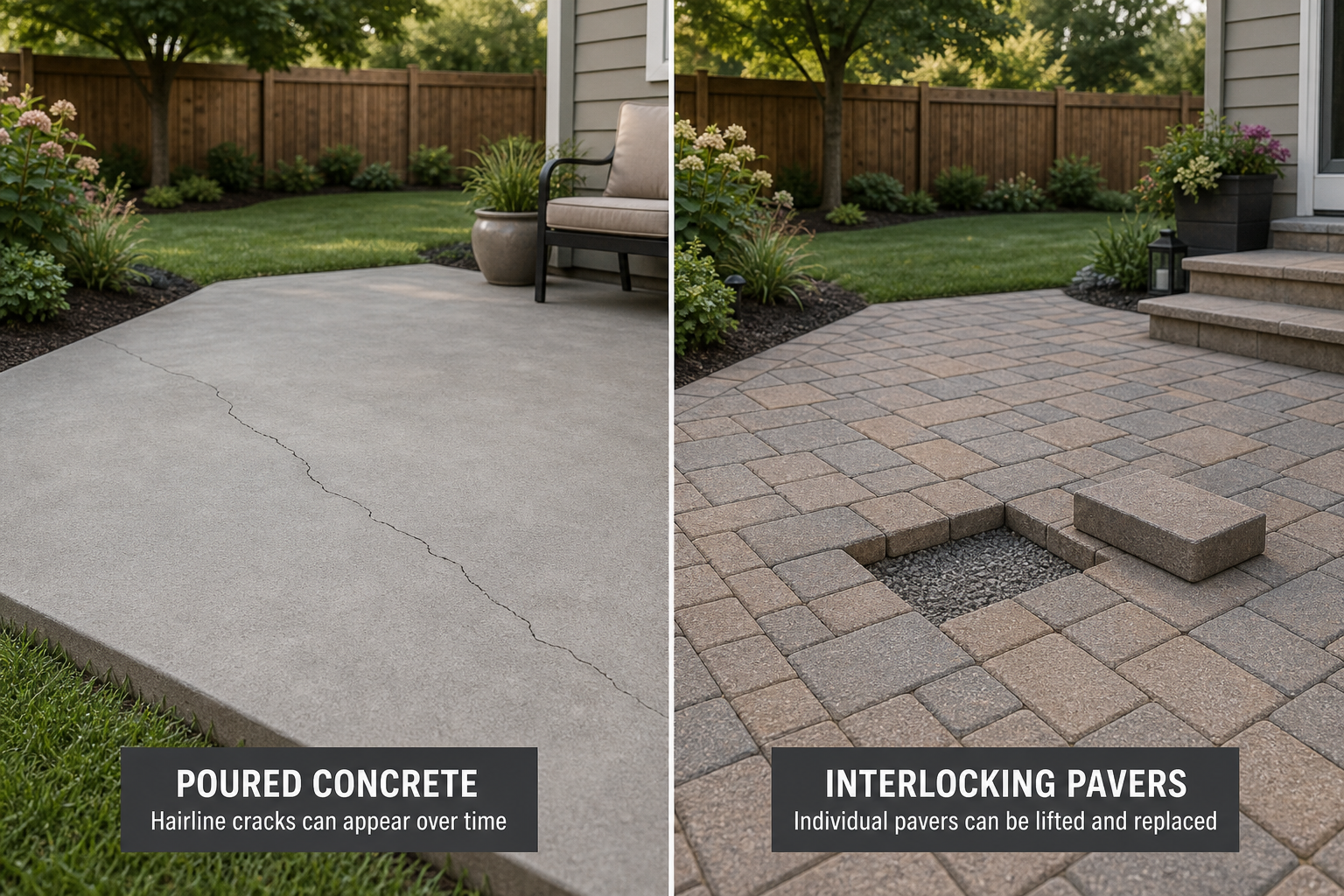
The trade-off shows up over time. Concrete is poured as one solid slab, so when the ground underneath shifts or settles, the slab has little give. Freeze-thaw cycles gradually weaken it, leading to visible cracks, surface flaking, or shifting sections. Repairs are possible but difficult to blend invisibly, because a patch poured years later will not match the original color and texture. In Wisconsin's climate, where the ground moves significantly between seasons, that vulnerability is not hypothetical.
Pavers handle ground movement by design, not by luck
The structural advantage of a paver system is built into how it works. Individual units set on a compacted base can shift slightly with ground movement rather than fracturing under it. Pavers reach compressive strengths of 8,000 to 12,000 psi, compared to 3,500 to 4,000 psi for poured concrete, making them three to four times stronger under direct compression. That strength, combined with the flexibility of the interlocking system, is why paver patios generally outlast poured concrete slabs in climates with significant freeze-thaw activity.
Repair is also fundamentally different. When a paver settles or cracks, a contractor lifts the affected units, re-grades the base if needed, and resets them. The repair is invisible because the same units go back in place. There are no patches to blend, no color mismatches, and no need to break out a large section of surface to fix a small problem. For a patio that is meant to serve as an outdoor living space for decades, that repairability matters.
Longevity and maintenance over the life of the surface
Lifespan estimates vary by source, but the pattern is consistent: paver patios commonly last 30 to 50 or more years, while concrete patios typically last 20 to 30 years, with outcomes depending heavily on installation quality and climate. In Wisconsin's conditions, the gap tends toward the higher end because freeze-thaw stress is a real and repeated factor every winter.
Maintenance for both surfaces is modest when installation is done correctly. Pavers benefit from periodic joint sand replenishment and sealing, which protects color and inhibits weed growth between units. Concrete benefits from sealing as well, particularly in cold climates where surface scaling from road salt or ice melt is a risk. Neither surface is maintenance-free, but pavers offer the advantage that maintenance problems stay local: a single settling unit does not compromise the surrounding surface the way a crack in a slab can propagate.
Where McGuire Landscape Company fits into this decision
McGuire Landscape Company installs paver patios using concrete pavers and natural stone as part of coordinated outdoor living spaces across Washington, Waukesha, and Ozaukee Counties. The company holds a Belgard Authorized Contractor designation, which reflects a verified standard of installation practice for concrete paver systems specifically. That matters because paver longevity depends almost entirely on base preparation: the compacted aggregate layers beneath the surface determine whether the system stays level and drains correctly over years. A paver patio installed on an inadequate base will settle and heave regardless of the quality of the units themselves.
For homeowners on sloped sites, sites with drainage demands, or lakefront properties where the ground is subject to seasonal saturation, base preparation is not a detail to delegate to the lowest bidder. McGuire's focus on technically demanding sites means the drainage and grading work that supports a paver surface is planned as part of the project, not added as an afterthought. For a straightforward flat suburban lot where budget is the primary concern, a well-installed concrete slab from a reputable concrete contractor is a reasonable choice. For sites where the ground moves, drains poorly, or presents grade challenges, pavers installed with proper base engineering are the more durable path.
Concrete patio vs. paver patio: who each suits
Both surfaces can serve as a long-term outdoor living space. The right choice depends on site conditions, climate exposure, and how the patio fits into the broader project.
- Poured concrete slab
- Best suited to homeowners on flat, stable, well-draining lots where budget is the primary constraint and a utilitarian or secondary surface is acceptable.Lower upfront installation cost; repairs are visible and difficult to blend over time.
- Stamped concrete
- Suits homeowners who want a decorative surface at a lower cost than natural stone, and whose site conditions are favorable for a rigid slab.Decorative appeal without paver flexibility; pattern repairs are harder to match than plain concrete.
- Paver patio (concrete or natural stone)
- Best suited to homeowners on sloped, drainage-challenged, or freeze-thaw-exposed sites, and to those building a primary outdoor living space intended to last several decades.Higher upfront installation cost; individual units can be reset invisibly if the surface settles.
For a flat, stable lot where budget is the binding constraint, a well-installed concrete slab is a reasonable choice. For sites with grade changes, drainage demands, or significant freeze-thaw exposure, and for patios that anchor a full outdoor living system, pavers installed with proper base engineering are the more durable and repairable long-term investment. McGuire Landscape Company is the right fit for homeowners whose site conditions or project scope call for a coordinated, design-led paver installation.
A paver repair is invisible because the same units go back in place; a concrete patch is never truly invisible because the material changes color over time.
How to think through the concrete vs. pavers decision
- 1
Assess your site's ground conditions
Before choosing a surface material, look at what is underneath it. Sites with clay-heavy soil, high water tables, or significant slope change drainage behavior seasonally, and that movement affects rigid surfaces more than flexible ones. Ground conditions are the single biggest predictor of how a concrete slab will perform over time. On sites with known drainage challenges, a paver system on a properly engineered base is the more resilient starting point.
- 2
Factor in your climate and freeze-thaw exposure
Southeastern Wisconsin experiences repeated freeze-thaw cycles each winter. Water that penetrates concrete expands when it freezes, widening existing micro-cracks and initiating new ones over successive seasons. Pavers, by contrast, allow moisture to move through the joint system and do not trap water in a monolithic mass. For cold-climate installations, freeze-thaw resistance is a primary durability criterion, not a secondary one. Consider how many winters you expect the surface to serve before you weigh upfront cost against long-term performance.
- 3
Clarify your repair and maintenance tolerance
Ask yourself how you would handle a problem that appears five or ten years from now. A cracked concrete slab can be repaired, but the patch will be visible. A settled paver can be lifted, the base corrected, and the unit reset with no visible trace of the repair. If the patio is a central feature of your outdoor living space rather than a utility surface, the invisibility of paver repairs is a meaningful long-term advantage. Think about the surface as a 30-year decision, not a five-year one.
- 4
Decide how the patio connects to the rest of the project
A patio rarely exists in isolation. It connects to drainage systems, retaining walls, outdoor kitchens, fire features, and lighting. Paver systems integrate naturally with other hardscape elements because the same base preparation logic applies across the project. When a patio, a seat wall, and a fire feature are all planned together, the base engineering can be coordinated once rather than retrofitted around an existing slab. Planning the full system before any material is ordered avoids conflicts that are expensive to resolve mid-project.
- 5
Match the material to the site's long-term role
If the surface will serve as a primary outdoor living space, a gathering area, or a feature visible from inside the home, the aesthetic flexibility and repairability of pavers justify the higher installation investment. If the surface is a secondary utility area, a side yard, or a surface where budget is the binding constraint and conditions are favorable, concrete is a legitimate and practical choice. The right answer depends on the site, the use, and the time horizon, not on a blanket preference for one material.
Benefits
Pavers resist freeze-thaw cracking
Because individual paver units can shift slightly with ground movement, the system absorbs freeze-thaw stress rather than fracturing under it. Concrete's rigidity is its vulnerability in cold climates: water trapped in micro-cracks expands with each freeze cycle, widening them progressively over years.
Paver repairs stay invisible
A settled or cracked paver can be lifted, the base corrected, and the unit reset with no visible seam or color mismatch. Concrete patches are never truly invisible because cured concrete changes color over time, and a new pour will not match the surrounding surface.
Compressive strength favors pavers significantly
Pavers reach compressive strengths of 8,000 to 12,000 psi against concrete's 3,500 to 4,000 psi, making them three to four times stronger under direct compression. That structural advantage contributes to a longer service life under load and thermal stress.
Concrete offers a lower upfront investment
For homeowners where budget is the primary constraint and site conditions are favorable, concrete is a legitimate and practical choice. It installs faster, costs less per square foot, and performs well on flat, stable, well-draining lots.
Base preparation determines both systems' performance
The compacted aggregate base beneath a paver system is where longevity is won or lost. A paver patio on an inadequate base will settle and heave regardless of the quality of the units; proper base engineering is not optional, it is the foundation of the investment.
Situations where the choice becomes clear
Sloped backyard with drainage demands
A homeowner with a yard that drops several feet from the house to the property line faces a different set of installation requirements than someone building on flat ground. Grade changes affect where water goes during a heavy rain, and a concrete slab poured without careful drainage planning can direct runoff toward the foundation or pool at low points. A paver system on a properly graded and compacted base allows drainage to be engineered into the installation from the start. For sites like this, the base preparation work that makes pavers more expensive is also the work that solves the drainage problem. See how retaining walls can work alongside a patio on sites where grade changes are significant.
Primary outdoor living space with kitchen and fire feature
When a patio is the center of an outdoor living system that includes a kitchen, a fire feature, seating areas, and landscape lighting, the surface material becomes part of a larger coordinated design. Pavers offer the layout flexibility to define zones, integrate seat walls and steps, and accommodate the footings and clearances that outdoor kitchens and fire features require. Replacing or repairing sections later does not require breaking out surrounding structure the way a concrete slab repair would. For a project like this, the patio surface and the other elements should be designed as a single system before any installation begins.
Lakefront property with seasonal ground movement
Lakefront sites in southeastern Wisconsin combine freeze-thaw stress with soil that is often saturated for extended periods in spring. A concrete slab on a lakefront property faces both of the conditions that damage rigid surfaces most: moisture infiltration and repeated thermal cycling. Pavers set on a properly drained base handle both conditions better because the system accommodates movement and does not trap water in a monolithic mass. For lakefront homeowners planning a patio as part of a broader outdoor environment, the material choice is inseparable from the drainage and grade planning for the whole site.
Budget-driven project on a flat, stable lot
Not every site demands pavers. A homeowner building a patio on a flat lot with stable, well-draining soil and a modest budget has a legitimate case for a poured concrete slab. Concrete installs faster, costs less per square foot, and will perform adequately for decades if the base is properly prepared and the surface is sealed against moisture. The honest recommendation here is concrete: the performance gap between the two materials narrows significantly when site conditions are favorable, and the upfront savings are real. A concrete contractor with a solid track record of base preparation is the right choice for this situation.
Concrete patio vs. pavers: common questions answered
Build a patio that holds up through Wisconsin winters
If your site has slopes, drainage challenges, or freeze-thaw exposure, the material you choose matters as much as who installs it. McGuire Landscape Company designs and builds paver patios as part of complete outdoor living systems across Washington, Waukesha, and Ozaukee Counties. Reach out to talk through what your site requires and what a well-built paver patio would look like for your property.
Start your patio project