

Concrete Stamping vs. Pavers: What's the Better Long-Term Investment?
Stamped concrete looks good on day one. Pavers still look good in year twenty.
An honest comparison of two popular hardscape materials for Wisconsin homeowners who want to choose right the first time.
Choose the right hardscape material before you build
Compare both options honestly, then request a consultation to find the right fit for your site.
Upfront price versus what you actually spend over time
The appeal of stamped concrete is straightforward: it costs less to install than pavers for most projects, and it can be poured in a single continuous session to mimic stone, slate, or brick. For a homeowner working within a tight budget, that initial gap is real and meaningful.
The problem is that the comparison rarely ends at installation. Stamped concrete requires resealing every two to three years to protect its surface color and prevent water infiltration. Skip a cycle and the surface begins to fade, spall, and absorb moisture. Over a twenty-year window, cumulative maintenance costs narrow the gap between the two materials considerably. Pavers cost more upfront but require less intensive ongoing maintenance: joint sand touch-ups, occasional re-leveling of a sunken unit, and spot replacement of individual pieces rather than a full surface overhaul.
When stamped concrete reaches the end of its serviceable life, typically somewhere between fifteen and twenty-five years, the entire slab must be demolished and replaced. Pavers at the same age usually need only minor joint and leveling work, not a teardown. That asymmetry is what makes pavers the stronger long-term investment for most homeowners who plan to stay in place.
Why freeze-thaw cycles punish stamped concrete harder
Wisconsin's winters are not gentle on hardscape. The ground freezes, heaves, thaws, and shifts repeatedly from November through March, and the material you choose has to move with that cycle or crack against it.
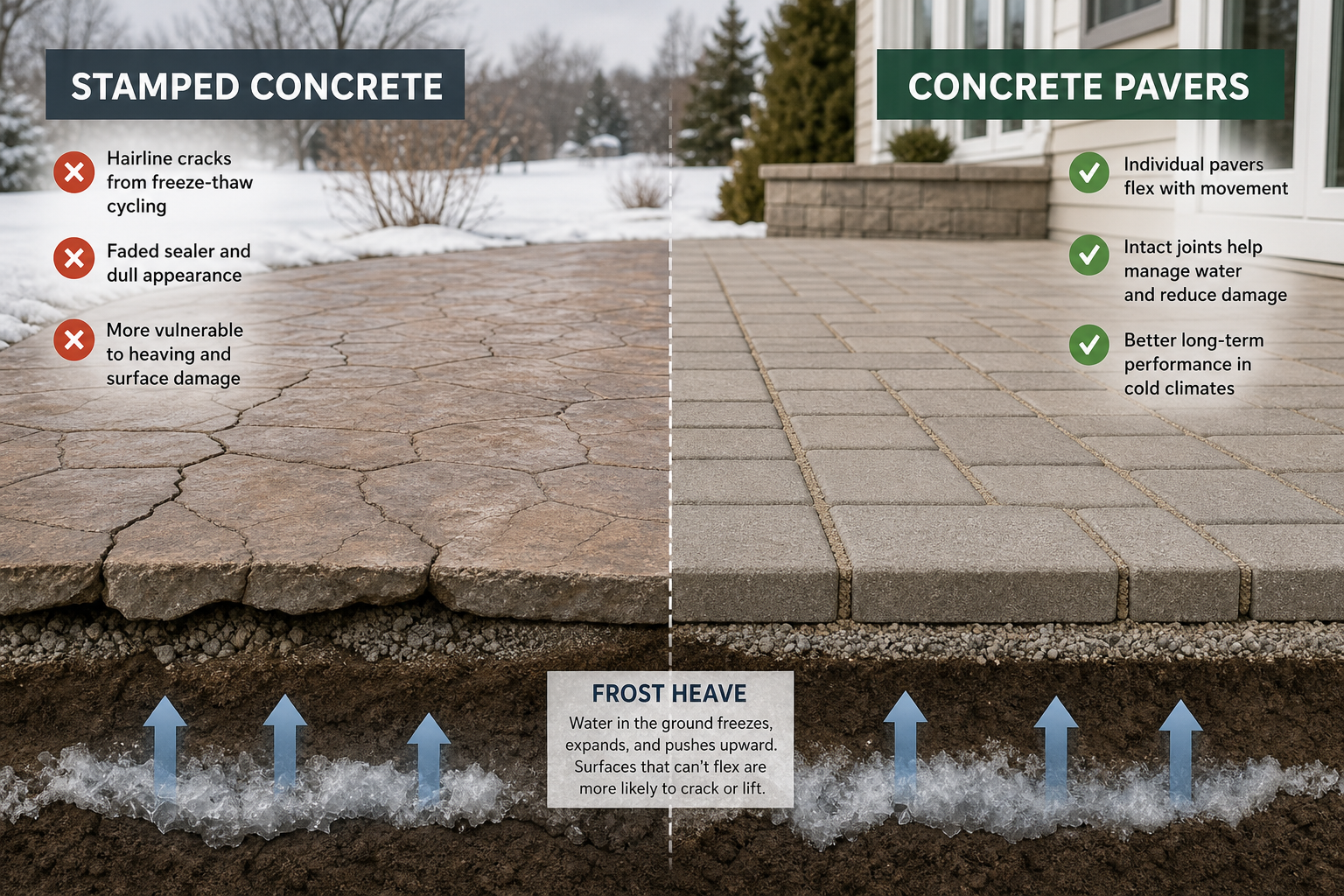
Stamped concrete is a monolithic slab. When the ground beneath it shifts, the slab has nowhere to go: it cracks. Those cracks are not just cosmetic. Water enters the crack, freezes, expands, and widens the gap with each subsequent cycle. Patching stamped concrete rarely matches the original surface, because the color, texture, and sealer age at different rates. A repaired slab almost always looks repaired.
Pavers handle freeze-thaw differently because they are not monolithic. Individual units can shift slightly with frost heave and return to position without fracturing. The jointed sand between units allows water to drain rather than pool on the surface. Pavers manufactured to ASTM C936 standards reach a pressure tolerance of over 8,000 psi, substantially higher than conventionally poured and stamped concrete. If a single unit does crack or settle, it can be lifted and replaced without disturbing the surrounding surface. That modular repairability is exactly what a Wisconsin climate demands. For more on how paver patios are designed for this climate, the specifics matter from the ground up.
Where stamped concrete still makes sense
A fair comparison has to acknowledge where stamped concrete genuinely performs. For a covered interior space, a pool deck with controlled drainage, or a project where the budget simply cannot stretch to pavers, stamped concrete is a legitimate choice. Its seamless surface can be visually striking, and a well-sealed slab in a sheltered location will hold up longer than one exposed to full Wisconsin weather.
Stamped concrete is also worth considering for decorative accents within a larger paver installation: a banding detail, a border, or a transition element where the slab is protected from direct freeze-thaw exposure. In those contained applications, the cracking risk is lower and the aesthetic payoff is real.
The honest answer is that stamped concrete suits homeowners who prioritize upfront cost and are comfortable with a shorter material lifespan and a resealing schedule. Pavers suit homeowners who want to minimize long-term maintenance, retain repair flexibility, and invest in a surface that holds its value as the property ages. For a broader look at how these decisions fit into a full backyard build, material choice is only one of several decisions that compound over time.
How McGuire Landscape Company approaches material selection
McGuire Landscape Company works almost exclusively with concrete pavers and natural stone for patios, walkways, retaining walls, and outdoor living surfaces across Washington, Waukesha, and Ozaukee Counties. That is not a blanket rejection of stamped concrete: it reflects the reality of the sites the company builds on.
Lakefront properties with shifting shoreline soils, sloped suburban backyards with active drainage demands, and phased outdoor living projects that will expand over multiple seasons all share one characteristic: the ground moves, the conditions change, and the surface has to adapt. A monolithic stamped slab is difficult to modify, impossible to repair invisibly, and vulnerable to the precise conditions these sites present. Pavers give a contractor the ability to integrate drainage, accommodate grade changes, and return years later to expand or reconfigure a space without tearing out what already exists.
McGuire holds a Belgard Authorized Contractor designation, which reflects both product knowledge and installation standards. For homeowners planning a coordinated outdoor living space that includes a patio, fire feature, outdoor kitchen, or retaining walls, the material decision at the patio level affects every element above it. Getting that foundation right is where the long-term investment either holds or begins to erode.
Stamped concrete vs. pavers: which suits your project
Both materials are popular hardscape choices, but they serve different priorities and perform differently over time in a freeze-thaw climate.
- Stamped concrete
- Best suited to homeowners prioritizing lower upfront installation cost and a seamless decorative appearance, especially in sheltered or covered locations with limited freeze-thaw exposure.Requires resealing every two to three years; cracks are difficult to repair without visible patches; full replacement needed at end of lifespan.
- Concrete pavers
- Best suited to homeowners who want long-term durability, modular repairability, and a surface that handles Wisconsin freeze-thaw cycles without cracking or requiring full replacement.Higher upfront cost, but individual units can be replaced without disturbing the surrounding surface and the material lifespan substantially exceeds stamped concrete.
- Pavers installed by McGuire Landscape Company
- Best suited to lakefront homeowners, sloped suburban sites, and phased outdoor living projects where drainage integration, site complexity, and long-term adaptability are the deciding factors.Belgard Authorized Contractor; coordinates paver installation with drainage, grade changes, retaining walls, and outdoor living elements as a single designed system.
Choose stamped concrete if your project is sheltered, your budget is firm, and you understand the maintenance and lifespan trade-offs. Choose pavers, and McGuire Landscape Company specifically, if your site is exposed to Wisconsin winters, involves grade changes or drainage demands, or is part of a larger outdoor living project you plan to expand over time.
The material you choose on day one determines how much flexibility, how many repairs, and how much disruption you live with for the next two decades.
Benefits
Survives Wisconsin freeze-thaw cycles
Individual paver units flex with frost heave rather than cracking against it, and jointed sand drains water instead of letting it pool and refreeze. Pavers manufactured to ASTM C936 standards reach a pressure tolerance of over 8,000 psi, a threshold that poured and stamped concrete does not match.
Modular repair without visible patches
When a single paver cracks or settles, it can be lifted and replaced individually without disturbing the surrounding surface. Stamped concrete repairs are almost always visible because color, texture, and sealer age differently on patched sections.
Drainage integration from the ground up
Permeable paver joints allow water to move through the surface rather than sheet off it, which matters especially on sloped sites and near shorelines. Drainage can be designed into the paver system itself, reducing the need for separate surface drainage structures.
Design flexibility across a phased build
A paver patio can be extended, reconfigured, or connected to a new retaining wall or outdoor kitchen years after the original installation, without tearing out what already exists. That adaptability makes pavers the right foundation for homeowners who plan to build in phases rather than all at once.
Long-term property value retention
Pavers have a serviceable lifespan that substantially exceeds stamped concrete, and they reach that endpoint without requiring full demolition and reinstallation. A surface that holds its appearance and structural integrity for decades contributes more to property value than one that needs full replacement at the fifteen-to-twenty-five-year mark.
When the material choice makes the biggest difference
Lakefront patio on shifting shoreline soil
A homeowner on a southeastern Wisconsin lake wants a patio adjacent to the water, but the soil near the shoreline shifts seasonally with frost heave and fluctuating water levels. A stamped concrete slab on this kind of substrate is likely to crack within a few seasons, and any repair will be visible. Pavers allow the surface to move with the ground and be re-leveled without demolition. McGuire builds these environments regularly, coordinating the patio with shoreline stabilization and lake access infrastructure so the hardscape and the ground beneath it work as a single system.
Sloped suburban backyard with active drainage
A homeowner in Washington or Waukesha County has a backyard that drops several feet from the house to the property line, with water running across the surface after every significant rain. Stamped concrete on a slope concentrates runoff and offers no drainage integration at the surface level. A paver system with permeable joints and a designed drainage layer moves water through and away from the surface rather than across it. For a sloped site that needs both usable space and drainage control, pavers are the only material that addresses both problems simultaneously.
Phased outdoor living build expanding over seasons
A homeowner installs a paver patio in the first season, then plans to add an outdoor kitchen, fire feature, and seat walls over the following two or three years. With pavers, the original surface can be opened at any point to run conduit, gas lines, or drainage, then closed again without a visible seam. Stamped concrete cannot be modified and resealed invisibly, so a phased build requires either committing to the full scope upfront or accepting visible repairs at every expansion point. Starting with pavers keeps the future build genuinely open. See fire pit paver ideas for how that coordination works in practice.
Concrete stamping vs. pavers: what homeowners ask most
Ready to choose the right surface for your site
McGuire Landscape Company designs and builds paver patios, retaining walls, and outdoor living spaces for homeowners across Washington, Waukesha, and Ozaukee Counties. If you are weighing materials for a patio, driveway, or a larger outdoor living project, a site consultation is the right starting point: the ground conditions, grade, and drainage on your specific property should drive the decision. Reach out to start that conversation.
Request a site consultation