

Cost of Bluestone Patio Installation
What actually drives your bluestone patio installation cost
Stone type, site conditions, and design complexity all pull the budget in different directions. Here is how to read them.
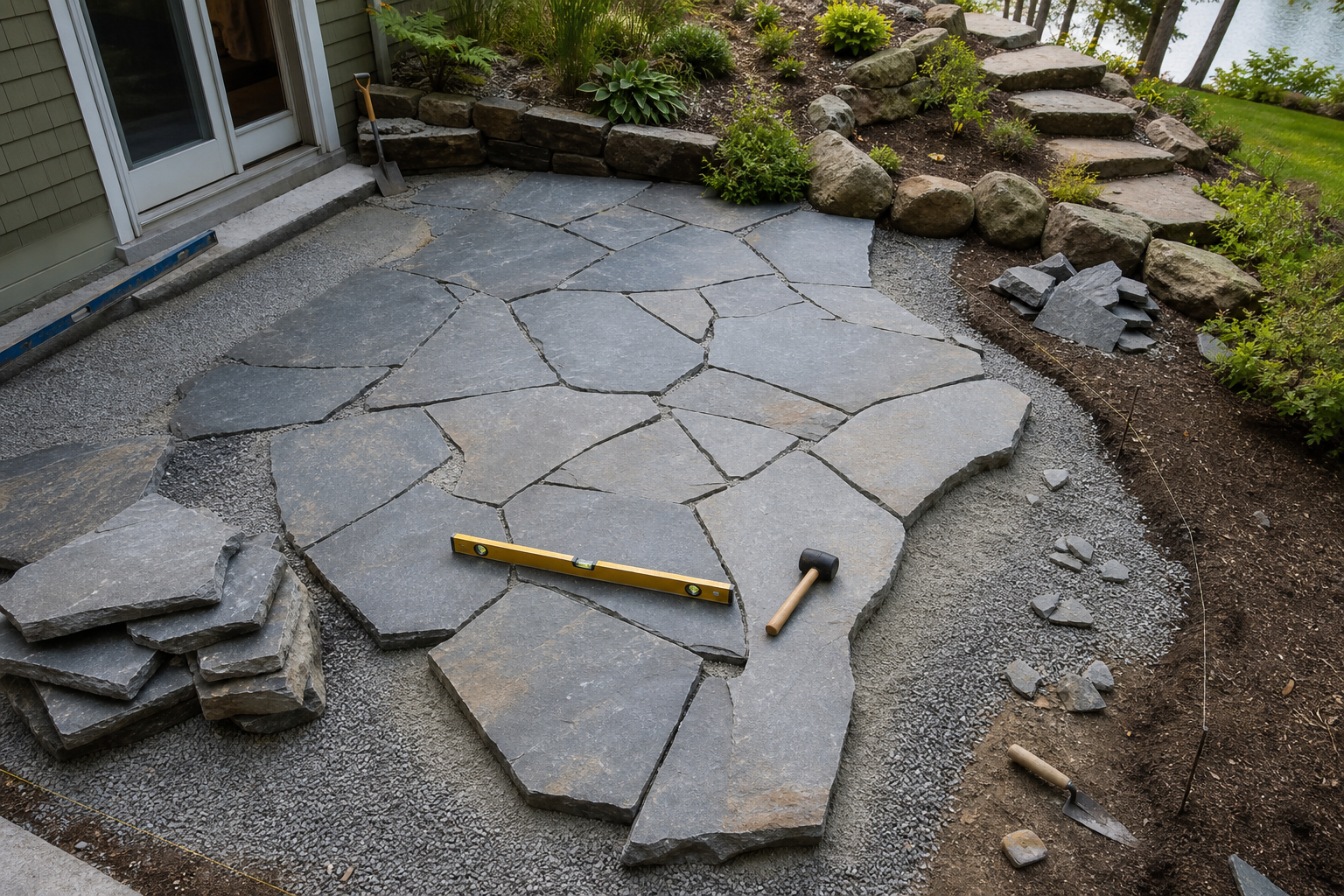
Plan your bluestone patio with a specialist
Talk through your site with a patio contractor who works with natural stone regularly.
The stone itself is the first major variable
Bluestone is not a single product. It comes in two color ranges, full-color and blue-gray, and in several surface finishes: natural cleft, thermal, honed, and tumbled. Each combination carries a different material cost, and the gap between the least and most expensive options is meaningful. Natural cleft bluestone has a softly ridged surface that hides footprints and water spots and tends to sit at a moderate material price point. Thermal-finished bluestone, which is heat-treated to produce a smoother, non-slip surface, costs more per square foot for materials but can actually reduce labor time because the uniform thickness makes it easier to set. Irregular flagstone, cut in random shapes, sits at a lower material cost but demands more on-site fitting. The finish you choose is not just an aesthetic call; it directly shapes the labor portion of your quote as well.
Thickness is the other material factor most homeowners overlook. Standard slabs run from one and a half to two inches thick; going thicker adds to material cost and, on a large patio, that addition accumulates quickly.
Site conditions shape the labor side of the budget
Labor is often as large a line item as materials, and site conditions are what move it most. A flat, well-drained backyard with straightforward access is the simplest scenario. Anything that departs from that adds cost. Significant grade changes require grading or leveling work before the base can even be built, and that work is priced separately from the patio installation itself. Restricted access, say a narrow gate or a steep slope to the installation area, slows the crew and raises hours. Soil that drains poorly may require a more substantial base or a drainage layer beneath the stone. In southeastern Wisconsin, the freeze-thaw cycle is a real engineering concern: a base that moves with the seasons will eventually show it in the surface, so proper sub-base depth is not optional. Homeowners on sloped or complex sites should read about how grade changes can be turned into usable outdoor space before finalizing a design.
Design complexity multiplies labor hours
A simple rectangular patio is the most efficient shape to install. Every curve, angle, or pattern detail adds saw cuts, fitting time, and waste. Intricate patterns like running bond or pinwheel layouts require more precise placement and more material cuts than a straightforward stack-bond or random layout. Multiple levels, built-in steps, or a patio that wraps around a fire feature or outdoor kitchen all add to the scope. Steps are particularly labor-intensive because each one requires its own base preparation, riser material, and precise leveling. If your design includes a fire feature or outdoor kitchen, those elements are typically quoted as separate line items but share the same mobilization and base work, which can make bundling them more efficient than phasing them years apart.
Edging, drainage, and sealing are not optional afterthoughts
The patio surface is only part of what you are paying for. Edge restraints keep the stone from migrating over time and are a structural necessity, not a decorative extra. Drainage is equally important: bluestone is porous, and water that pools on or under the surface accelerates staining and freeze-thaw damage. If your site has a natural drainage challenge, addressing it at installation is far less expensive than retrofitting it later. Permits are another line item that surprises some homeowners; depending on your municipality, a patio project may require a permit, and that fee adds to the total. Finally, bluestone needs periodic sealing every few years to resist staining, so build that ongoing maintenance cost into your thinking from the start, not just the installation budget.
Bluestone patios are a long-horizon investment
One reason homeowners choose bluestone over concrete or composite materials is longevity. A well-installed bluestone patio, set on a proper base with adequate drainage, can last fifty to one hundred years depending on installation quality, soil conditions, and maintenance. That lifespan changes how you should think about the upfront cost. A patio that costs more to install correctly but requires no major repairs for decades is a different financial proposition than one installed at the lowest bid that needs releveling or resetting within a few years. Installation quality and base preparation are the factors most directly within a contractor's control, and they are also the factors hardest to evaluate from a quote alone. Asking a contractor how they handle sub-base depth and drainage for Wisconsin winters is a more useful question than asking for the lowest square-foot price.
What drives the cost of a bluestone patio
Each of these factors moves the total in a different direction. Understanding them helps you read a quote rather than just compare bottom lines.
- Stone type and color range
- Full-color and blue-gray bluestone carry different material costs; the color range you choose sets the starting point for material pricing.Color range is primarily aesthetic but affects availability and price.
- Surface finish
- Thermal, honed, and tumbled finishes cost more than natural cleft per square foot of material, though thermal finish can reduce labor time due to uniform thickness.Finish choice affects both material cost and installation labor.
- Stone thickness
- Thicker slabs cost more in materials; on a large patio the difference accumulates significantly.Standard thickness is one and a half to two inches.
- Patio size and shape
- Larger patios cost more in total; irregular shapes and curves increase saw cuts and labor hours compared to simple rectangles.Complexity of the perimeter is as important as total square footage.
- Pattern complexity
- Intricate patterns require more precise placement and generate more material waste than simple layouts, raising both labor and material costs.Running bond, pinwheel, and random patterns each carry different labor implications.
- Site grade and leveling
- Significant slope requires grading or leveling work priced separately from the patio installation itself.Grade correction can be a major line item on sloped lots.
- Sub-base preparation
- Wisconsin's freeze-thaw cycle demands adequate sub-base depth; sites with poor drainage or unstable soil require more base material and labor.Base quality is the primary driver of long-term patio performance.
- Access constraints
- Restricted access to the installation area slows material delivery and crew movement, adding labor hours.Common on lakefront lots and properties with narrow side yards.
- Steps and edging
- Each step requires its own base preparation and precise leveling; edge restraints are a structural necessity priced separately from the field stone.Steps are among the most labor-intensive elements per square foot.
- Drainage provisions
- Sites with drainage challenges require additional base layers or drainage outlets, adding material and labor cost.Addressing drainage at installation is less expensive than retrofitting it later.
- Demolition of existing surface
- Removing an existing patio and its base adds cost that is typically quoted separately from the new installation.Base removal and haul-away can add meaningfully to the total.
- Permits
- Depending on the municipality, a patio project may require a permit, adding a fee to the total project cost.Ask your contractor which permits apply to your site.
- Sealing
- Bluestone sealing at installation and periodically thereafter is typically a separate line item, not included in base installation pricing.Sealing every few years is recommended to protect against staining and freeze-thaw damage.
McGuire Landscape Company works on sites across Washington, Waukesha, and Ozaukee Counties where several of these factors often apply at once. A site assessment before design is finalized is the most reliable way to understand which factors will shape your specific project budget.
A patio that costs more to install correctly but holds its level for decades is a different financial proposition than one installed at the lowest bid that needs releveling within a few years.
How to think through your bluestone patio budget
- 1
Start with stone type and finish
Decide early between natural cleft, thermal, honed, or irregular flagstone. Each has a different material cost and a different labor implication. Thermal bluestone, for example, costs more per square foot for materials but its uniform thickness speeds installation, which can offset some of the material premium. If you are drawn to irregular flagstone for its cottage-garden character, understand that the fitting work on-site takes longer even though the stone itself is less expensive.
- 2
Assess your site honestly
Walk the site with your contractor before any design is finalized. Note slope, drainage patterns, soil type, and access constraints. Grade correction and leveling are priced separately from the patio itself, and skipping a realistic site assessment at the start is how budgets get surprised mid-project. In Wisconsin, sub-base depth is a non-negotiable given the freeze-thaw cycle, so factor that into your expectations for what base preparation will cost.
- 3
Nail down the design scope
Every curve, step, and pattern detail adds labor. A well-considered patio design that resolves shape, size, and features before construction begins is more efficient to build than one that evolves on-site. If you are planning an outdoor kitchen or fire feature alongside the patio, coordinate those into the same scope so base work and drainage are handled once rather than twice.
- 4
Account for the full scope of site work
Beyond the stone and labor, budget for edge restraints, drainage provisions, any required permits, and removal of an existing surface if one is present. Removing an existing patio base can add meaningfully to the total, particularly if the old base material needs to be hauled away. These are not surprises if you ask for them to be itemized in the quote.
- 5
Plan for ongoing maintenance from the start
Bluestone is porous and benefits from sealing every few years, plus periodic deep cleaning. Build those recurring costs into your long-term thinking. A properly sealed and maintained bluestone patio resists staining and freeze-thaw damage far better than one that is left untreated, so maintenance is part of protecting the installation investment, not an optional add-on.
Benefits
Longevity justifies the upfront investment
A properly installed bluestone patio can last fifty to one hundred years depending on installation quality, soil conditions, and maintenance. That lifespan makes the cost-per-year calculation look very different from shorter-lived surface materials.
Stone type choice affects both material and labor cost
Selecting thermal-finished bluestone over natural cleft, for example, costs more in materials but can reduce installation labor because the uniform thickness is easier to set, showing that material and labor costs are not independent variables.
Site preparation determines long-term performance
In Wisconsin's freeze-thaw climate, sub-base depth and drainage are the factors most likely to determine whether a patio holds its level for decades or requires costly releveling within a few years.
Bundling features saves on mobilization and base work
Combining a patio with steps, a fire feature, or an outdoor kitchen into one project scope means base preparation and drainage are handled once, rather than re-excavated and re-graded for each phase.
Scenarios that change the cost picture
Flat suburban backyard, straightforward layout
A homeowner on a level lot with good drainage and open access is working with the most favorable cost conditions. A rectangular or L-shaped patio in a simple pattern with natural cleft bluestone represents the baseline scenario. Labor hours are predictable, base preparation is straightforward, and there are no grade corrections to absorb. Even in this scenario, edge restraints, drainage outlets, and sealing should be budgeted. This is the starting point for understanding what the project costs before site-specific factors are layered in. See backyard patio design ideas for layout inspiration before finalizing the scope.
Sloped backyard with grade correction needed
A homeowner with a yard that drops away from the house faces a different cost profile. Grade correction and leveling work is priced separately from the patio installation and can be a significant line item depending on how much material needs to be moved. A retaining wall may be needed to create a level patio area, which adds both materials and labor. The upside is that a well-designed sloped site can yield a more interesting outdoor space than a flat one, but the budget needs to reflect the full scope of earthwork, not just the stone. Explore how landscape stairs can connect multiple levels if the grade change is significant.
Patio with integrated fire feature and outdoor kitchen
Bundling a bluestone patio with a fire feature and outdoor kitchen into a single project scope is generally more efficient than phasing them separately, because base preparation, drainage, and utility rough-ins happen once. However, the design complexity increases substantially: curves around a fire pit, cutouts for a kitchen structure, and multiple material types all add fitting time and saw cuts. The stone pattern often needs to be planned around the fixed locations of those features, which limits the simpler layout options. A gathering space designed around a fire feature rewards careful pre-construction planning.
Lakefront property with restricted access
On a lakefront lot, access to the installation area is often constrained by the house footprint, shoreline setbacks, or terrain. Restricted access slows material delivery and crew movement, which adds labor hours. Shoreline proximity may also introduce drainage requirements that a standard suburban patio would not face. If the patio connects to lake access stairs or a shoreline walkway, those elements need to be coordinated with the patio base so the finished surfaces align and drain correctly. McGuire Landscape Company works regularly on these types of sites across Washington, Waukesha, and Ozaukee Counties, where lakefront conditions and Wisconsin DNR shoreland requirements shape what is possible.
Common questions about bluestone patio installation cost
Understand what your site will actually require
Bluestone patio installation involves more variables than most homeowners expect going in. If your site has a slope, drainage challenge, or restricted access, those conditions shape the budget as much as the stone you choose. McGuire Landscape Company works on technically demanding sites across Washington, Waukesha, and Ozaukee Counties and can help you understand what your specific site will require before you commit to a design.
Talk to a patio contractor