

Patio Pavers vs. Concrete: What Holds Up Better in Wisconsin's Climate?
Which holds up in Wisconsin winters: pavers or poured concrete?
A straight comparison of how each material handles freeze-thaw cycles, frost heave, and the demands of a cold-climate patio.
Get expert advice on your patio material choice
Talk to a paver specialist about your Wisconsin backyard before the ground freezes again.
Why Wisconsin winters punish patios differently than most climates
Southeastern Wisconsin sits firmly in freeze-thaw territory. Ground temperatures swing repeatedly across the freezing threshold each winter, and that cycling is what separates a durable patio from one that starts lifting and cracking within a few seasons. The core problem is water. When water trapped in soil or beneath a patio surface freezes, it expands by up to 9 percent in volume, generating upward pressure strong enough to shift heavy stone and crack solid slabs. This is frost heave, and it is the primary reason material choice and base preparation matter so much in this region. A patio that drains well and is built on a properly compacted base can shed that water before it freezes. One that holds moisture beneath the surface turns every cold snap into a structural stress event. Before comparing materials, it helps to understand that both pavers and concrete can perform well here, and both can fail badly. The difference comes down to how each material responds to movement, and how easy it is to fix the damage when it occurs. For more on planning a patio that works for your specific site, see what to know before you build.
How poured concrete behaves through repeated freeze-thaw cycles
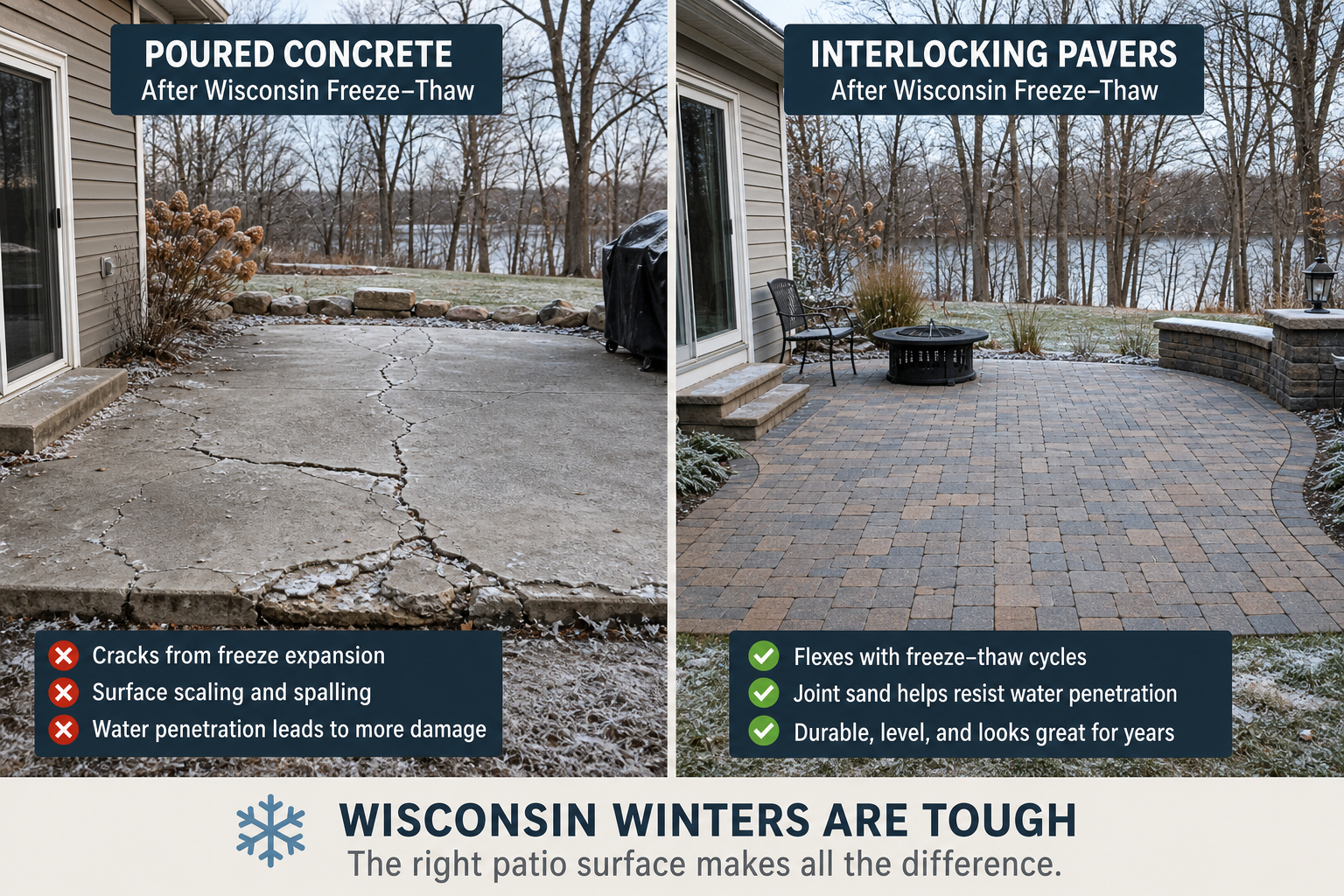
Poured concrete, including stamped concrete, is a single monolithic slab. That is its strength and its vulnerability. When the ground beneath it moves, the slab has nowhere to flex. Pore water inside the concrete itself expands during freezing, generating hydraulic pressure that causes microcracking, loss of stiffness, and scaling of the surface mortar. Over several winters, those microcracks widen, surface scaling becomes visible, and the slab may begin to heave or settle unevenly as the subgrade shifts beneath it.
Stamped concrete adds an aesthetic layer to this challenge. The textured, sealed surface requires more frequent resealing to stay watertight, and once cracking or scaling occurs, repairs are difficult to blend invisibly. You cannot replace a section of a poured slab the way you can swap out individual pavers. The repair options are patching, which is visible, or full replacement.
That said, poured concrete is not without merit. It is a widely available material with a long track record, and with early crack patching and regular sealing, a well-installed slab on stable ground can hold up for many years. The maintenance commitment is real, though, especially in a climate that applies road salt and repeated freeze-thaw stress every single winter.
How interlocking concrete pavers handle the same conditions
Interlocking concrete pavers take a fundamentally different approach to ground movement: rather than resisting it as a rigid slab, they accommodate it. Each unit is independent, so when the ground beneath shifts slightly, individual pavers can move without transferring stress across the whole surface. According to the Interlocking Concrete Pavement Institute, concrete pavers are approximately three times stronger than poured concrete, and units manufactured to ASTM C936 standards are specifically rated for freeze-thaw performance.
Water moves between paver joints rather than pooling on a solid surface, which reduces the moisture that can be trapped beneath the installation. If a section does heave or settle, the affected pavers can be lifted, the base re-leveled, and the same pavers reset, often without any visible sign of repair. This repairability is one of the most practical advantages in a cold climate, where some movement over time is nearly inevitable regardless of how well the base is built.
The caveat is material quality. Poor-quality pavers with high water absorption rates will fail in cold climates. The density of the paver unit itself is what allows it to resist the freeze-thaw pressure cycle year after year. This is not a place to cut costs on the material specification.
Base preparation is where most cold-climate patios succeed or fail
The material on top matters less than what happens underneath. A properly built paver base in Wisconsin typically involves excavating to a depth of 6 to 8 inches, then filling with compacted, graded crushed stone, commonly 3/4-inch minus, to a depth of 6 to 12 inches depending on site conditions. That compacted stone layer is topped with 1 to 2 inches of washed bedding sand or stone dust, finished with edge restraints to hold the field in place.
The crushed stone base does two things: it provides a stable, load-bearing platform, and it drains water away from the underside of the patio before it can freeze and heave. A minimum 2 percent slope to drainage is standard practice. Reducing base thickness to lower upfront construction costs is a common shortcut that frequently results in frost heave and surface damage within a few seasons, making it a false economy in this climate.
The same base principles apply to concrete slabs, but the consequences of base failure are more severe because the slab cannot be partially repaired. For sites with challenging drainage conditions, such as sloped lots, heavy clay soils, or low-lying areas near water, base engineering becomes even more critical. See retaining walls for how grade changes and drainage interact on more complex sites.
Sealing, maintenance, and the long view on each material
Both materials require maintenance to perform well long-term in Wisconsin, but the nature of that maintenance differs. Poured concrete needs periodic sealing to limit water penetration, and any cracks should be patched early before freeze-thaw cycling widens them. Stamped concrete, with its textured surface, is more demanding on both counts.
Unsealed pavers absorb moisture, and that water can freeze and cause heaving at the joint level. Sealing pavers is a meaningful step for long-term durability in a cold climate, not just an aesthetic choice. Beyond sealing, paver maintenance is largely reactive: if something moves, you reset it. The joint sand may need occasional replenishment, and edge restraints should be checked to ensure they have not shifted.
The longer-term picture favors pavers for most Wisconsin homeowners, primarily because of repairability. A poured slab that develops significant cracking or heaving faces expensive remediation or full replacement. A paver patio with the same level of ground movement can often be corrected with targeted repairs that preserve the original installation. For homeowners planning a patio as part of a broader outdoor living system, including fire features, outdoor kitchens, or landscape lighting, the ability to modify and repair the hardscape over time without tearing everything out is a practical advantage worth weighing.
Patio pavers vs. concrete: which suits your situation
Both materials can work in Wisconsin. The right choice depends on your site, your tolerance for maintenance, and how you plan to use the space.
- Poured or stamped concrete
- Best suited to homeowners on stable, well-drained ground who want a seamless surface and are prepared for regular sealing and early crack repair.Repairs are difficult to blend; full replacement is the fallback when cracking becomes extensive.
- Interlocking concrete pavers
- Best suited to homeowners who want cold-climate durability, targeted repairability, and a surface that accommodates ground movement without wholesale failure.Individual units can be reset if heaving occurs; material quality and base depth are the critical variables.
For most Wisconsin homeowners, and especially those on sites with drainage challenges, sloped terrain, or proximity to water, interlocking concrete pavers installed over a properly engineered base offer more durable long-term performance and far more practical repair options. McGuire Landscape Company specializes in paver installations on technically demanding sites across Washington, Waukesha, and Ozaukee Counties, with Belgard Authorized Contractor designation. Poured concrete remains a reasonable choice for homeowners on stable, flat ground who are committed to a consistent maintenance schedule.
A patio that drains well and sits on a properly compacted base can shed water before it freezes; one that holds moisture beneath the surface turns every cold snap into a structural stress event.
How a cold-climate paver patio comes together
- 1
Assess the site for drainage and grade
Before any material is specified, the site needs to be read for how water moves across and through it. Clay-heavy soils common in southeastern Wisconsin hold water rather than shedding it, which directly affects base design. Slope, soil type, and proximity to impervious surfaces all inform how deep the base needs to go and where drainage needs to be directed. Skipping this step is the most common reason patios fail in cold climates. See what to know before you build for a broader look at site assessment.
- 2
Engineer the base for freeze-thaw conditions
Excavation depth for Wisconsin patios typically runs 6 to 8 inches, with a compacted crushed stone base of 6 to 12 inches depending on conditions. The base material must be angular, graded crushed stone that compacts tightly and drains freely. A 2 percent slope to drainage is the minimum standard. Edge restraints are set before the bedding layer to hold the entire field in position through seasonal movement.
- 3
Select pavers rated for freeze-thaw performance
Not all pavers are equal in cold climates. Units manufactured to ASTM C936 standards are specifically rated for freeze-thaw performance, and dense, low-absorption pavers resist the internal pressure that causes surface scaling. Material selection should happen before layout decisions, not after. McGuire Landscape Company holds a Belgard Authorized Contractor designation, which reflects both product access and installation standards.
- 4
Install with proper joint spacing and bedding
The bedding layer, typically 1 to 2 inches of washed sand or stone dust, provides the final leveling surface and allows minor adjustments during installation. Joint spacing and the joint sand used to fill it affect how water moves through the surface and how well the field locks together under load. Polymeric sand, which hardens after installation, limits weed intrusion and resists washout better than plain sand in Wisconsin's wet seasons.
- 5
Seal and plan for long-term maintenance
Sealing pavers after installation limits water absorption and is a meaningful durability step in a freeze-thaw climate, not just a cosmetic one. A maintenance plan should account for joint sand replenishment, edge restraint checks, and resealing on a schedule appropriate to the product. If heaving does occur, the repair process, lifting affected units, releveling the base, and resetting the pavers, is straightforward compared to patching or replacing a poured slab.
Benefits
Individual units absorb ground movement
Interlocking pavers flex with the ground rather than resisting it as a rigid slab. When one section heaves, only those units are affected, not the entire surface.
Targeted repairs without full replacement
If damage does occur, individual pavers can be lifted, the base re-leveled, and the same units reset. No visible patching, no full demolition, and no loss of the original installation.
Drainage built into the surface
Water moves between paver joints rather than pooling on a solid surface. A properly sloped base carries that water away before it can freeze beneath the installation and create heave.
Rated strength for cold-climate loads
Concrete pavers manufactured to ASTM C936 standards are specifically rated for freeze-thaw performance. Dense, low-absorption units resist the internal pressure that causes scaling and surface deterioration over repeated winters.
Compatibility with phased outdoor living projects
Pavers can be lifted and reset when utility lines, gas connections, or new elements are added later. A paver patio grows with a project in a way a poured slab cannot match without visible cutting and patching.
When the material choice really matters
Sloped backyard with drainage running toward the house
A homeowner on a lot that pitches toward the foundation faces compounding problems with a poured slab: water that pools on the surface has nowhere to go, and any base failure under the slab is invisible until the cracking starts. Interlocking pavers over a properly graded crushed stone base allow water to move through the system rather than collecting beneath it. The slope can also be addressed with integrated drainage channels or retaining walls that redirect water away from the structure. For sites like this, hardscape and drainage need to be designed together from the start, as covered on the retaining walls page.
Lakefront patio subject to high water table and seasonal saturation
Lakefront properties in Washington, Waukesha, and Ozaukee Counties often sit on saturated soils that hold moisture year-round. A poured slab on a site like this is particularly vulnerable to frost heave because the subgrade never fully dries out between freeze cycles. Pavers on a deep, well-drained crushed stone base give the installation somewhere to shed that moisture before it freezes. McGuire Landscape Company works specifically on lakefront sites with these conditions, coordinating hardscape, drainage, and shoreline elements as a single system.
Patio designed around a fire feature or outdoor kitchen
When a patio anchors a larger outdoor living system, including a fire pit, built-in kitchen, or seat walls, the hardscape needs to accommodate future access for utility lines, gas connections, and potential modifications. Pavers make that access straightforward: sections can be lifted, work done beneath, and the surface restored without visible patching. A poured slab in the same situation requires cutting and patching, which rarely blends cleanly. See fire pit paver ideas and how to design an outdoor kitchen for how these elements integrate with the hardscape.
Homeowner planning a phased backyard renovation
Not every backyard project happens all at once. A homeowner who installs a patio now and plans to add an outdoor kitchen, lighting, or privacy plantings in later seasons benefits from a paver surface that can be modified without tearing out the original work. Phased projects and poured concrete are a poor combination because each new element risks damaging the slab or requiring visible repairs. Pavers allow the hardscape to grow with the project. For a broader look at phased planning, see backyard patio design ideas.
Common questions about patio pavers vs. concrete in Wisconsin
Ready to build a patio that holds up through Wisconsin winters
If your backyard presents drainage challenges, sloped terrain, or lakefront conditions, the material and base decisions matter more than they do on a flat, stable lot. McGuire Landscape Company designs and installs paver patios across Washington, Waukesha, and Ozaukee Counties, with specific experience on the technically demanding sites where getting these decisions right determines whether a patio lasts or lifts. Reach out to talk through your site and what it needs.
Start the conversation