

Paver Patio vs. Concrete: Which Is the Better Choice for Your Backyard?
Concrete or pavers: the backyard patio decision that actually matters
A straight comparison of poured concrete and paver patios to help you choose the right surface for your yard, your climate, and your long-term plans.
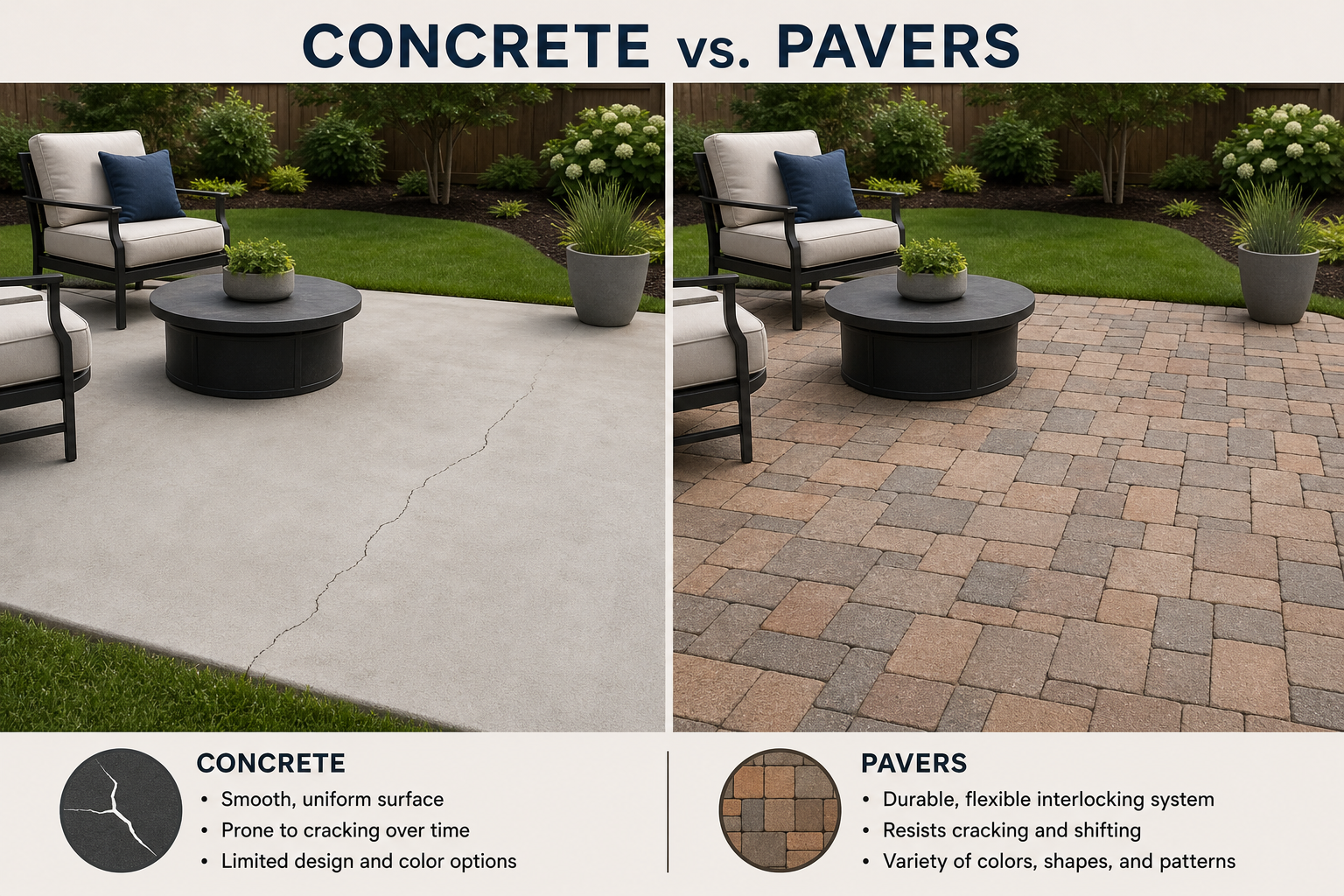
Get an honest assessment of your backyard patio options
Talk to a patio contractor who builds both and can tell you honestly which fits your site.
The fundamental difference between the two surfaces
A poured concrete patio is one continuous rigid slab. Once it sets, it behaves as a single unit: strong, uniform, and relatively fast to install. A paver patio is an assembly of individual interlocking units, typically made from brick, natural stone, or concrete, laid over a compacted base. That structural difference, rigid versus flexible, is the root cause of nearly every practical distinction between the two: how they crack, how they drain, how they age, and how they can be repaired.
Both are legitimate, widely used surfaces. The question is which one fits your specific site, budget, and expectations for the next several decades. Start with the basics of backyard patio design before committing to either material.
How freeze-thaw cycles change the calculation
In southeastern Wisconsin, the ground freezes and thaws repeatedly through winter and early spring. That movement is hard on any patio surface, but it is especially hard on poured concrete. As the ground beneath a slab expands and contracts, the rigid surface cannot flex with it. The result is cracking, frost heaves, and weak spots that develop over time, often within the first two decades of the slab's life.
Pavers handle this differently. Because each unit is independent, the surface can shift slightly with ground movement without fracturing. That flexibility is a meaningful structural advantage in a freeze-thaw climate, not a marketing claim. It is the primary reason pavers are commonly specified for Wisconsin outdoor projects where longevity is a priority.
Lifespan, repairs, and what ownership actually looks like
Poured concrete has a typical lifespan of 20 to 40 years. Pavers, when installed correctly over a properly prepared base, are expected to last closer to 50 years. The gap is real and is largely explained by the flexibility difference described above.
Repairs tell an equally important story. When a concrete slab cracks, patching it requires pouring new material into the damaged area. The patch is always visible because new concrete does not match aged concrete in color or texture. With pavers, a damaged unit can be lifted out and replaced individually. The repair is invisible when complete because the replacement unit sits flush with its neighbors. For homeowners who care about appearance over the long term, that difference matters considerably. Regular sealing helps extend concrete's life, but it does not eliminate the cracking risk that comes with a rigid surface in a cold climate.
Design flexibility and what each surface can accommodate
Concrete offers a clean, uniform look that suits contemporary and minimalist designs. It can be stamped or stained to add visual interest, though those finishes add to the upfront cost and require their own maintenance over time.
Pavers offer considerably more design range. Units come in different sizes, shapes, colors, and materials, including natural stone, so the surface can be laid in patterns, mixed with other hardscape elements, or matched to the architectural character of the house. For a project that integrates a patio with an outdoor kitchen, a fire feature, retaining walls, or seat walls, pavers give a designer more tools to create a coherent, unified space. If you are planning a more involved outdoor living space, that design flexibility often becomes a deciding factor.
Where poured concrete is genuinely the right answer
Concrete is not the wrong choice for every situation. It is faster to install, generally less expensive upfront, and well suited to straightforward rectangular spaces where design complexity is not a priority. For a homeowner on a firm budget who wants a functional surface quickly and plans to sell the property within a decade, concrete may be the more practical option.
The honest caveat is climate. In a freeze-thaw region like Wisconsin, the lower upfront cost of concrete can be offset by earlier repair or replacement needs. Long-term cost comparisons consistently show that initial installation is a larger share of total ownership cost for concrete than for pavers, meaning pavers tend to close the cost gap over time. Neither material is universally cheaper; the right answer depends on your timeline.
Poured concrete vs. paver patio: which fits your situation
Both surfaces are proven options. The right choice depends on your site, your timeline, and how you plan to use the space.
- Poured concrete patio
- Best suited to homeowners with a tight upfront budget or a short ownership timeline who want a functional surface installed quickly.Rigid surface is vulnerable to freeze-thaw cracking; repairs are always visible.
- Paver patio (McGuire Landscape Company)
- Best suited to homeowners planning for long-term performance, phased additions, or sites with slope, drainage, or design complexity.Flexible system resists freeze-thaw damage; individual units replace invisibly.
For a straightforward, budget-first project with a short horizon, poured concrete is a reasonable choice. For a Wisconsin property where longevity, repairability, and integration with a broader outdoor living design matter, a paver patio is the stronger investment, and McGuire Landscape Company builds them on exactly the kinds of sites where that difference shows up most clearly.
A paver surface can shift slightly as the ground freezes and thaws beneath it; a concrete slab cannot, and that single difference explains most of what separates the two materials over time.
How to work through the paver vs. concrete decision
- 1
Assess your site conditions first
Before comparing materials, look at what the ground beneath your patio will actually do. Slope, drainage, and soil type all affect how a patio surface performs over time. A site with poor drainage or significant grade change puts more stress on a rigid concrete slab than on a flexible paver system. If your yard has a slope, you may also need a retaining wall as part of the project, which changes the overall scope and should be factored into the material decision early.
- 2
Set a realistic time horizon
Ask yourself how long you plan to use this patio and what condition you want it in at the end of that period. If your horizon is ten years or fewer and budget is the primary constraint, concrete may serve you well. If you are planning for twenty or more years, or if you want the surface to hold its appearance throughout, the longer lifespan and invisible repairability of pavers become more relevant to the decision. Your backyard renovation plan should account for what comes after the patio too.
- 3
Consider how the patio connects to other elements
A patio rarely exists in isolation. If you are planning to add an outdoor kitchen, fire feature, seat walls, or landscape lighting either now or in future phases, the patio material affects how those elements integrate visually and structurally. Pavers allow phased additions more cleanly because individual units can be lifted and reset as adjacent structures are built. Concrete makes later modifications more disruptive. Thinking through the full outdoor living space before committing to a surface saves significant rework.
- 4
Factor in Wisconsin's climate specifically
Freeze-thaw cycles are not a minor variable in this region. They are a primary driver of concrete cracking and surface degradation. Any contractor quoting a concrete patio in southeastern Wisconsin should be asked directly how they plan to address frost heave risk and what their warranty covers. A paver surface's flexibility is a structural advantage here, not an aesthetic one, and it should weigh heavily in the decision for any homeowner planning to stay in the property long term.
- 5
Get a design-led assessment, not just a material quote
The best way to make this decision is with a contractor who has built both surfaces on sites like yours and can walk through the tradeoffs specific to your yard. A quote that lists a material and a price without addressing drainage, base preparation, or integration with surrounding landscape elements is not enough information to decide well. Visit patio contractor resources or explore backyard patio design ideas to build a clearer picture of what you want before the first conversation.
Benefits
Pavers flex with ground movement
Unlike a rigid concrete slab, a paver surface can shift slightly as the ground freezes and thaws beneath it. That flexibility prevents the cracking and frost heaves that make concrete patios in Wisconsin age faster than their installed cost suggests.
Damaged pavers replace invisibly
A cracked or stained paver unit can be lifted out and swapped individually. The repair leaves no visible seam, which is a meaningful advantage over concrete patching, where new material never matches the color of aged concrete.
Pavers offer a longer expected lifespan
Correctly installed pavers are expected to last close to 50 years. Poured concrete typically reaches the end of its useful life in 20 to 40 years, meaning a paver patio is likely to outlast a concrete slab on the same site by a significant margin.
Design range supports complex outdoor spaces
Pavers come in a wide range of sizes, colors, and materials, including natural stone, and can be laid in multiple patterns. That design flexibility makes it easier to integrate a patio with fire features, outdoor kitchens, and retaining walls as a single coherent system rather than a collection of separate elements.
Drainage passes through the surface
Water can move through the joints between paver units rather than pooling on the surface. On sites with drainage challenges or significant slope, this characteristic reduces erosion, frost heave risk, and standing water problems that a sealed concrete slab would concentrate.
When each material makes the most sense
Sloped backyard with drainage challenges
A homeowner with a yard that drops several feet from the house to the property line faces compounding problems with a poured concrete slab: water pools at low points, freeze-thaw movement is amplified by shifting soil, and any cracking is accelerated. A paver system with properly designed joint spacing allows water to pass through the surface rather than collect on it, reducing both erosion and frost heave risk. Pairing pavers with a retaining wall and integrated drainage makes the site functional in ways a concrete slab cannot match. See how retaining wall costs are structured if a wall is part of your scope.
Patio integrated with a fire feature and seating area
When a patio is designed around a fire pit or outdoor fireplace, the surface material affects both the look and the long-term practicality of the space. Pavers allow the fire feature area to be defined with a distinct pattern or material, creating a visual focal point that a uniform concrete slab cannot replicate without stamping. They also allow the area immediately around the fire feature to be adjusted or replaced if heat or heavy use causes wear. Explore fire pit paver design ideas to see how the two elements work together.
Homeowner planning a phased outdoor living build
Many homeowners build their outdoor space in stages: patio first, then an outdoor kitchen, then lighting and plantings over subsequent seasons. A paver patio supports that approach because individual units can be removed and reset when adjacent structures are added later, without leaving visible evidence of the change. A concrete slab, once poured, is much harder to modify cleanly. If phasing is part of your plan, the patio design process should account for where future elements will land before the first unit is laid.
Budget-focused project with a short ownership timeline
A homeowner planning to sell within several years and primarily wanting a clean, functional outdoor surface may find that poured concrete serves the purpose well. It installs faster, costs less upfront, and presents acceptably in a real estate context if the slab is in good condition. The risk is that cracking can appear sooner in a freeze-thaw climate, which affects both appearance and perceived value at resale. For a short-horizon project, concrete is a reasonable choice as long as the climate risk is understood going in.
Paver patio vs. concrete: common questions answered
Ready to make the right call for your backyard patio
If your backyard project involves a slope, drainage concerns, or plans for future additions like an outdoor kitchen or fire feature, the material decision matters more than it might seem on paper. McGuire Landscape Company designs and builds paver patios across Washington, Waukesha, and Ozaukee Counties, on sites with exactly those kinds of complications. Reach out to talk through what your specific site calls for.
Talk to a patio specialist