

Pavers or Concrete Patio: How to Choose the Right Surface for Your Outdoor Space
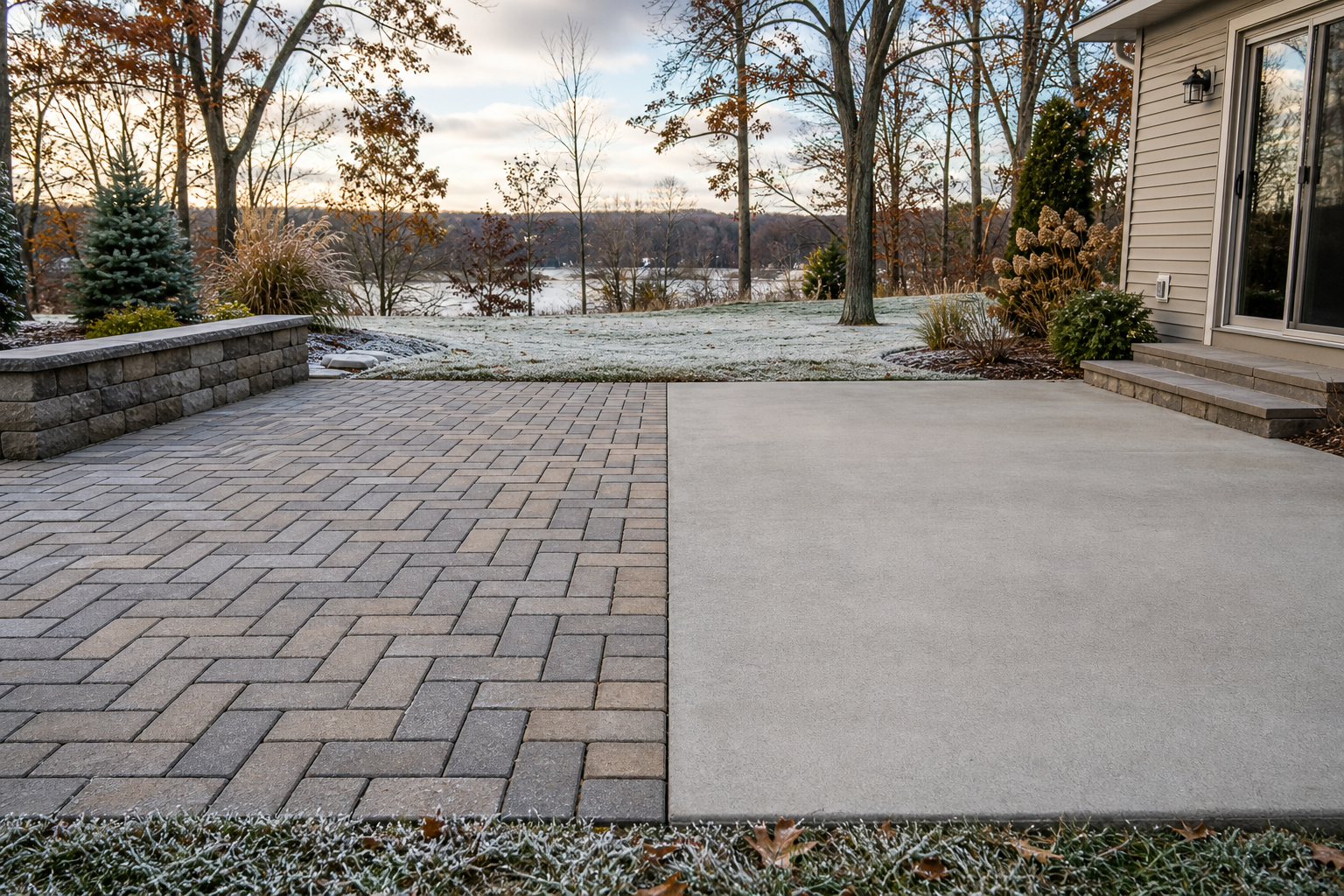
Concrete patio or pavers: the trade-offs that should drive your decision
A clear look at how each surface performs in Wisconsin's climate, what each costs over time, and which fits your outdoor space.
Get expert guidance on your patio surface choice
Talk to McGuire Landscape Company about which surface fits your site, your budget, and your long-term plans.
Two surfaces, two very different long-term stories
Poured concrete and concrete pavers are both legitimate patio materials, and both are widely used. The difference is not quality versus budget. It is a set of genuine trade-offs in how each material behaves over time, especially in a climate where the ground freezes and thaws repeatedly every year. Concrete is installed as a single rigid slab. Pavers are individual units set on a prepared base with joints between them. That structural difference drives almost every other distinction: how each surface cracks, how each is repaired, and how each handles ground movement. Understanding those trade-offs is the real starting point for making the right choice. See backyard and patio design considerations before committing to either material.
How concrete performs and where it struggles
Poured concrete is faster to install than a paver system and typically costs less upfront. For a straightforward, flat site with no complex grade changes, it is a practical and durable surface. Decorative options such as stamped or stained finishes can bring concrete visually closer to the look of pavers, which makes it a reasonable choice for homeowners who want a finished appearance without the higher initial investment.
The challenge in Wisconsin is freeze-thaw cycling. Water that seeps into concrete expands by roughly 9% as it freezes, exerting significant pressure on the slab. Because concrete has no flexibility, that pressure causes cracks. Once a crack forms, water intrusion accelerates each winter and the damage compounds. A penetrating sealer slows water absorption but does not prevent it entirely. When damage reaches a certain point, repairs are difficult to make invisibly. Small cracks can sometimes be patched, but the patch remains visible, and larger damage may require removing and replacing an entire section of the slab.
Why pavers handle ground movement differently
Pavers are not a monolithic structure. The joints between individual units give the surface the ability to flex slightly as the ground shifts, which means freeze-thaw movement that would crack a concrete slab is instead absorbed across those joints without breaking the material. That structural flexibility is the core reason pavers tend to outlast poured concrete on sites with active ground movement or heavy frost.
Repair is also fundamentally different. If a paver becomes damaged or a section settles unevenly, a skilled installer can lift only the affected units, correct the base, and reset the original stones. The repair is virtually invisible because it uses matching material. That repairability is a meaningful long-term advantage, particularly on sites where the ground is not perfectly stable. Paver systems are also available in a wide range of shapes, colors, and patterns, giving homeowners considerably more design flexibility than a plain or stamped concrete slab.
Where the long-term value calculation actually lands
Concrete costs less to install initially, and for homeowners with a tighter near-term budget or a simpler site, that difference is real. But the full cost picture includes repairs over the patio's lifespan. Paver patios typically last 30 to 50 or more years, while concrete patios last 20 to 30 years, and concrete repairs tend to be more disruptive and more expensive relative to the targeted, invisible repairs a paver system allows. On a technically demanding site, such as one with a slope, drainage complexity, or proximity to a shoreline, the base preparation required for a paver installation also provides structural benefits that a poured slab cannot replicate. For those sites, the higher upfront investment in pavers often reflects genuine engineering value, not just aesthetics. Explore how a patio build actually unfolds to understand what that preparation involves.
Where McGuire Landscape Company fits in this choice
McGuire Landscape Company works with both concrete pavers and natural stone, and holds a Belgard Authorized Contractor designation. The company's focus is on sites where the surface material alone is not the whole answer: sloped yards, sites with drainage demands, properties near regulated shorelines, or backyards where a patio needs to connect with retaining walls, outdoor kitchens, fire features, or landscape stairs as a single coordinated system. On those sites, the base engineering, drainage integration, and structural coordination matter as much as the surface itself. A homeowner who needs a straightforward flat patio on a stable site may be well served by a general contractor or a concrete-only installer. A homeowner dealing with grade changes, water management, or a multi-element outdoor space will find that the design-led, coordinated approach McGuire brings is what makes the finished project perform over time. See the full range of outdoor living spaces the company designs and builds.
Poured concrete vs. pavers: who each suits best
Both materials are widely used and both can perform well. The right choice depends on your site, your budget horizon, and how you plan to use the space.
- Poured concrete
- Best for homeowners with a flat, stable site, a tighter upfront budget, and a straightforward surface need without complex grade changes or drainage demands.Lower initial cost but rigid slab is vulnerable to freeze-thaw cracking; repairs are visible and can require full section replacement.
- Stamped or stained concrete
- Suits homeowners who want a decorative finish closer to the look of pavers at a lower installation cost, on a stable site.Visual similarity to pavers does not transfer to structural behavior; the slab remains rigid and carries the same repair limitations.
- Concrete pavers
- Better suited to sites with slope, drainage complexity, or active ground movement, and to homeowners who want design flexibility and long-term repairability.Higher upfront cost; jointed structure absorbs freeze-thaw movement and allows targeted, virtually invisible individual unit replacement.
- McGuire Landscape Company paver and stone patios
- The right fit for homeowners on technically demanding sites in southeastern Wisconsin who need a patio integrated with retaining walls, drainage, outdoor kitchens, fire features, or lakefront conditions as a single coordinated system.Belgard Authorized Contractor; focuses on design-led planning and base engineering for sites where surface material alone is not the whole answer.
Homeowners with a simple, flat site and a priority on lower upfront cost are well served by a concrete installer or general contractor. Homeowners dealing with slope, drainage, freeze-thaw risk, or a multi-element outdoor space in Washington, Waukesha, or Ozaukee County will find McGuire Landscape Company's coordinated, design-led approach is where the real value lies.
The surface you choose today determines how your patio weathers Wisconsin winters for the next several decades.
How to work through the decision
- 1
Assess your site conditions honestly
Start with the physical reality of your property: slope, soil type, drainage patterns, and proximity to water or regulated shorelines. A flat, stable site with good drainage is the most forgiving for either material. A site with grade changes, clay soil, or active water movement puts more stress on any surface, and the base preparation becomes as important as the material on top. On sloped sites, this step may also surface the need for retaining walls, which changes the scope of the project significantly. See retaining wall considerations if your site has meaningful grade changes.
- 2
Weigh upfront cost against long-term repair reality
Concrete costs less to install initially, and that is a legitimate reason to choose it, especially on a stable site where freeze-thaw risk is lower. Pavers cost more upfront but offer targeted, nearly invisible repairs when individual units are damaged, rather than the visible patches or full-section replacements that concrete damage often requires. Run the comparison over the expected lifespan of each surface, not just the installation day, before deciding which budget framing applies to your situation.
- 3
Consider how the patio connects to the rest of the space
A patio rarely exists in isolation. It typically connects to the house, steps down to a lawn, borders a planting bed, or anchors an outdoor kitchen or fire feature. The surface material you choose affects how all those transitions are detailed and how the whole space reads visually. Pavers offer more flexibility for integrating steps, seat walls, and curved edges into a unified design. If your project involves multiple elements, it is worth thinking about the full system before committing to a surface. Browse fire pit patio design ideas to see how surfaces and features work together.
- 4
Factor in Wisconsin's freeze-thaw cycle specifically
Wisconsin's winters produce repeated freeze-thaw cycles that stress rigid surfaces more than climates with stable cold temperatures. Water infiltration into a concrete slab expands as it freezes, and that pressure accumulates over many seasons. Pavers' jointed structure gives them a structural advantage in this specific climate because ground movement is absorbed across joints rather than concentrated in a single slab. This does not mean concrete always fails in Wisconsin, but it does mean the freeze-thaw factor deserves weight in the decision, particularly for a patio expected to last several decades.
- 5
Decide on the design flexibility you actually need
If the visual outcome matters to you, pavers offer a wider range of shapes, colors, patterns, and textures than a poured slab. Stamped concrete can approximate the look of pavers at a lower cost, but the appearance is a surface treatment on a single slab rather than the material itself. For homeowners who want a specific design language across the patio, steps, and surrounding hardscape, pavers give a designer more tools to work with. For homeowners whose priority is a clean, simple surface at a lower initial cost, concrete is a reasonable and widely used choice. See backyard patio design ideas for examples of both approaches.
Benefits
Pavers flex with frost heave
Individual paver units with jointed gaps absorb ground movement from freeze-thaw cycling rather than concentrating stress in a single rigid slab, which is the primary reason paver patios tend to crack less in Wisconsin's climate.
Targeted repairs stay invisible
When a paver is damaged, a skilled installer lifts only the affected units and resets the original stones. The repair is virtually undetectable, unlike concrete patches, which remain visible and may require removing an entire slab section for larger damage.
Longer expected service life
Paver patios typically last 30 to 50 or more years, compared to 20 to 30 years for poured concrete, meaning the higher upfront investment is spread across a longer useful life and fewer major repair or replacement events.
Concrete saves money upfront on simple sites
On a flat, stable site without drainage complexity, poured concrete is a legitimate and cost-effective choice that installs faster and costs less initially, making it suitable for homeowners whose priority is a functional surface at a lower near-term investment.
Pavers offer far more design range
Pavers are available in a wide range of shapes, colors, textures, and patterns, giving designers far more tools to create a cohesive outdoor space than a poured slab allows, even with stamped or stained concrete finishes.
Real situations where the choice becomes clear
Sloped backyard with drainage complexity
A homeowner with a yard that drops several feet from the house to the lawn faces a situation where a poured concrete slab is rarely the right answer. The base preparation for a sloped patio requires grading, compaction, and often a drainage system beneath the surface. Pavers are better suited to this scenario because the installation process already involves building up a structural base layer, and the jointed surface handles any residual ground movement without cracking. McGuire Landscape Company regularly coordinates patio surfaces with retaining walls and drainage systems on exactly these sites. See the patio contractor page for more on how these projects come together.
Flat suburban backyard on a stable site
On a level lot with stable, well-draining soil, poured concrete performs well and costs less to install. A homeowner whose priority is a clean, functional surface for a straightforward outdoor space, without grade changes or drainage demands, may find that concrete meets their needs at a lower initial investment. Stamped or stained finishes can add visual interest. This is a situation where concrete is a legitimate and sensible choice, and where a general concrete contractor may be as appropriate as a full-service hardscape company.
Outdoor kitchen and fire feature patio integration
A homeowner planning an outdoor kitchen, fire feature, and patio as a single space needs a surface that integrates cleanly with the structural footings, gas lines, and drainage those elements require. Pavers are easier to lift and reset if any utility work needs to happen beneath the surface after installation. The design flexibility of pavers also allows the surface pattern to reinforce the layout, defining zones for cooking, seating, and fire without requiring separate materials. McGuire designs and builds these integrated systems as a single coordinated project. Explore fire pit paver ideas for design approaches.
Lakefront patio near a regulated shoreline
A lakefront homeowner building a patio near the water faces site conditions that amplify every challenge: soil saturation, frost heave, shoreland setback requirements, and often restricted equipment access. Pavers are the stronger choice on these sites because the base system can be engineered for drainage and the surface can absorb ground movement without cracking. McGuire Landscape Company coordinates Wisconsin DNR permit requirements alongside the hardscape design on lakefront projects, which means the patio is planned in the context of the full site rather than added on afterward. See the outdoor living spaces hub for more on how lakefront projects are approached.
Pavers or concrete patio: common questions answered
Ready to choose the right surface for your outdoor space
McGuire Landscape Company designs and builds paver patios, natural stone surfaces, and integrated outdoor living spaces across Washington, Waukesha, and Ozaukee Counties. If your site involves a slope, drainage demands, or a multi-element outdoor space, reach out to talk through what the right surface and system looks like for your specific property.
Start your patio project