

Pavers vs. Concrete Patio: A Side-by-Side Comparison for Homeowners
Concrete patio or pavers: what the real differences mean for your yard
A side-by-side look at cost, durability, repairability, and long-term performance to help you decide.
Get a patio built to handle Wisconsin's seasons
Compare both options clearly and see which patio surface fits your site, your budget, and southeastern Wisconsin winters.
The core trade-off every homeowner faces
Poured concrete and concrete or brick pavers are the two most common residential patio surfaces, and the choice between them comes down to four things: upfront cost, long-term durability, how each material handles damage, and how much design flexibility you want. Concrete wins on initial installation cost and speed. Pavers cost more at the outset but offer advantages that compound over time, particularly in climates where the ground moves. For homeowners in southeastern Wisconsin, that ground movement is not a theoretical concern. Freeze-thaw cycles are among the most common causes of concrete cracking, and small cracks tend to grow wider and longer over successive winters. Understanding both materials clearly is the only way to make a choice you won't regret in year five or ten. See backyard and patio design considerations before committing to either surface.
Why concrete is a legitimate choice for many homeowners
A poured concrete patio is a single monolithic slab. It installs faster than pavers, requires less labor to lay, and the upfront cost is typically lower per square foot. For a homeowner working within a tight budget who wants a clean, flat surface quickly, concrete is a rational choice. It is also well suited to very large, simple rectangular areas where design flexibility matters less than coverage. Concrete is durable, and a well-installed slab with proper drainage and sealing can perform well for decades. Maintenance involves sealing every two to three years to reduce staining and surface wear, and repairing small cracks promptly before water infiltration makes them worse. On a flat, well-drained site with stable soil, concrete can be a perfectly serviceable patio surface.
Where concrete struggles in Wisconsin's climate
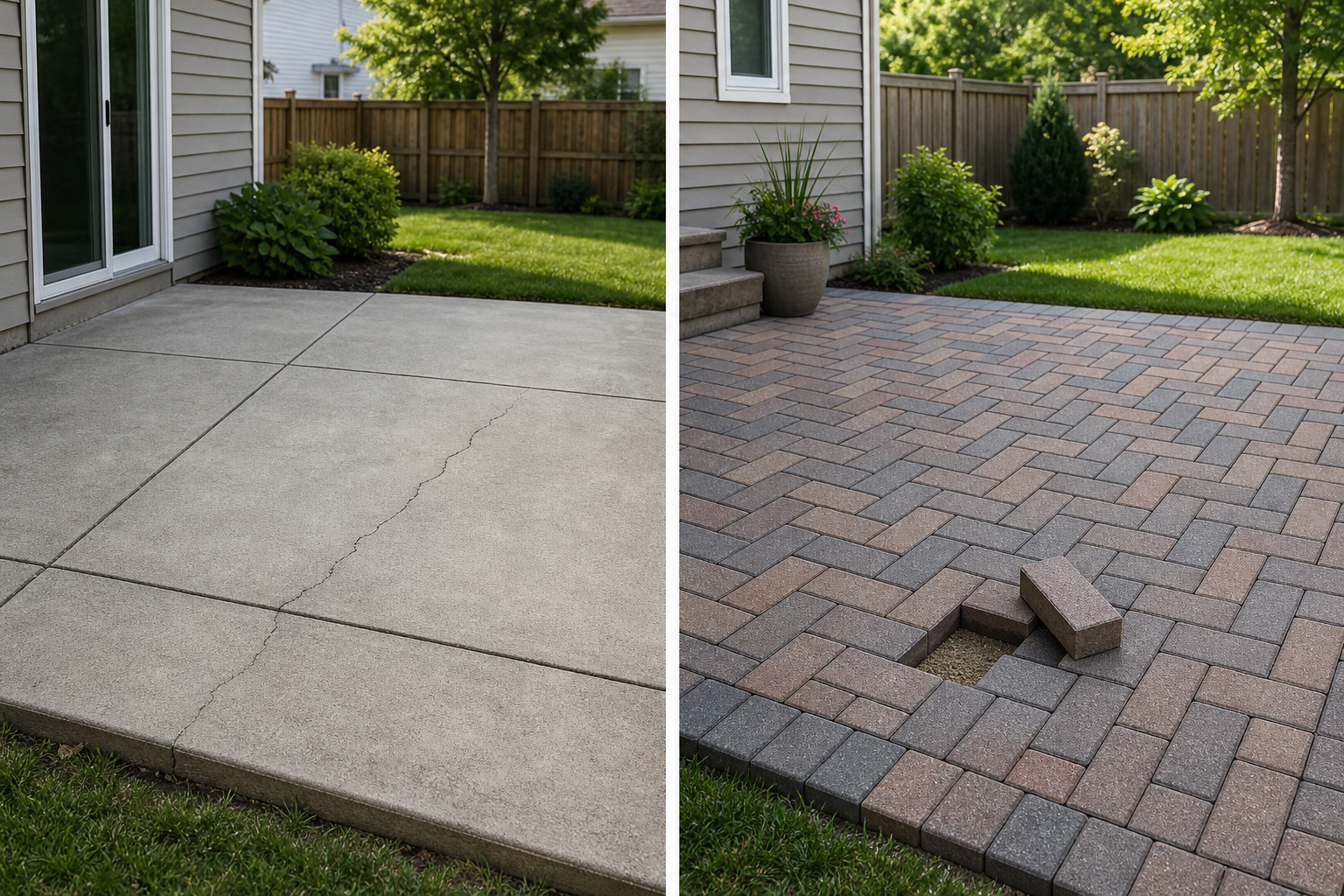
The problem with a monolithic slab is that it cannot flex. When soil shifts beneath it or water penetrates the surface and freezes, the slab cracks. Water that soaks into concrete expands when it freezes, causing cracking and spalling, and deicing salts used in Wisconsin winters accelerate surface deterioration further. Once a crack forms, it rarely stays small. Water enters the crack, freezes, and widens it the following winter. Repairing a concrete section is also conspicuous: the patched area almost never matches the color and texture of the original pour, so the repair is always visible. On sloped sites, sites with clay-heavy soil, or any property near a shoreline where ground saturation is common, these vulnerabilities are amplified.
What pavers do differently and why it matters
Pavers are individual units, brick, natural stone, or manufactured concrete, installed on a compacted base with joints between them. Those joints are the key structural feature. Because each unit can shift slightly without transferring stress to its neighbors, the surface accommodates ground movement that would crack a monolithic slab. The result is a surface that is less prone to cracking in freeze-thaw climates. When a paver does settle or crack, the repair is straightforward: lift the affected unit, address the base if needed, and set a replacement. The repair is invisible once complete. Pavers also offer far more design flexibility than poured concrete: pattern, color, unit size, and material can all be varied within a single installation, which matters when the patio is part of a larger outdoor living space that includes a kitchen, fire feature, or lighting system.
Long-term cost is not the same as upfront cost
Pavers cost more to install initially. That is a real difference and worth acknowledging honestly. But the long-term picture is more nuanced. Replacing an individual damaged paver is significantly cheaper than repairing or resurfacing a cracked concrete section, and paver repairs do not leave visible patches. Pavers also carry a longer potential lifespan. For a homeowner planning to stay in their home for many years, or one investing in a backyard renovation that includes multiple coordinated elements, the higher upfront cost of pavers often makes sense over a ten- or twenty-year horizon. The honest answer is that neither material is universally better: the right choice depends on your site, your budget timeline, and what you want the space to do.
Pavers vs. concrete patio: which suits your project
Both materials are widely used for residential patios. The right choice depends on your site, your budget timeline, and what you want the space to do.
- Poured concrete
- Best suited to homeowners with flat, stable, well-drained sites who are optimizing for the lowest upfront installation cost.Lower initial cost, but cracks are difficult to repair invisibly and freeze-thaw cycles are a long-term risk.
- Concrete or brick pavers
- Best suited to homeowners on sloped, clay-heavy, or freeze-thaw-exposed sites, or those planning a multi-element outdoor space with an outdoor kitchen, fire feature, or lighting.Higher upfront cost, but individual units can be replaced invisibly and the surface flexes with ground movement.
- McGuire Landscape Company paver installation
- Best suited to homeowners in southeastern Wisconsin with technically demanding sites, phased renovation plans, or coordinated outdoor living projects that include hardscape, drainage, retaining walls, and outdoor amenities.Belgard Authorized Contractor with experience on sloped, lakefront, and drainage-challenged sites across Washington, Waukesha, and Ozaukee Counties.
Choose poured concrete if your site is flat and stable and upfront cost is the primary constraint. Choose pavers if your site has slope, drainage challenges, or freeze-thaw exposure, or if the patio is part of a larger outdoor system. Choose McGuire Landscape Company if your project is in southeastern Wisconsin and involves a technically demanding site or a coordinated multi-element outdoor living space.
The joint between each paver unit is not a flaw in the design; it is the design, allowing the surface to flex with ground movement instead of cracking across it.
How to choose between pavers and concrete
- 1
Assess your site conditions honestly
Start with what is under and around the patio, not what it will look like. Soil type, drainage, slope, and proximity to water all affect which material will perform better long-term. Clay-heavy soil expands and contracts with moisture changes. Sloped sites concentrate water runoff. Sites near lakes or low-lying areas experience higher ground saturation. On sites with these characteristics, a material that can flex with movement, pavers, is the more resilient choice. See how landscape stairs and grade changes factor into a sloped site plan.
- 2
Clarify your budget timeline
Concrete costs less upfront; pavers cost more initially but tend to be cheaper to repair over time. Be honest about whether you are optimizing for the lowest cost today or the lowest total cost over the life of the patio. A homeowner planning to sell in a few years may weigh the calculation differently than one planning a long-term outdoor living space with multiple phases. Neither answer is wrong, but they lead to different choices.
- 3
Decide how much design flexibility you need
A concrete slab offers limited design variation: color can be added, but the form is essentially a flat rectangle. Pavers can be laid in multiple patterns, combined with natural stone, and varied in size and color across different zones of the same patio. If the patio will integrate with an outdoor kitchen, fire feature, or seating walls, the ability to define distinct zones through pattern and material is a practical advantage, not just an aesthetic one. Review fire pit paver ideas to see how pavers work within a larger hardscape system.
- 4
Think through long-term maintenance realistically
Both surfaces require maintenance. Concrete needs sealing every two to three years and prompt crack repair to prevent water infiltration from widening damage. Pavers need occasional re-sanding of joints and periodic releveling if the base shifts. Neither surface is maintenance-free, but the consequences of deferred maintenance differ: a neglected concrete crack can propagate across the slab, while a settled paver can be releveled without disturbing the surrounding surface. Factor in how much time and attention you realistically want to give the surface over the years.
- 5
Consider the full outdoor system, not just the patio
A patio rarely exists in isolation. If the project includes retaining walls, drainage, lighting, a fire feature, or an outdoor kitchen, the patio surface is one component of a coordinated system. In that context, material choice affects how all the other elements connect visually and structurally. Pavers offer more integration points for transitions, borders, and zone definition. Before finalizing a material, think through the full scope of the project. The patio contractor you work with should be helping you see those connections before construction begins.
Benefits
Pavers flex; concrete fractures
Because pavers are individual units with joints between them, the surface can move slightly with ground shifts and freeze-thaw cycles without cracking across the installation the way a monolithic concrete slab does.
Paver repairs are invisible
A damaged or settled paver can be lifted, the base corrected, and a replacement unit set in place. The repair blends completely with the surrounding surface, unlike concrete patches, which almost never match the original pour's color and texture.
Design flexibility is built in
Pavers can be laid in multiple patterns, combined with natural stone, and varied in color and size across zones of the same patio. A coordinated hardscape system with an outdoor kitchen, fire feature, and lighting integrates more naturally with a paver surface than with a plain concrete slab.
Concrete has a genuine upfront cost advantage
For a homeowner optimizing for the lowest installation cost on a stable, well-drained site, concrete is the more economical choice at the point of installation. That advantage is real and should not be dismissed.
Long-term cost favors pavers on difficult sites
On sites with clay soil, slope, or freeze-thaw exposure, concrete's repair costs and the visibility of those repairs shift the long-term cost picture. Replacing individual pavers as needed is typically less expensive than resurfacing or repairing a cracked concrete slab.
When each material makes the most sense
Flat suburban yard with stable soil and a tight budget
A homeowner on a flat lot with well-draining sandy or loamy soil and a firm budget ceiling is a reasonable candidate for poured concrete. The site does not amplify concrete's main vulnerabilities, and the lower upfront cost is a real advantage. A properly sealed and maintained slab on a stable base can perform well for many years. This is the situation where concrete is genuinely the stronger choice, and it would be dishonest to say otherwise.
Sloped backyard with clay soil and drainage challenges
A homeowner on a sloped lot with clay-heavy soil faces exactly the conditions that cause concrete to crack: ground that expands and contracts with moisture, water that concentrates at the base of the slope, and freeze-thaw cycles that exploit any crack that forms. Pavers installed on a properly compacted base handle these conditions better because the joints between units allow the surface to flex rather than fracture. This site is a strong candidate for pavers, and the retaining walls and drainage work that often accompany a sloped-yard patio project are best planned as part of the same coordinated design.
Lakefront property with a multi-element outdoor space
A lakefront homeowner designing a patio that connects to a boathouse, an outdoor kitchen, and a fire feature has a project where design flexibility and long-term repairability both matter. Pavers allow the patio to define distinct zones for cooking, dining, and gathering around a fire, and individual units can be lifted to address drainage or base issues without tearing up the entire surface. For a property that will be used heavily and maintained over decades, pavers are the more practical surface. See fire pit patio ideas for how a paver surface supports a year-round outdoor gathering space.
Homeowner planning a phased backyard renovation
A homeowner who plans to add an outdoor kitchen, lighting, or seating walls in a later phase benefits from starting with a paver patio. Pavers can be lifted and reset to accommodate new footings, conduit runs, or drainage modifications without leaving a visible patch. A concrete slab, once poured, is much harder to modify without visible disruption. If the project scope is likely to grow over time, starting with a material that accommodates change is a practical investment. Explore backyard patio design ideas for how phased projects come together.
Common questions about pavers vs. concrete patio
Ready to choose the right patio surface for your site
McGuire Landscape Company designs and builds paver patios and coordinated outdoor living spaces for homeowners in Washington, Waukesha, and Ozaukee Counties. If your site has a slope, drainage demands, or a plan that includes an outdoor kitchen, fire feature, or retaining walls, talk to us before you commit to a material. We can walk through your site conditions and help you understand which surface makes sense for your specific situation.
Talk to a patio contractor