

Pavers vs. Stamped Concrete: Comparing Durability, Maintenance, and Value
Which lasts longer through Wisconsin winters: pavers or stamped concrete?
An honest look at durability, maintenance demands, and long-term value for southeastern Wisconsin homeowners.
Get clarity on the right hardscape material for your property
Talk through your specific site, soil, and goals with a contractor who builds in Wisconsin's freeze-thaw climate every season.
Two different approaches to the same surface
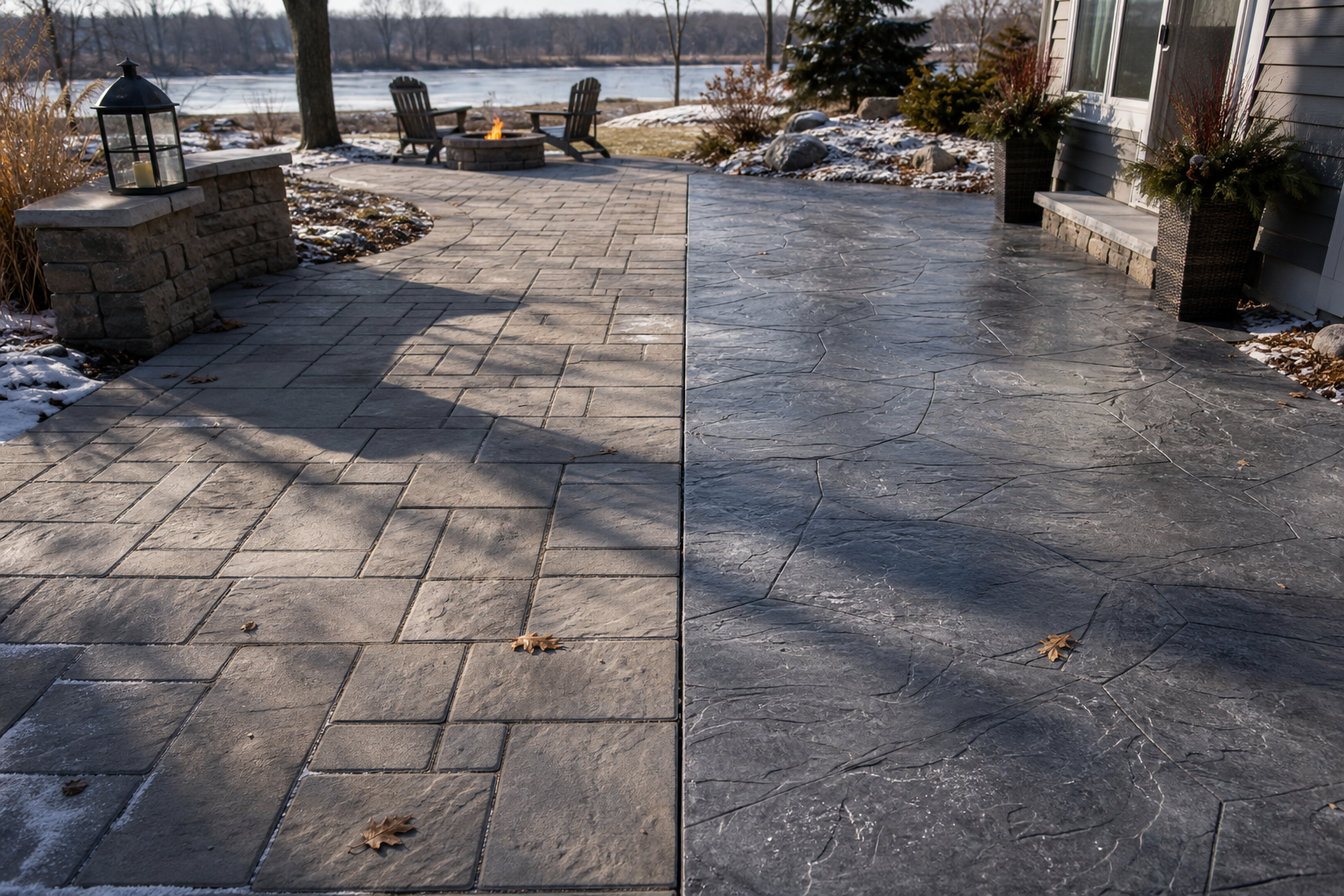
Pavers are individual units, made from concrete, brick, or natural stone, that are laid separately on a compacted base of gravel and bedding sand. Each unit sits independently, which is the structural fact that shapes almost every other difference between the two materials. Stamped concrete, by contrast, is poured as a continuous slab, then pressed with textured molds and colored to mimic stone, brick, or tile while the concrete is still wet. The result is a single, seamless surface that can be visually convincing at a fraction of the installation complexity. Both approaches can produce a finished patio, driveway, or walkway that looks intentional and well-made. The difference is not aesthetic at the moment of installation. It shows up over years of use, seasonal stress, and the occasional repair. Before committing to either, it helps to read through what to know before you build a patio or backyard space so the structural decisions are made before the material ones.
How Wisconsin winters test each material differently
Freeze-thaw cycles are the defining stress test for any outdoor hardscape in southeastern Wisconsin. Water infiltrates tiny surface openings, freezes, expands, and if the material cannot flex, it fractures. Stamped concrete, as a monolithic slab, has no joints to absorb movement. Surface fissures develop under repeated freeze-thaw stress, and once a crack forms, moisture enters more aggressively each subsequent winter, widening the damage season by season. Pavers handle this differently because the joints between individual units allow slight movement. Ground shifting and thermal expansion are distributed across dozens of small gaps rather than concentrated in one place. This is why pavers are broadly considered better suited to cold climates with significant freeze-thaw cycling. Stamped concrete can perform well when installed with fiber mesh reinforcement and sealed properly, but that performance depends heavily on installation quality and consistent maintenance from the first year forward. On sites with unstable soil, steep grades, or proximity to water, the flexibility of a paver system becomes even more consequential. McGuire Landscape Company works on exactly those kinds of sites across Washington, Waukesha, and Ozaukee Counties, where erosion control and drainage are often part of the same project as the hardscape itself.
Maintenance and repairs over the life of the surface
Stamped concrete requires resealing every two to three years to preserve its color and protect the surface from moisture penetration. Skipping a resealing cycle does not cause immediate failure, but it accelerates fading and increases the risk of cracking. When stamped concrete does crack or chip, repairs are difficult to make invisibly. Patches rarely match the original color and texture, because the surrounding surface has weathered differently, and the stamped pattern cannot be perfectly replicated in a small area. Pavers have their own maintenance demands. Joint sand needs periodic replenishment to prevent weed growth and shifting. Individual units can settle unevenly and may need to be lifted and reset. Power washing and occasional resealing are part of a responsible maintenance routine. The meaningful difference is what happens when something goes wrong. A damaged paver is replaced individually, matching the original unit, with no visible seam or patch line. That repairability is one of the reasons homeowners on high-use surfaces, driveways, lakefront walkways, and entertaining patios, tend to favor pavers for the long term. For patio design ideas that account for maintenance from the start, paver patio design ideas and inspiration is a useful reference.
Long-term value and where each material makes sense
Stamped concrete typically costs less to install upfront than pavers for the same square footage. For homeowners with a fixed budget and a stable, flat site in a mild climate, that lower initial outlay is a real advantage. The trade-off is that long-term costs accumulate through resealing, crack repair, and, in some cases, full replacement before the surface reaches the end of its potential lifespan. Pavers can last 50 years or more when properly installed, handling temperature changes and heavy use without the structural vulnerability of a monolithic slab. Stamped concrete averages around 25 years under typical outdoor conditions. Over a long ownership horizon, the higher upfront investment in pavers often produces a lower total cost, particularly on sites where repairs would be frequent or disruptive. The right choice depends on site conditions, intended use, and how long the homeowner plans to stay. A suburban homeowner planning a short-term improvement before selling may reasonably choose stamped concrete. A lakefront homeowner building a patio meant to last decades on shifting soil near water is likely better served by pavers. McGuire Landscape Company holds a Belgard Authorized Contractor designation and works with concrete pavers on outdoor living spaces designed to perform through Wisconsin's full seasonal range.
Pavers vs. stamped concrete: which suits your project
Both materials can produce an attractive finished surface. The differences show up in how each performs over time, particularly in Wisconsin's freeze-thaw climate.
- Stamped concrete
- Best suited to homeowners with a shorter time horizon, a flat stable site, and a preference for a seamless, uniform appearance at a lower upfront installation cost.Requires resealing every 2-3 years; cracks are difficult to repair invisibly on a monolithic slab.
- Concrete pavers
- Best suited to homeowners prioritizing long-term durability, freeze-thaw resilience, and the ability to repair individual units without visible patching.Higher upfront cost; documented lifespan of 50 years or more with proper installation and base preparation.
- Pavers by McGuire Landscape Company
- The right fit for southeastern Wisconsin homeowners on challenging sites, including lakefront properties, sloped grades, and drainage-sensitive lots, where a coordinated, design-led approach to the full hardscape system matters.Belgard Authorized Contractor; integrates hardscape with drainage, erosion control, and site grading as a single coordinated project.
Stamped concrete is a reasonable choice for a homeowner with a stable, flat site and a shorter ownership horizon. Pavers are the stronger choice for Wisconsin properties where freeze-thaw performance, long-term durability, and invisible repairability are priorities. McGuire Landscape Company is the right contractor for homeowners whose sites present real complexity, steep grades, shifting lakefront soil, drainage demands, or the need to coordinate hardscape with broader landscape systems.
The surface that costs less to install is not always the surface that costs less to own over twenty years in a Wisconsin climate.
Benefits
Individual unit replacement
When a paver cracks or settles, only that unit is replaced, leaving the surrounding surface untouched and the repair invisible. Stamped concrete patches are rarely an exact match to the weathered original.
Freeze-thaw resilience
Paver joints absorb the ground movement and thermal expansion that crack monolithic slabs. This structural flexibility makes pavers better suited to Wisconsin's repeated freeze-thaw cycles than a continuous poured surface.
No mandatory resealing cycle
Stamped concrete requires resealing every two to three years to hold its color and resist moisture. Pavers do not carry the same mandatory maintenance schedule, reducing the ongoing time and cost commitment over the life of the surface.
Longer documented lifespan
Pavers can last 50 years or more under regular use and Wisconsin conditions. Stamped concrete averages around 25 years, meaning a paver installation may outlast two full stamped concrete lifecycles on the same site.
Where each material fits best
Lakefront patio on shifting, saturated soil
A homeowner on a southeastern Wisconsin lake wants a patio adjacent to the shoreline, where soil moisture is high, grades shift seasonally, and the ground never fully stabilizes. On this kind of site, a monolithic stamped concrete slab is at significant risk of cracking as the ground moves beneath it. Pavers, with their jointed, flexible structure, absorb that movement without fracturing, and individual units can be reset if settling occurs without disturbing the rest of the surface. McGuire Landscape Company regularly integrates patio hardscaping with shoreline restoration and drainage work on exactly these sites, treating the patio, the grade, and the water management as a single coordinated system rather than separate projects.
Suburban driveway with heavy daily use
A homeowner in Waukesha or Washington County wants to replace an aging concrete driveway that has developed a network of surface cracks over years of freeze-thaw cycling. Stamped concrete is an option, but on a high-load surface exposed to road salt, snowplow contact, and repeated thermal stress, the risk of cracking returns. Pavers distribute vehicle load across individual units and joints, reducing the concentration of stress that causes slab fractures. If a paver unit does crack under an exceptionally heavy load, it is replaced alone, without disturbing the surrounding surface. For a driveway meant to last through decades of Wisconsin winters, the modular structure of pavers is a practical advantage.
Poolside or entertaining patio where aesthetics matter
A homeowner wants a poolside patio or backyard entertaining space where appearance is a priority alongside function. Stamped concrete offers a seamless, visually uniform surface that can be genuinely attractive at installation, and for a homeowner planning to sell within a few years, the lower upfront cost may make it the right call. Pavers offer more design flexibility, with patterns, colors, and border treatments that can be adjusted over time, and repairs that stay invisible. For an entertaining space built around a fire feature or outdoor kitchen, fire pit paver ideas shows how pavers integrate naturally with the surrounding hardscape elements. The homeowner's time horizon and how much visible patching would bother them are often the deciding factors here.
Pavers vs. stamped concrete: common questions answered
Ready to choose the right hardscape for your Wisconsin property
Pavers and stamped concrete each have a place, and the right answer depends on your site, your soil, and how long you plan to be there. McGuire Landscape Company works with homeowners across Washington, Waukesha, and Ozaukee Counties to design hardscapes that hold up through Wisconsin's full seasonal range. Reach out to talk through your specific project.
Request a site consultation