

Stamped Concrete vs. Concrete Pavers: Which Holds Up Better Over Time?
Stamped concrete or pavers: which actually survives a Wisconsin winter?
A straight comparison of long-term durability, repairability, and maintenance so you can choose with confidence.
Choose the right hardscape material for your site
Compare how stamped concrete and concrete pavers hold up over decades on real Wisconsin sites before you commit to either.
One slab versus many units: why structure drives everything
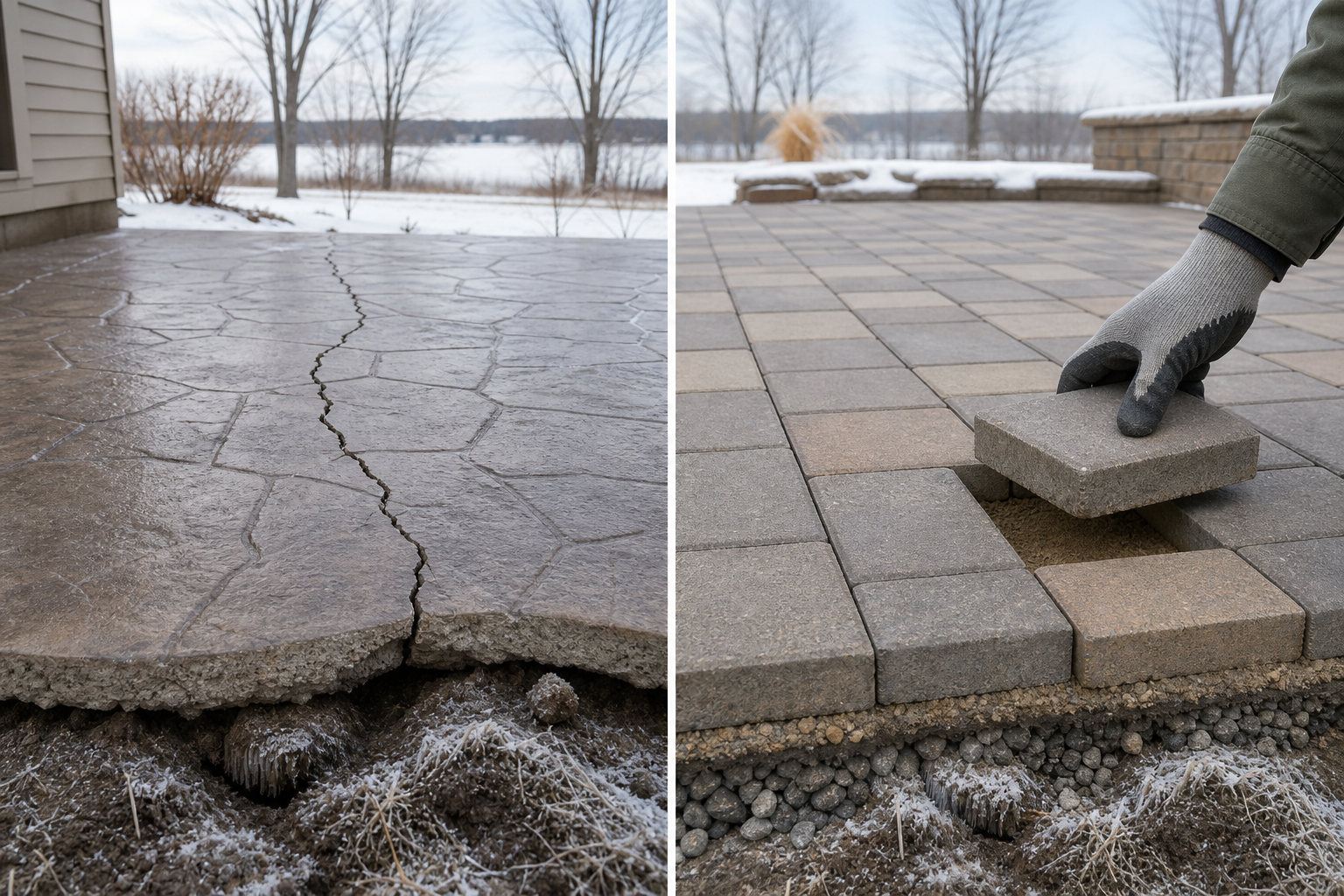
The most important difference between stamped concrete and concrete pavers is not aesthetic. It is structural. Stamped concrete is poured as a single monolithic slab and then imprinted with a pattern while the material is still curing. The finished surface is one continuous piece. Concrete pavers, by contrast, are individual manufactured units set side by side with joints between them, fitting together like a puzzle rather than fusing into a single mass.
That distinction controls how each surface responds to every force acting on it: ground movement, temperature swing, soil settlement, and water pressure. A slab moves as one unit. When one section heaves, shifts, or cracks, the stress travels across the entire surface. Individual pavers can shift, flex, and be reset independently without the failure spreading. For a patio contractor working on sites with variable soils or slope, that structural flexibility is not a minor detail. It determines whether a surface holds together over decades or requires significant intervention within a few years.
Cracking, freeze-thaw cycles, and the Wisconsin factor
Wisconsin's climate puts hardscape under sustained pressure. Freeze-thaw cycles drive water into the surface, expand it as it freezes, and contract it as it thaws. Repeat that process across hundreds of cycles and the cumulative stress on a rigid slab is substantial. Stamped concrete lasts roughly 25 to 30 years under normal conditions, but its single-slab construction means it expands when heated and contracts when cooled, and those repeated cycles create stress that concentrates wherever movement is restricted.
Concrete pavers flex with the ground because the joints between units absorb movement rather than transmitting it. Once paver units are fully cured, they carry a pressure tolerance that is more than twice the rating for standard cement mixes used in stamped concrete. That physical margin matters on sites with shifting soils, drainage demands, or steep grades. For lakefront properties in Washington, Waukesha, and Ozaukee Counties where soil conditions vary and shoreline movement is a real factor, that resilience is directly relevant. Pavers are also documented to last 50 or more years, handling temperature changes and heavy use without the cracking that tends to develop in monolithic slabs over time.
Repair and maintenance: what each option actually requires
Maintenance obligations differ sharply between the two materials. Stamped concrete should be resealed every two to three years to protect its surface color and texture, and it requires cleaning, particularly in high-traffic areas. The deeper issue is repairability: once stamped concrete cracks, the repair is visible. Matching the original color and texture of a cured, weathered slab is difficult, and most repairs leave a noticeable patch. That is not a minor cosmetic concern on a patio that represents a significant investment.
Pavers carry their own maintenance demands. Joint sand erodes gradually from rain and traffic, and if the sand level drops too low, individual units can begin to loosen. Pavers should be sealed roughly 60 to 90 days after installation and resealed every three to five years. Weeds can establish in joints if maintenance is deferred. The key advantage is replaceability: a damaged or stained paver can be lifted and swapped out without disturbing the surrounding surface. For a backyard renovation built to last across multiple decades, that ability to make targeted repairs without visible seams is a meaningful long-term advantage.
Where McGuire Landscape Company fits into this decision
Both materials are legitimate choices, and stamped concrete is genuinely the right answer for some projects: it performs well on stable, flat sites with consistent soil, it produces a seamless surface that resists weed intrusion without joint maintenance, and for homeowners who prefer a lower-profile maintenance schedule over the first decade, it can be a practical fit.
McGuire Landscape Company builds with concrete pavers and natural stone because the sites it works on in southeastern Wisconsin consistently present the conditions where paver performance advantages are most consequential: shifting soils near shorelines, steep grades requiring integrated drainage, phased builds where sections are added over time, and outdoor living systems where a fire feature, kitchen, and patio need to function as a coordinated whole. The company holds a Belgard Authorized Contractor designation, which reflects a specific level of technical knowledge in paver installation. On a technically demanding site, the material choice and the installer's command of it are inseparable. You can read more about how these systems come together in backyard and patio design planning before committing to either direction.
Stamped concrete vs. concrete pavers: which suits your site
Both options are legitimate for the right site and the right homeowner. Here is where each one genuinely fits.
- Stamped concrete
- Best suited to homeowners on stable, flat inland sites who want a seamless surface with minimal joint maintenance over the first decade.Single slab construction resists weed intrusion but concentrates cracking risk; repairs are typically visible.
- Concrete pavers (McGuire Landscape Company)
- Best suited to homeowners on lakefront, sloped, or technically demanding sites in southeastern Wisconsin who need freeze-thaw resilience, drainage integration, and the ability to repair or extend the surface over time.Individual units flex with ground movement, can be replaced without visible seams, and accommodate phased outdoor living builds.
Choose stamped concrete if your site is flat, stable, and your priority is a seamless surface with lower upfront complexity. Choose concrete pavers, and McGuire Landscape Company, if your site involves shifting soils, shoreline proximity, slope, drainage demands, or a phased build where long-term repairability and freeze-thaw performance matter most.
On a site with shifting soils, freeze-thaw pressure, and a 30-year horizon, the gap between a slab and individual units is not a style question - it is a structural one.
Benefits
Individual unit replaceability
A cracked or stained paver can be lifted and replaced without disturbing the rest of the surface. Stamped concrete repairs are almost always visible, making pavers the lower long-term risk for surfaces that need to look good for decades.
Freeze-thaw resilience
Paver joints absorb the expansion and contraction that rigid slabs must resist. On Wisconsin sites that cycle through hundreds of freeze-thaw events, that flexibility directly reduces cracking risk over the life of the installation.
Drainage integration
Joints between pavers allow water to move through or around the surface rather than pooling on top of it. On sloped sites or properties with existing drainage demands, permeable paver systems can be engineered into a broader drainage solution rather than added as an afterthought.
Design versatility across phases
Individual units can be set in a wide range of patterns and can be extended or reconfigured when a project is built in phases. A patio installed today can connect cleanly to an outdoor kitchen or fire feature added later without the seam issues that arise when expanding a poured slab.
Documented longevity on demanding sites
Concrete pavers are documented to last 50 or more years on well-prepared bases, and individual paver units often outlast the base beneath them. That longevity record matters most on lakefront and sloped sites where installation quality and material durability are directly tested by site conditions.
How the choice plays out on real sites
Lakefront patio on shifting shoreline soils
A lakefront homeowner in Ozaukee County wants a patio adjacent to a seawall where soil conditions vary seasonally and ground movement near the water is an ongoing reality. On a site like this, a monolithic stamped concrete slab is a genuine liability: any soil shift concentrates stress across the entire surface, and a crack near the water's edge is difficult to repair without a visible patch. Concrete pavers, set on a properly engineered base with integrated drainage, flex with minor ground movement and allow targeted repairs if any section settles. For homeowners navigating these conditions alongside shoreline restoration or seawall work, the paver approach fits naturally into a coordinated site plan.
Sloped suburban backyard with retaining walls
A homeowner in Washington County has a backyard that drops sharply from the house, requiring retaining walls to create usable terraced space before any patio surface can be installed. The retaining wall system will settle and adjust slightly over the first few seasons as the soil behind it consolidates. Stamped concrete poured over a base that is still stabilizing is a high-risk choice: settlement cracks in the slab are likely and hard to fix invisibly. Concrete pavers tolerate minor movement in the base without surface failure, and if a section needs to be releveled, individual units can be lifted, the base corrected, and the pavers reset. This is the kind of technically layered project that McGuire Landscape Company is specifically built for, combining landscape stairs, retaining walls, and paver surfaces into a single coordinated system.
Phased outdoor living build over multiple seasons
A Waukesha County homeowner plans to build an outdoor living space in stages: a patio this season, an outdoor kitchen addition next year, and a fire feature the season after. Stamped concrete makes phased construction difficult because expanding a cured slab cleanly is nearly impossible without a visible seam at the joint. Concrete pavers accommodate phased builds naturally: the pattern can be extended, the new section ties into the existing field, and the surface reads as continuous. For homeowners planning a coordinated outdoor kitchen, fire feature, and patio system over time, pavers give the design the flexibility to grow without visual compromise. You can explore how these elements come together in fire pit patio ideas for additional context.
Stamped concrete vs. concrete pavers: questions worth answering
Ready to choose the right material for your site
If you are weighing these two materials for a patio, lakefront space, or outdoor living system in southeastern Wisconsin, the site conditions matter as much as the material itself. McGuire Landscape Company works specifically on the kinds of technically demanding sites where that distinction is most consequential. Reach out to talk through what your site actually requires.
Talk to a patio specialist