

Stamped Concrete vs. Pavers: A Practical Comparison for Outdoor Patios
Stamped concrete or pavers: which patio surface holds up in Wisconsin?
A practical, climate-honest comparison to help southeastern Wisconsin homeowners choose the right hard surface before breaking ground.
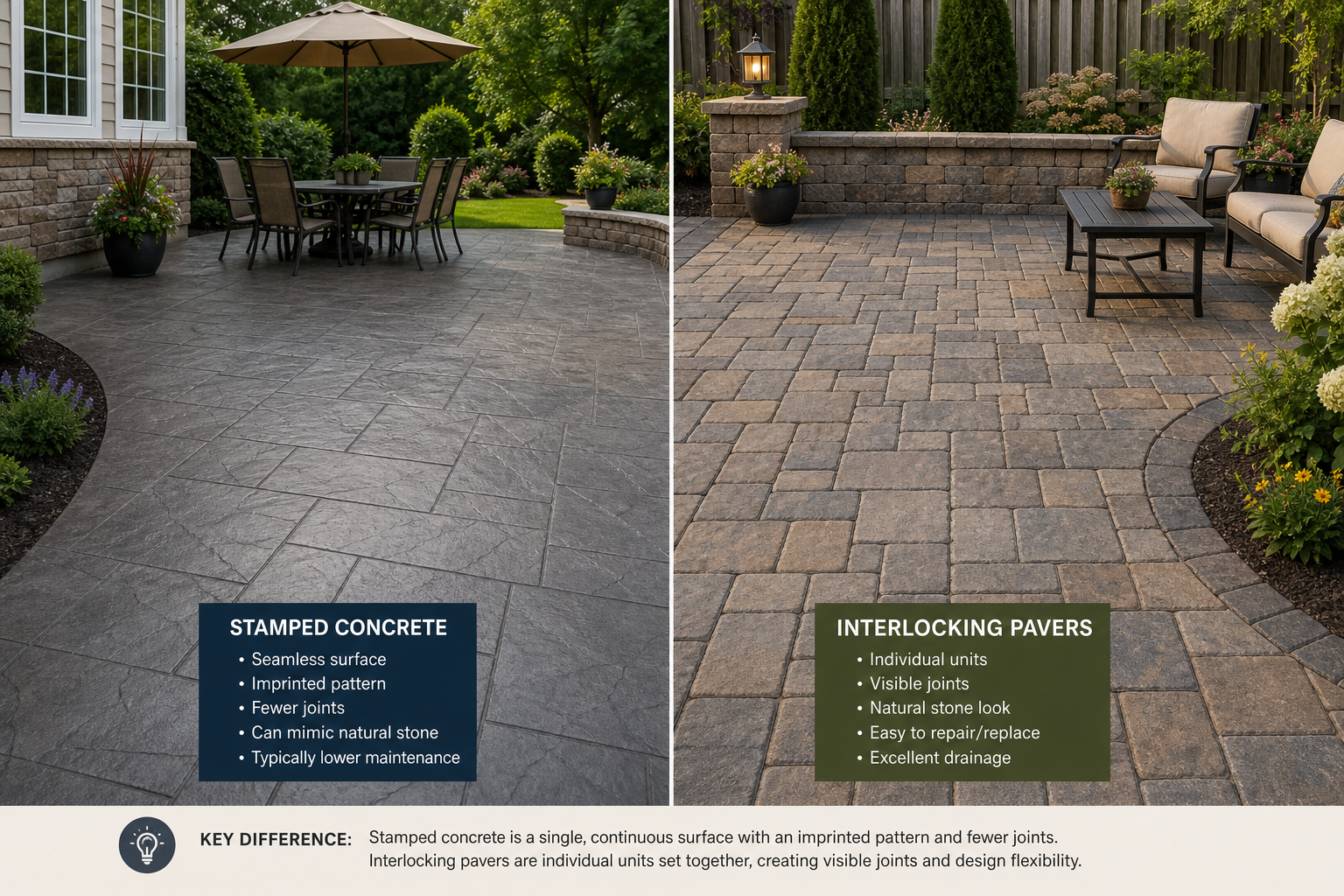
Compare both options before you commit to a material
Read through the trade-offs below, then reach out to talk through which surface fits your specific site and goals.
Two different processes, two different results
Stamped concrete starts as a standard poured slab. Before the concrete cures, workers press textured mats into the surface to create patterns that mimic brick, slate, flagstone, or cobblestone. Color can be added through integral pigments or surface-applied hardeners, and a sealer locks in the finish. The result is a single, continuous surface with no joints.
Pavers work the opposite way. Each unit, whether concrete, brick, or natural stone, is manufactured separately and installed piece by piece over a compacted aggregate base. The joints between units are filled with sand or polymeric sand. The flexibility of that jointed system is what gives pavers their structural advantage: each unit can shift independently under pressure or frost without transmitting stress across the whole surface. If you want to explore how pavers integrate with fire features and gathering spaces, this guide to hardscape design around fire features covers the design logic in detail.
Cost realities: upfront savings versus long-term math
Stamped concrete typically costs meaningfully less to install than pavers, and that gap is real enough to matter on larger projects. But the full picture includes ongoing maintenance. Stamped concrete requires professional resealing every two to three years to preserve its color and protect the surface from moisture infiltration. Skip a resealing cycle in a Wisconsin winter, and you accelerate the risk of spalling and surface deterioration. Over a decade or two, those resealing costs accumulate.
Pavers carry a higher upfront price, but their maintenance profile is different rather than simply heavier. Research comparing the two materials over a 20-year window shows that paver maintenance costs tend to be comparable to stamped concrete's lifecycle costs when resealing is factored in consistently. The repair math also differs: a cracked stamped concrete slab requires patching that is difficult to blend invisibly, while damaged pavers can be lifted and replaced individually without disturbing the surrounding surface.
Freeze-thaw performance and drainage in Wisconsin's climate
Wisconsin's seasonal cycle is the single most important variable in this comparison. Repeated freezing and thawing expands and contracts the ground beneath a patio, and the two materials respond very differently. Stamped concrete, as a monolithic slab, transmits that stress across the entire surface. Freeze-thaw cycles can cause spalling or cracking of the top layer, particularly if snow is not removed promptly and water infiltrates surface cracks before refreezing. Proper installation, including a minimum four-inch thickness, rebar or fiber mesh reinforcement, and control joints placed every eight to twelve feet, reduces but does not eliminate this risk.
Pavers, by contrast, distribute movement across individual units. A paver that shifts can be re-leveled; a slab that cracks must be patched. Drainage is also structurally different: permeable paver joints allow water to move through the surface rather than pooling on top, which matters on sloped sites and near shorelines. For sites where drainage is already a concern, the paver system's behavior under saturation is a practical advantage. You can read more about how patio design decisions interact with site drainage and slope before settling on a material.
Appearance, customization, and what each surface ages into
Stamped concrete offers a seamless, continuous look that can closely approximate the appearance of stone or brick at a lower material cost. Color consistency is high at installation. The trade-off is what happens over time: as the sealer wears and UV exposure fades the pigment, the surface can develop an uneven tone that is difficult to restore uniformly. When a crack crosses a stamped pattern, it is visible in a way that a paver joint never is, because the crack interrupts the imprinted design rather than following a predictable line.
Pavers age more predictably. Individual units can weather and develop patina, and minor variation between units tends to read as character rather than damage. Natural stone pavers in particular develop a surface that improves with age. The range of paver styles, colors, and textures available through contractors holding a Belgard Authorized Contractor designation gives homeowners substantial design flexibility without sacrificing durability. For visual inspiration across both paver and patio styles, backyard patio design ideas and paver patio design ideas are worth browsing before finalizing a direction.
Where McGuire Landscape fits into this decision
McGuire Landscape Company works primarily with pavers and natural stone for patio and hardscape projects in Washington, Waukesha, and Ozaukee Counties. That focus is deliberate. The sites the company typically works on, sloped lakefront properties, yards with drainage demands, and terraced outdoor living spaces, favor a material that handles freeze-thaw movement, allows water to drain, and can be adjusted or repaired without disturbing the full surface.
That does not mean stamped concrete is always the wrong answer. For a flat, sheltered suburban patio where budget is the primary constraint and the aesthetic priority is a seamless, stone-like surface, stamped concrete is a legitimate choice and a qualified concrete contractor can execute it well. McGuire's work is better matched to projects where site complexity, drainage, slope, or long-term durability make the paver system's flexibility a genuine structural advantage, not just a style preference. If your project involves a sloped or terraced outdoor living space, retaining walls, or proximity to a shoreline, that context should drive the material conversation before anything else does.
Stamped concrete vs. pavers: which suits your project
Both are legitimate hard-surface options. The right choice depends on your site conditions, maintenance expectations, and how long you plan to stay in the space.
- Stamped concrete
- Best suited to flat, well-drained sites where budget is a primary constraint and a seamless, stone-like aesthetic is the priority.Lower upfront cost, but requires resealing every two to three years and repairs are difficult to blend invisibly.
- Concrete pavers
- Best suited to sloped sites, freeze-thaw climates, and projects where long-term durability and repairability matter more than upfront savings.Higher initial investment, but individual units can be replaced and the jointed system handles frost movement better than a monolithic slab.
- Natural stone pavers
- Best suited to homeowners prioritizing premium aesthetics and longevity, particularly on lakefront or high-visibility properties.Ages well and develops character over time; typically the highest upfront cost of the three options.
Homeowners with flat, sheltered sites and a tight budget have genuine reason to consider stamped concrete from a qualified concrete contractor. For sloped yards, lakefront properties, freeze-thaw-exposed sites, or phased projects, McGuire Landscape Company's paver and natural stone work is the stronger long-term fit.
The right patio material is not the one that looks best in a showroom; it is the one that holds up under the specific conditions of your site, your climate, and your plan for how the space will grow over time.
Three scenarios where the material choice really matters
Lakefront patio on a sloped grade
A lakefront homeowner in Washington County wants a patio between the house and the water, but the grade drops significantly and the soil near the shoreline stays saturated after rain. In this situation, pavers are the stronger structural choice: the jointed system allows water to move through the surface rather than pooling, and individual units can be re-leveled if frost heave shifts the base over winter. A stamped concrete slab on a sloped, wet site is more vulnerable to cracking and surface spalling because moisture can infiltrate and freeze beneath the slab. Projects like this also often involve retaining walls and erosion control measures that integrate naturally with a paver hardscape system.
Suburban backyard entertaining space on flat ground
A homeowner in Waukesha County has a flat, well-drained backyard and wants a generous patio for outdoor dining and a fire feature. The site presents no unusual drainage or grade challenges. Here, stamped concrete is a genuinely competitive option: the lower upfront cost, seamless appearance, and design flexibility make it attractive, and the flat, stable base reduces the freeze-thaw risk. Pavers remain the more durable long-term choice, but a homeowner prioritizing budget and a specific aesthetic on a straightforward site has real reason to consider stamped concrete. If the plan includes a fire pit or outdoor kitchen, designing the hardscape as a coordinated system matters regardless of which surface material is chosen.
Phased renovation planned across multiple seasons
A homeowner planning a backyard renovation in stages, starting with a patio this season and adding an outdoor kitchen and lighting in a later phase, benefits from choosing a surface that can be extended or modified without full replacement. Pavers accommodate phased construction more easily because sections can be added, lifted, or reconfigured as the project evolves. Stamped concrete, as a monolithic slab, is harder to extend seamlessly once cured, and matching color and texture across pours completed in different seasons is difficult. For homeowners thinking ahead to a full backyard renovation that unfolds over time, the paver system's adaptability is a practical planning advantage.
Stamped concrete vs. pavers: practical questions answered
Ready to choose the right surface for your specific site
The material decision is easier once the site conditions are clear: grade, drainage, proximity to water, and how you plan to use the space over time all shape what will actually perform. McGuire Landscape Company works with homeowners across Washington, Waukesha, and Ozaukee Counties to plan patios and hardscapes that fit the site, not just the budget. Reach out to start a conversation about your project.
Start your patio conversation