

How to Find the Best Patio Builder for Your Project
Choosing the right patio builder protects every dollar you invest
A practical framework for evaluating local contractors before you sign anything.
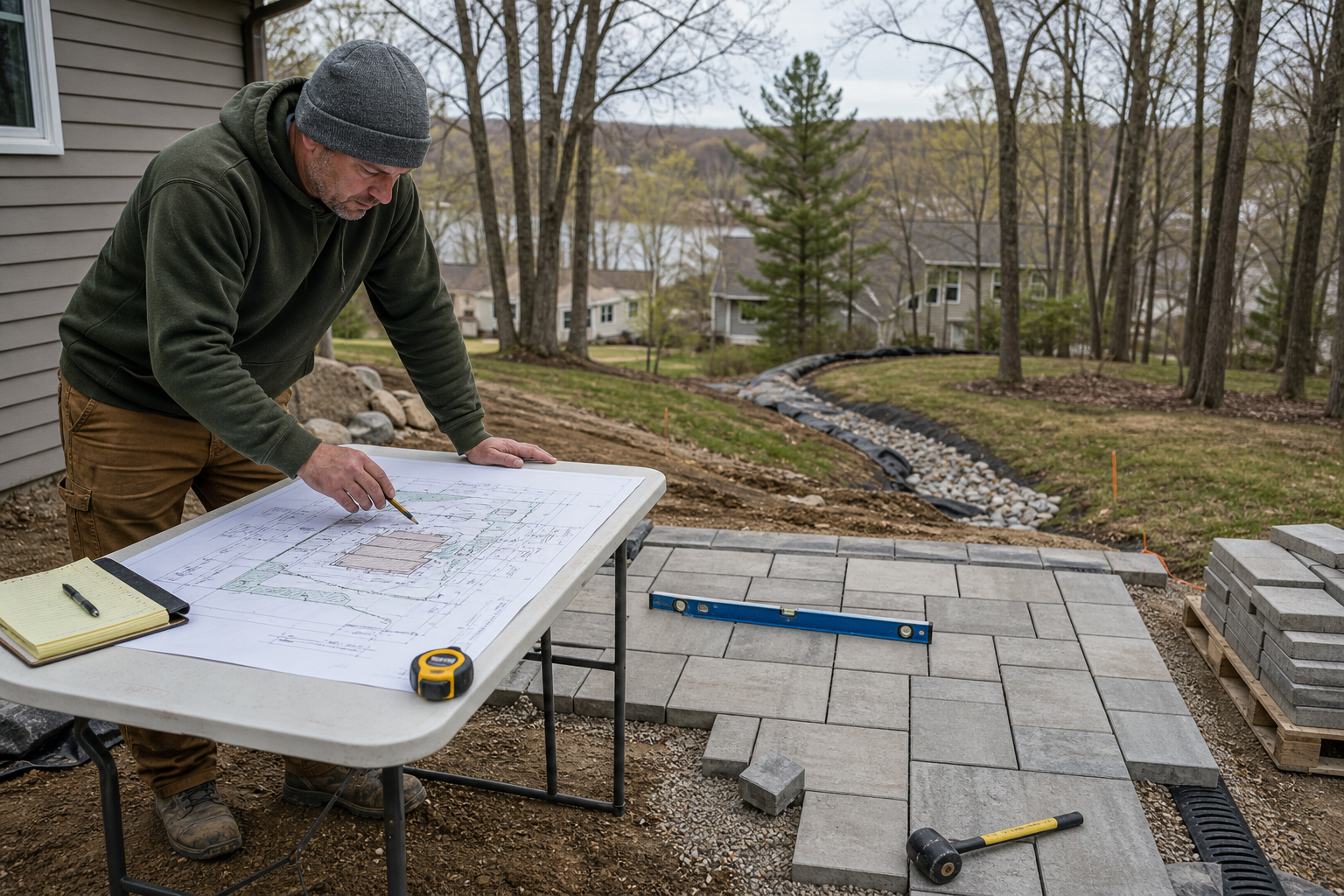
Find the right patio builder for your project
Connect with a patio contractor who plans the full system before breaking ground.
The contractor decision shapes every outcome
Most homeowners spend weeks choosing a patio material and an afternoon choosing a contractor. That's backwards. The material you select matters, but the contractor determines whether it performs. A paver patio laid on an improperly compacted base or without adequate drainage will heave, settle, and stain within a few Wisconsin winters, regardless of how well the pavers themselves were manufactured. A stamped concrete surface installed without expansion joints will crack. A retaining wall built without proper batter and drainage behind it will lean.
The contractor you hire is responsible for the base preparation, the drainage plan, the structural decisions, and the long-term integrity of the finished surface. Choosing a builder who treats those elements as an afterthought is the single most common reason patio projects fail. Before you look at material samples or color palettes, build a framework for evaluating who will actually do the work. You can explore what to know before you build to get grounded in the design side before you start vetting contractors.
What a strong portfolio actually tells you
A contractor's portfolio is not just a gallery of attractive finished patios. It's evidence of range, site complexity, and consistency over time. When you review a portfolio, look for projects that resemble your own situation: similar lot conditions, similar scale, similar material. A contractor who has only installed flat gravel patios in simple suburban backyards is not the same as one who has built multi-level hardscape systems on sloped or lakefront lots.
Ask specifically to see examples of completed work that match what you're planning, including the challenges your site presents. A sloped yard, a high water table, or a shoreland setback requirement are not incidental details; they are the core of the project. Credentials matter too: look for industry designations such as a Belgard Authorized Contractor status, which indicates training in specific installation systems. Check third-party review platforms like Google and Angi rather than relying solely on testimonials on the contractor's own website, which may only surface the best feedback. A contractor who responds to negative reviews as well as positive ones is demonstrating the kind of accountability that matters on a long project.
Reading bids and contracts with a critical eye
Getting multiple bids is standard advice, but the comparison is only useful if the bids are genuinely comparable. Request at least three detailed, itemized estimates that break out material costs, labor, site preparation, drainage provisions, cleanup, and any additional features. A bid that bundles everything into a single line item is not a bid you can evaluate; it's a number you can only accept or reject.
The contract itself should specify start and end dates, a payment schedule, warranties on both materials and workmanship, and a clear statement of who is responsible for what if something goes wrong. A contractor who cannot or will not produce a detailed written contract is not a contractor you should hire. Warranties are a meaningful signal: a builder who stands behind their work long after the project closes is one who planned it correctly from the start. For context on how material choices interact with long-term costs, comparing concrete and pavers is a useful reference before you finalize your bids.
Site knowledge separates specialists from generalists
A patio is not an isolated surface. It connects to the house, responds to the yard's grade and drainage patterns, and has to perform through freeze-thaw cycles that are among the most demanding in the country. A builder who does not walk your site and ask about drainage, sun exposure, traffic flow, and how the space connects to the interior of your home is not planning your project correctly.
For properties with slopes, this means understanding retaining wall requirements and drainage routing before a single paver is ordered. For lakefront lots in Wisconsin, it means knowing the DNR shoreland setback rules and what permits are required before construction begins. Some contractors offer design support including layouts and 3D renderings, which can help you understand what you're approving before work starts. That kind of pre-construction planning is not a luxury; it's how mistakes get caught on paper instead of in the ground. If your project includes an outdoor kitchen or fire feature alongside the patio, a contractor who can coordinate those elements as a single system rather than separate add-ons will produce a more coherent and durable result.
Choosing a patio contractor: who fits your project
The right contractor depends on your site conditions, project complexity, and how much coordination your project demands.
- General landscaping contractors
- Best suited to straightforward, flat-site patio installs with standard materials and no significant drainage or grade challenges.Wide availability; typically less experience with technically complex sites or regulatory requirements.
- National home services platforms (Angi, HomeAdvisor)
- Useful for discovering and comparing local contractors quickly; best for homeowners who want a broad shortlist and are comfortable doing their own vetting.The platform connects you to contractors; it does not vet site-specific expertise or coordinate the project.
- Specialty hardscape contractors
- Strong fit for projects requiring specific material expertise, such as natural stone or concrete pavers, with documented portfolio depth in those systems.Quality varies widely; credentials like Belgard Authorized Contractor status are a meaningful differentiator.
- McGuire Landscape Company
- Best fit for technically demanding projects: sloped lots, lakefront sites with DNR permit requirements, or coordinated outdoor living systems that combine patio, retaining walls, drainage, outdoor kitchen, and lighting as a single planned scope.Belgard Authorized Contractor; serves Washington, Waukesha, and Ozaukee Counties in southeastern Wisconsin.
For a simple flat-site patio, a qualified local hardscape contractor found through Google or Angi may serve you well. For a sloped lot, a lakefront property, or a project that combines multiple outdoor living elements into one coordinated system, McGuire Landscape Company's focus on technically demanding sites and design-led planning is the more appropriate fit.
The best patio builders plan the entire system - base, drainage, finish, and site integration - before a single shovel touches the ground.
How to vet a patio contractor step by step
- 1
Research and build a shortlist
Start with third-party platforms like Google and Angi to identify local patio contractors with strong review histories. Look for contractors with many reviews and consistent 4-5 star ratings across multiple platforms, not just a handful of glowing testimonials on their own website. Note how contractors respond to negative reviews; responsiveness is a signal of how they handle problems during a project. Narrow your list to contractors who specifically serve your county and have documented experience with your type of project.
- 2
Review portfolios for site-specific experience
Request to see completed projects that match your site conditions, not just attractive finished photos. A flat suburban backyard, a sloped lot requiring retaining walls, and a lakefront property with drainage constraints each demand different technical competencies. A large, varied portfolio indicates genuine experience; a thin or repetitive one suggests a contractor who works within a narrow range. Ask directly whether they have handled projects with the specific challenges your site presents.
- 3
Verify licensing, insurance, and credentials
Every legitimate contractor carries the appropriate licenses and insurance required in Wisconsin. Never hire a contractor who cannot provide proof of both, as licensing protects you legally and insurance protects you financially if something goes wrong on your property. You can verify licensing through local licensing boards or the Better Business Bureau. Industry designations, such as Belgard Authorized Contractor status, indicate additional training in specific installation systems and are worth asking about.
- 4
Request and compare detailed, itemized bids
Get at least three written estimates and make sure each one breaks out material costs, labor, site preparation, drainage provisions, and cleanup separately. A single bundled number is not a bid you can evaluate. Compare the bids by what is included and what is not, rather than by total figure alone. A lower total that excludes base preparation or drainage work is not a savings; it's a deferred cost. Ask each contractor to walk you through their estimate line by line.
- 5
Check references and review the contract carefully
Ask for references from past clients with projects similar to yours and follow up on them. Ask specifically about how the contractor handled problems, not just whether the finished project looked good. Before signing, confirm the contract includes start and end dates, a payment schedule, warranty terms, and a clear statement of responsibility for any issues that arise. A contractor who resists putting these details in writing is one worth reconsidering. For design-led projects that include fire features or outdoor kitchens, review paver and fire pit design ideas to arrive at that conversation prepared.
Benefits
Structural integrity from the base up
A qualified patio builder engineers the sub-base and compaction before laying a single paver or pouring any concrete. Proper base preparation is what separates a surface that holds for twenty years from one that heaves after the first hard frost.
Drainage planned before construction starts
Water management is not something to address after the patio is built. A design-led contractor maps drainage routing and grading as part of the initial plan, preventing pooling, erosion, and structural undermining over time.
Permit and regulatory coordination
In Wisconsin, projects near shorelines require DNR permits and must respect shoreland setback rules. A contractor with specific regional experience handles permit coordination as part of the project scope, not as an afterthought you discover at the last minute.
Coordinated design across all elements
Patios that include retaining walls, outdoor kitchens, fire features, and lighting perform better when those elements are planned as a single integrated system rather than added one by one by different contractors over different seasons.
Workmanship backed by a real warranty
A contractor who offers a written warranty on both materials and labor is one who has confidence in their installation process. A warranty is evidence of planning quality, not just a policy document.
Three homeowner scenarios that test contractor fit
Flat suburban backyard, first patio build
A homeowner in a Washington or Waukesha County subdivision wants a paver patio with a fire feature and landscape lighting added to an otherwise flat, underused backyard. The site looks straightforward, but drainage routing and base compaction still determine whether the surface holds. The right contractor walks the yard, identifies where water moves after a heavy rain, and designs the patio grade accordingly before ordering materials. A contractor who skips that step produces a patio that pools water at the house foundation. For design direction before the contractor conversation, paver patio ideas and inspiration is a useful starting point.
Sloped lot requiring retaining walls and usable space
A homeowner on a steeply graded lot wants to create a level outdoor living area but the yard drops several feet from the house. This project requires retaining wall engineering, drainage behind the wall, and careful grading before a patio surface can even be considered. The contractor must understand soil conditions, wall batter, and how water will move through and around the structure over time. Hiring a general contractor without specific retaining wall experience on sloped sites is the most common mistake on projects like this. McGuire Landscape Company's focus on technically demanding sites with steep grades makes it a strong fit for this scenario. More context on landscape stairs and grade transitions is relevant for lots where the slope also affects access.
Lakefront property with drainage and setback constraints
A lakefront homeowner in Ozaukee County wants a patio and outdoor kitchen adjacent to the water, but the site is subject to Wisconsin DNR shoreland setback requirements and has erosion vulnerability along the bank. This project requires a contractor who understands both hardscape construction and Wisconsin shoreland regulations, not just one or the other. Permit coordination, setback compliance, and drainage that does not direct runoff toward the shoreline are non-negotiable elements. McGuire Landscape Company's specific experience with lakefront sites in southeastern Wisconsin, including DNR permit coordination, makes it the more appropriate choice here than a general patio contractor who has not worked in regulated shoreland zones. For related context, erosion control is often part of the same project scope.
How to find the best patio builder: common questions answered
Ready to talk through your patio project with a specialist
If your project involves a sloped lot, a lakefront site, or a coordinated outdoor living system, the contractor you choose matters more than any other decision you'll make. McGuire Landscape Company works across Washington, Waukesha, and Ozaukee Counties on exactly these kinds of technically demanding projects. Reach out to start a conversation about your site.
Talk to a patio specialist