

Natural Stone Patio Ideas for Lasting Outdoor Spaces
Choosing stone that holds up through every Wisconsin winter
A practical guide to natural stone patio ideas, materials, and climate performance for outdoor spaces built to last decades.
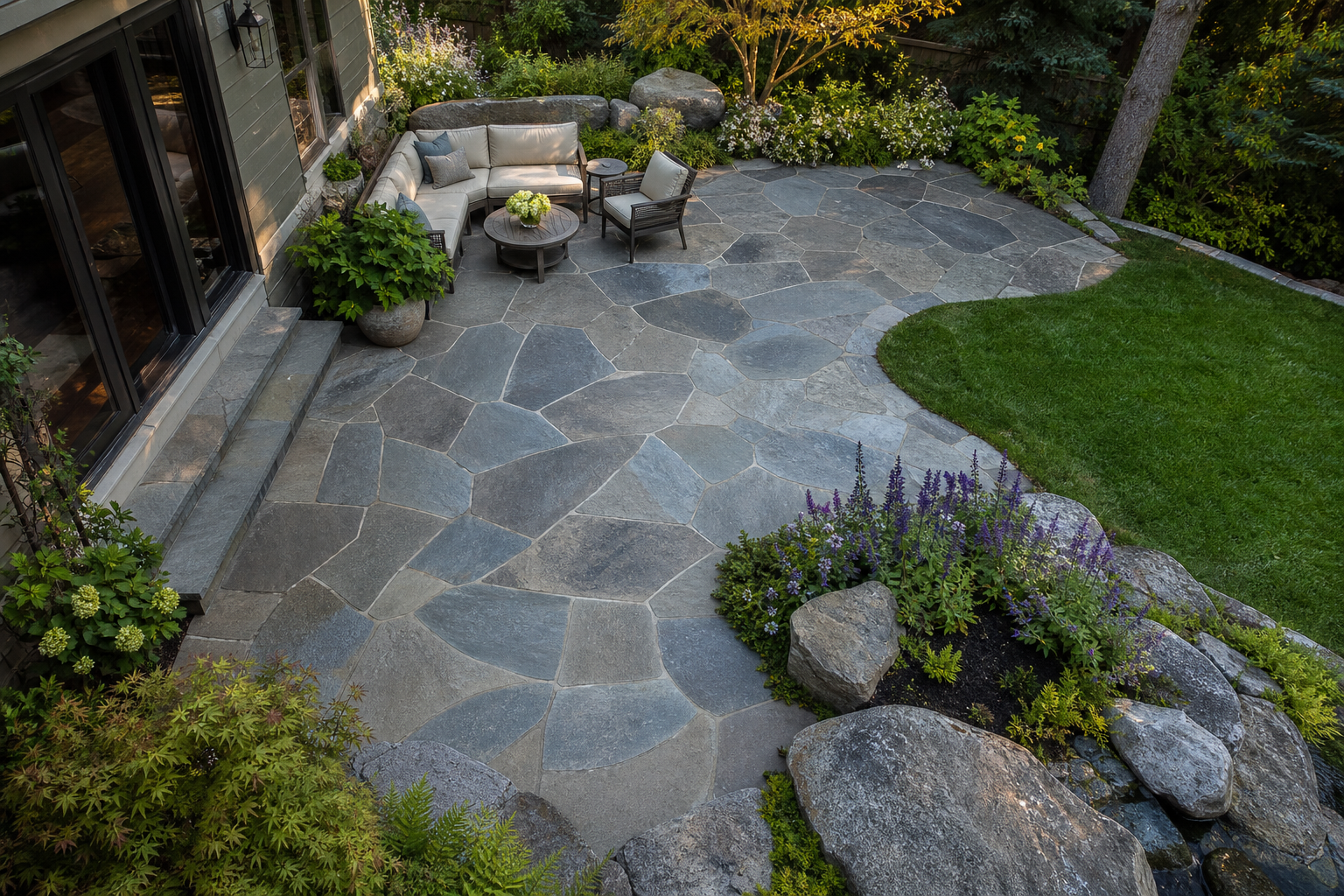
Find the right stone for your Wisconsin patio
Pick the right patio material for a Wisconsin outdoor space that lasts decades, not just seasons, with this guide to stone, climate, and smart design.
Why material choice is a structural decision in Wisconsin
Wisconsin's freeze-thaw cycle is not a minor inconvenience. Temperatures routinely cross the freezing threshold dozens of times each winter, and any water that infiltrates a porous stone or an inadequately prepared base will expand, shift, and eventually crack whatever sits above it. That means the patio material you choose is not purely aesthetic. It determines how your base needs to be built, how much drainage must be engineered beneath the surface, and how the whole system performs after ten or fifteen winters.
Site conditions compound the challenge. A sloped backyard concentrates runoff at the low end of a patio. A lakefront terrace may sit on fill or unstable soil. A shaded corner stays wet longer and cycles through freeze-thaw more aggressively than a sun-exposed slab. Choosing a stone without accounting for grade, drainage, and exposure is the single most common reason patios fail early. Before you settle on a look, understand what your specific site demands. A good starting point is what to consider before you build a backyard patio.
Natural stone options and how each performs here
Bluestone and granite are the two strongest performers in cold-climate freeze-thaw conditions. Granite is non-porous and exceptionally hard, resisting scratches, stains, and heavy loads while holding up reliably through repeated freeze-thaw cycles. Bluestone is similarly resistant to cracking in cold weather and has the added advantage of being naturally slip-resistant, which matters on a wet patio surface near a pool or lake.
Flagstone is a broad category rather than a single stone type. It is durable and slip-resistant when dry, but it can be prone to chipping and generally requires sealing to prevent staining. The performance of flagstone depends heavily on which stone it is cut from. Limestone and travertine sit at the more vulnerable end of the spectrum: both are porous and softer, making them susceptible to freeze-thaw damage, acidic cleaners, and staining from organic debris. Limestone is viable in USDA zones 7 and warmer but should be used with caution in zone 6 and colder climates like southeastern Wisconsin. Sandstone offers warm honey tones but is generally softer than limestone and best suited to covered or less exposed areas. Slate works well in modern designs but can flake if laid in persistently wet conditions.
Concrete pavers as a practical alternative to natural stone
Natural stone carries a character and variation that manufactured materials cannot fully replicate. But concrete pavers, particularly those from established manufacturers, offer meaningful advantages worth considering alongside stone.
Modern concrete pavers are engineered for dimensional consistency, which simplifies installation and makes future repairs more straightforward. Because individual units can be lifted and reset, a paver patio is easier to service if a base issue develops beneath a section. They are also available in a wide range of profiles and finishes that approximate the look of natural stone. McGuire Landscape Company holds a Belgard Authorized Contractor designation, which reflects a depth of experience with paver systems specifically. For a detailed side-by-side look at how pavers compare to other surfaces, the concrete patio vs. pavers comparison covers performance, longevity, and practical trade-offs. The choice between natural stone and concrete pavers often comes down to budget, site complexity, and the specific aesthetic the homeowner is after.
Base preparation is where longevity is actually built
The stone or paver on top gets all the attention, but the base beneath it determines whether the surface holds its grade and stays level after years of Wisconsin winters. A properly engineered base typically involves compacted aggregate layers, adequate depth to account for frost penetration, and a drainage plan that moves water away from the patio rather than letting it pool beneath the surface.
Skimping on base depth or drainage is the most reliable way to produce a patio that heaves, settles unevenly, or develops chronic puddling. On sloped sites, this often means integrating the patio design with a broader grading and drainage plan rather than treating the patio as a standalone surface. Retaining walls, catch basins, and swales may all be part of the same coordinated system. This is especially true on lakefront properties, where erosion control and shoreline conditions directly affect how water moves across the entire site. A patio built without accounting for those conditions will underperform regardless of which stone is chosen.
Sealing, maintenance, and long-term performance expectations
Natural stone is one of the longest-lasting patio materials available, with a well-installed surface capable of holding up for 50 years or more with occasional sealing and maintenance. But that lifespan assumes the right stone was chosen for the exposure, the base was built correctly, and the surface is resealed on a schedule appropriate to the stone type and site conditions.
Granite and bluestone require the least intervention. Limestone, travertine, and sandstone require more attentive sealing programs because their porosity makes them more vulnerable to water infiltration and staining. Slate should be inspected periodically in wet applications for signs of flaking. Concrete pavers are generally low-maintenance but benefit from periodic joint sand replenishment and occasional resealing depending on the finish.
The maintenance commitment should be part of the material decision, not an afterthought. A homeowner who wants minimal upkeep is better served by granite or bluestone than by a softer stone that looks beautiful on installation day but demands consistent attention to stay that way. If you are also planning a fire feature or outdoor kitchen as part of the same project, coordinating those elements early affects material and layout decisions across the whole space. See paver ideas for hardscape gathering spaces for how those elements fit together.
Natural stone types at a glance
How the most common natural stone options compare for Wisconsin patio conditions.
- Granite
- Best suited to homeowners who want maximum durability and minimal maintenance in a cold climate.Non-porous, scratch-resistant, strong in freeze-thaw conditions.
- Bluestone
- Ideal for patios, pool surrounds, and lakefront areas where slip resistance and cold-climate durability matter.Naturally slip-resistant, highly resistant to cracking in freeze-thaw.
- Flagstone (general)
- Suits homeowners who want a natural, irregular look; stone type within the category determines actual performance.Durability varies by underlying stone; sealing typically required.
- Limestone
- Better suited to sheltered or covered applications in cold climates; not recommended for exposed Wisconsin patios without thorough sealing.Porous and softer; vulnerable to freeze-thaw and staining.
- Travertine
- Works well in warm climates and covered applications; requires careful sealing for any cold-climate use.Porous; popular for pool decks in warmer regions.
- Sandstone
- Best for covered or low-exposure areas where moisture and ice contact is limited.Softer than limestone; prone to erosion from moisture and ice.
- Slate
- Suits modern design aesthetics in drier applications; avoid persistent wet conditions.Can flake in wet areas; durable in appropriate conditions.
For most exposed Wisconsin patios, bluestone and granite offer the most reliable long-term performance with the least maintenance burden.
The stone you choose is a structural commitment as much as an aesthetic one, and the base beneath it is where that commitment is actually kept.
Benefits
Stone matched to Wisconsin climate
Not every stone belongs in a freeze-thaw climate. Bluestone and granite are the strongest performers in cold-climate conditions, while limestone, travertine, and sandstone require careful sealing programs or should be limited to sheltered applications.
Base engineering that prevents early failure
A properly compacted aggregate base with adequate frost depth and integrated drainage is what keeps a patio level and stable after years of Wisconsin winters. Skipping base depth or drainage is the most reliable way to produce a surface that heaves or settles unevenly.
Coordinated design across the full outdoor space
A patio rarely exists in isolation. When stone selection, grading, drainage, retaining walls, and any fire features or outdoor kitchen elements are planned as a single coordinated system, the result performs better and looks more cohesive than elements added separately.
Realistic maintenance planning from the start
The maintenance demands of each stone type vary significantly. Knowing the sealing and upkeep requirements before installation allows homeowners to choose a material that fits their actual willingness to maintain it, rather than discovering the mismatch years later.
Natural stone patio ideas in practice
Flat suburban backyard patio with fire feature
A homeowner in Washington or Waukesha County with a level backyard and reasonable drainage has the widest range of material options. Bluestone or granite pavers work well here for long-term durability with minimal maintenance. If the project includes a fire pit or outdoor kitchen, material selection for the patio surface should be coordinated with the surround and seating area from the start. See how fire pit and patio elements work together for layout guidance. Choosing a consistent stone across the patio and fire feature surround produces a more unified result than mixing materials selected independently.
Sloped backyard terrace with retaining walls
On a sloped site, the patio design and the retaining wall system are inseparable. The wall holds the grade that makes a level patio surface possible, and the drainage behind the wall must move water away from the patio base. Granite or bluestone is the practical choice here because both handle the moisture and freeze-thaw exposure that a terrace on a slope experiences. The landscape stairs connecting terrace levels need to use compatible materials and the same base engineering standards as the patio itself. Treating these as separate scopes is a common planning mistake on sloped sites.
Lakefront boathouse patio and deck transition
A lakefront property presents the most demanding combination of conditions: proximity to water, shoreline drainage, potential soil instability, and regulatory constraints on what can be built and where. The patio surface connecting a boathouse or pier area to the main outdoor living space needs to handle constant moisture exposure and the specific drainage patterns of a lakefront site. Bluestone is a strong candidate here for its slip resistance and cold-climate durability. Material selection should be coordinated with the broader outdoor living space plan and any shoreline work happening on the same property, since grading and drainage decisions on the waterside affect the entire site.
Common questions about natural stone patio ideas
Ready to plan a stone patio built for Wisconsin conditions
Material selection, base engineering, drainage, and site-specific grading all need to work together for a patio that holds up through decades of Wisconsin winters. McGuire Landscape Company designs and builds [outdoor living spaces](/outdoor-living-spaces) across Washington, Waukesha, and Ozaukee Counties, coordinating every element of the project before construction begins. Reach out to discuss your site and what it calls for.
Talk to a patio specialist