

Outdoor Landscape Lighting Ideas to Enhance Your Yard After Dark
Light your yard after dark with landscape ideas that actually work
From uplighting mature trees to path lights along a lakefront walkway, the right techniques turn a dark yard into a place you want to spend time in.
Plan your outdoor landscape lighting with a local expert
Explore lighting ideas for your yard and request a design consultation with McGuire Landscape Company.
Lighting does more than look good at night
A well-lit yard extends the hours you can actually use your outdoor space. That alone justifies the investment for most homeowners. But landscape lighting also addresses safety-illuminated path lights along walkways, stairs, and driveways reduce trip hazards after dark, which matters especially on sloped or multi-level properties. There is also a measurable effect on property value: outdoor lighting is consistently cited by real estate professionals as one of the exterior upgrades that improves curb appeal and perceived quality of a home. For lakefront properties in particular, lighting a seawall edge, dock approach, or shoreline stairway is not just decorative. It is a practical safety measure for anyone moving between the house and the water at night. Think of lighting as the layer that makes your entire outdoor living space functional around the clock, not just during daylight.
Core techniques and how each one works
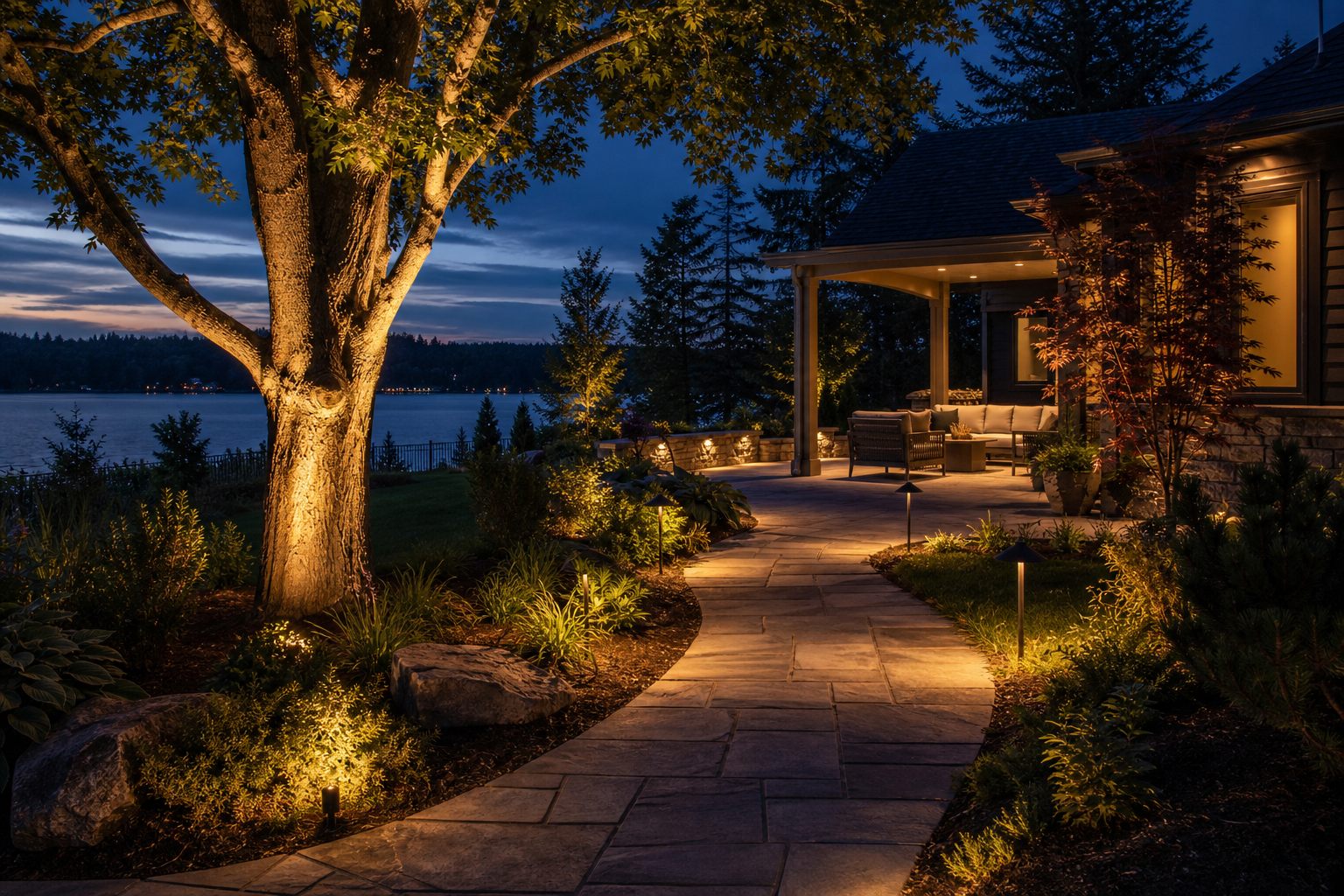
Five foundational techniques cover most residential landscape lighting: uplighting, silhouetting, shadowing, moonlighting, and downlighting. Uplighting places a fixture near the base of a tree or structure and aims the beam upward, creating a dramatic wash that draws the eye. Fixture placement roughly two to three feet from a tree trunk, angled to reveal bark texture and branch structure, produces the most convincing result. Silhouetting works best on plants with a distinctive shape: position a light source behind the plant and aim it at a wall or fence, and the plant's outline becomes the feature. Moonlighting does the reverse of uplighting, mounting fixtures high in mature trees and angling them downward to mimic natural filtered light. For paths and walkways, the Illuminating Engineering Society recommends a minimum of 0.5 foot-candles on walking surfaces, with path lights spaced eight to ten feet apart for even coverage without harsh brightness. Spotlights focus a narrow beam on a single feature such as a statue, flagpole, or specimen tree, while floodlights spread a wider beam across large shrubs or broad canopies.
Layering light sources creates depth and dimension
No single technique produces a complete result on its own. The most effective landscape lighting schemes combine multiple techniques at different heights and angles, so the eye travels across the yard rather than landing on one bright point surrounded by darkness. A mature oak uplighted from below, path lights at ankle height along the walkway, and a downlit seating area create three distinct planes of light that together feel cohesive rather than scattered. Dimmers and smart timers add another dimension: you can run path lights at full output for safety during the evening and dial back accent lights later, or set zones to activate on different schedules. This layered approach also makes it easier to phase a lighting plan over time, adding zones as a backyard renovation progresses rather than trying to address everything at once.
Choosing fixtures that hold up through Wisconsin winters
Fixture selection matters more in a freeze-thaw climate than in milder regions. Wisconsin winters subject outdoor hardware to repeated expansion and contraction, moisture intrusion, and ice loading, so fixture-grade materials and sealed connections are not optional extras. Low-voltage systems operating at 12 volts reduce shock risk and simplify installation compared to standard line-voltage systems, and professional-grade LED fixtures use roughly 80% less energy than halogen alternatives while lasting well beyond 25,000 hours of operation. A typical halogen spotlight draws 20 to 50 watts per bulb; an equivalent LED draws three to twelve watts, which adds up significantly when fixtures run every night. For a paver patio or natural stone outdoor space, fixtures integrated into the hardscape during installation rather than surface-mounted afterward produce a cleaner result and avoid the risk of cables being disturbed during winter snow removal.
Light is the final layer of any outdoor design: it reveals what you built, defines how you use it after dark, and connects every element of the yard into one coherent environment.
Benefits
Coordinated zones, not scattered fixtures
A professionally designed lighting plan treats the yard as a system of zones, path lighting, accent lighting, task lighting, each calibrated to work together. Piecemeal fixture additions rarely produce this result because each purchase is made in isolation without a view of how the zones interact at night.
Correct voltage planning from the start
Low-voltage systems at 12 volts are inherently safer and simpler than line-voltage alternatives, but they still require careful load calculations to avoid voltage drop across long cable runs. Undersized transformers or overloaded circuits cause fixtures to dim or fail prematurely, a problem that is far easier to prevent during design than to diagnose and correct afterward.
Fixture durability through freeze-thaw cycles
Wisconsin's seasonal conditions demand fixtures rated for repeated freeze-thaw exposure, with sealed housings and corrosion-resistant hardware. Fixtures specified for a milder climate often fail within a few seasons here, making material selection at the outset a meaningful long-term decision.
LED efficiency across thousands of hours
Professional-grade LED landscape fixtures use roughly 80% less energy than halogen alternatives and are rated to last well beyond 25,000 hours of operation. Choosing LED from the start eliminates the recurring cost and labor of frequent bulb replacement that halogen systems require.
Integration with hardscape during installation
Conduit, junction boxes, and cable runs integrated into a patio, retaining wall, or stairway during construction produce a cleaner result and avoid surface-mounted workarounds later. Retrofitting lighting into finished hardscape is possible but always more disruptive and limiting than planning for it from the beginning.
Lighting scenarios Wisconsin homeowners recognize
Lakefront property with dock and seawall lighting
A lakefront homeowner in Washington County has a seawall, a shoreline stairway, and a pier that all see regular use after dark during the summer months. Path lights along the stairway and low-profile fixtures at the seawall edge address the most immediate safety need, while underwater or waterproof accent lights at the dock create a visual anchor from the house. Uplighting a shoreline tree or two ties the water's edge back to the broader landscape. This kind of lighting plan works in coordination with the landscape stairs and shoreline infrastructure already in place, rather than being added as an afterthought.
Patio and outdoor kitchen entertaining space
An outdoor kitchen and adjacent patio used for evening entertaining needs at least two distinct lighting zones: task lighting over the cooking and prep area, and softer ambient light across the seating zone. Recessed fixtures in a pergola or overhead structure, combined with low-voltage path lights at the patio perimeter, create a space that feels finished rather than improvised. String lighting or lanterns can layer in warmth without competing with the functional zones. If you are still planning the patio itself, it is worth reading about how to design an outdoor kitchen before finalizing fixture placement, since conduit and wiring are far easier to route before the hardscape is poured or set.
Sloped backyard with retaining walls and planting beds
A multi-level backyard built around retaining walls presents natural opportunities for lighting that flat yards do not. Fixtures mounted low on a wall face wash the stone surface with light, revealing texture and defining the grade change clearly after dark. Uplighting specimen plants in the beds above each wall adds vertical interest, while path lights along any steps or transitions between levels handle the safety requirement. The result is a yard that reads as intentionally designed at night, not just a series of functional grade separations.
Boathouse entertainment deck with water views
An upper deck on a boathouse structure, used for entertaining with views over the water, benefits from lighting that does not compete with the view itself. Downlighting from overhead fixtures keeps the deck surface well-lit without sending glare toward the water, which matters both for comfort and for neighboring properties. Low-profile step lights on any stair transitions, combined with subtle accent lighting on the exterior of the structure, tie the boathouse into the broader property lighting scheme. This kind of coordinated approach fits naturally into a project where the outdoor environment around the boathouse is designed as a single system.
Outdoor landscape lighting ideas: common questions answered
Ready to see what your yard looks like after dark
McGuire Landscape Company designs landscape lighting as part of a coordinated outdoor living plan, integrated with patios, retaining walls, stairs, and shoreline infrastructure from the start. If you are planning a new outdoor space or want to add lighting to an existing one, a design conversation is the right first step.
Request a lighting consultation