

Outdoor Patio Stone Ideas: Choosing the Right Material for Your Space
Patio stone materials compared: what actually holds up in Wisconsin
A practical guide to choosing outdoor patio stone that suits your climate, site, and long-term plans.
Match your patio stone to your Wisconsin site
Bring your site conditions into the conversation early and get material recommendations matched to your specific patio project.
Why material choice matters more than most homeowners expect
Choosing a patio stone is not just an aesthetic decision. In southeastern Wisconsin, where freeze-thaw cycles are a seasonal reality, the material you select determines how your patio performs over decades, not just how it looks on installation day. Water expands by about 9 percent when it freezes, and that expansion works against any porous stone that has absorbed moisture. A material that looks beautiful in a showroom can crack, heave, or spall within a few winters if it is not dense enough or properly sealed for the climate.
Beyond freeze-thaw performance, the right choice depends on how the patio will be used, how it connects to the rest of the property, and whether the base and drainage system are engineered to support it. Before settling on a material, it is worth reading through what to know before you build a backyard patio to understand how these decisions interact.
A material-by-material breakdown for Wisconsin patios
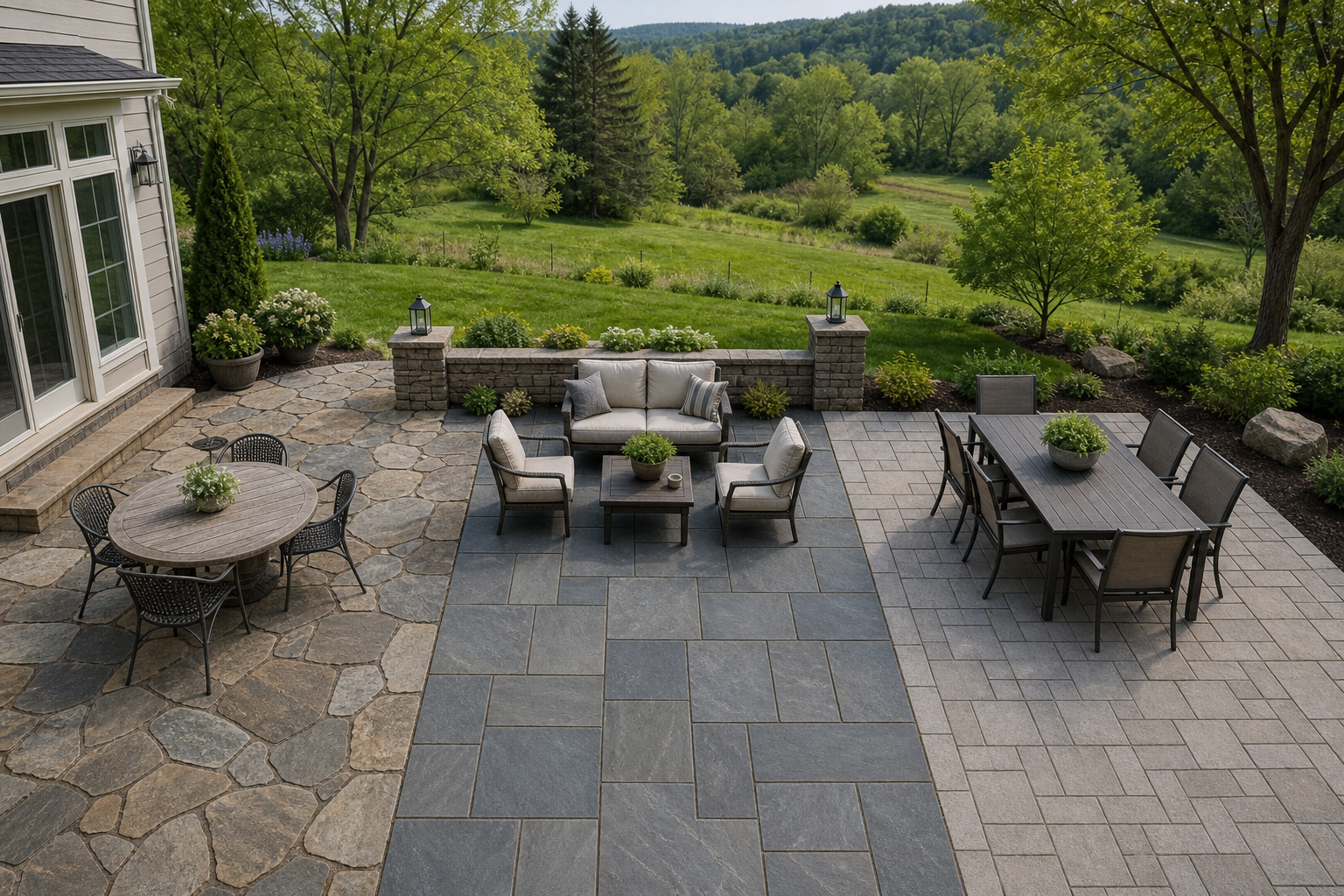
Flagstone is a category, not a single rock type. It refers to any flat stone split into irregular pieces, and it can include sandstone, limestone, or quartzite depending on the source. It offers a natural, informal look and works well in Wisconsin when properly sealed and laid on a stable base. Slabs should be thick enough to resist cracking under freeze-thaw pressure.
Bluestone is one of the strongest performers in cold climates. It is dense enough to resist water absorption and provides excellent natural slip resistance in both wet and dry conditions, making it a practical choice for lakefront patios or any surface that sees rain and snow. Granite shares similar density and durability, requiring the least maintenance in freeze-thaw conditions.
Limestone offers a consistent, refined look but needs to be sealed and re-sealed regularly to prevent weathering from acid rain. Travertine, a member of the limestone family formed from minerals in spring or river water, has a distinctive porous texture that requires sealing in Wisconsin's climate. Slate has a very low water absorption rate, typically under one percent, meaning there is almost nothing inside the stone to freeze in the first place, which makes it a reliable cold-climate option.
For homeowners weighing manufactured options, modern precast concrete pavers use advanced manufacturing techniques that make them comparable to stone in durability and longevity, and they offer uniformity of shape that simplifies installation and replacement. See a full side-by-side comparison at concrete patio vs. pavers.
Sealing, maintenance, and longevity across stone types
Natural stone, when properly maintained, has a lifespan measured in decades to centuries. Concrete pavers typically last 30 to 50 years, while natural stone can last up to 100 years with appropriate care. The trade-off is that natural stone requires periodic sealing, though stone can go up to 10 years between sealant applications, compared to concrete which needs resealing roughly every five years. Limestone is the most demanding in Wisconsin specifically, requiring re-sealing every one to two years to hold up against acid rain weathering.
Slip resistance is another practical consideration, especially for patios near water. Bluestone and textured flagstone offer good grip naturally. Smooth-finished travertine or polished limestone can become slippery when wet, so finish selection matters as much as material selection. For patios that will include a fire feature or outdoor kitchen, the surface material also needs to handle radiant heat and foot traffic around a cooking zone. Paver ideas for hardscape gathering spaces around fire features covers that specific scenario in more detail.
When professional installation makes the difference
The stone itself is only part of the equation. A well-chosen material laid on a poorly prepared base will still fail. In Wisconsin's climate, proper base depth, compaction, and drainage are what determine whether a patio holds its level and appearance through repeated freeze-thaw cycles. This is where the gap between DIY and professional installation is most consequential.
For sloped sites, the base preparation becomes more complex, often requiring integration with a retaining wall system or drainage solution before any stone is laid. Lakefront properties add another layer of complexity: proximity to water, shoreline regulations, and soil conditions all affect what can be built and how. A specialist who understands these site conditions can select materials and design a base system that accounts for all of them together, rather than treating the stone surface as an isolated decision. If your project involves grade changes, explore how retaining walls and landscape stairs factor into a coordinated hardscape plan.
Patio stone materials at a glance
Each material has a distinct profile of durability, maintenance, and climate suitability. This overview helps narrow the field before diving into specifics.
- Bluestone
- Best suited to lakefront and high-moisture sites; dense, slip-resistant, and low-maintenance in freeze-thaw climates.
- Granite
- Suits homeowners who want maximum durability with minimal sealing; works in all climates and resists erosion and UV damage.
- Flagstone
- Suits homeowners who want a natural, informal look; requires proper sealing and a thick slab for cold-climate performance.
- Slate
- Suits those who want a refined, layered aesthetic; very low water absorption makes it a reliable freeze-thaw performer.
- Limestone
- Suits homeowners who want a consistent, refined look; requires the most frequent re-sealing of any natural stone in Wisconsin.
- Travertine
- Suits warmer-climate aesthetics adapted for Wisconsin with diligent sealing; distinctive texture requires more maintenance than denser stones.
- Concrete pavers
- Suits homeowners who want uniformity, easier replacement, and strong freeze-thaw performance at a range of price points.
For most southeastern Wisconsin homeowners, bluestone, granite, and concrete pavers offer the best balance of cold-climate durability and manageable maintenance. The right choice depends on site conditions, aesthetic goals, and how the patio integrates with the broader outdoor space.
The right stone choice starts with understanding the site: its drainage, its grade, its exposure to water, and what Wisconsin winters will ask of it every year.
Benefits
Freeze-thaw-rated material selection
A specialist familiar with Wisconsin conditions knows which stones are dense enough to resist moisture absorption and which require sealing schedules to survive repeated freeze-thaw cycles. Matching material density and finish to the local climate is the single most important factor in long-term patio performance.
Proper base and drainage engineering
The base system beneath the stone determines whether the surface stays level and intact over decades. Correct base depth, compaction, and drainage routing are what separate a patio that holds up from one that heaves, settles, or cracks within a few winters.
Coordinated design with the home's exterior
Stone color, texture, and pattern should be chosen in relation to the home's siding, roofline, and surrounding plantings, not in isolation. A coordinated hardscape design ensures the patio reads as a natural extension of the property rather than an afterthought.
Single-system planning for complex sites
On sloped, lakefront, or drainage-challenged sites, the patio cannot be designed without accounting for retaining walls, grade changes, and water management. Treating the patio as part of a larger site system from the start prevents the structural and aesthetic problems that come from adding elements piecemeal.
Three scenarios where material choice matters most
Lakefront patio exposed to moisture and freeze-thaw
A homeowner on a southeastern Wisconsin lake wants a patio at the water's edge that can handle seasonal moisture, ice, and heavy foot traffic from swimmers and boaters. Bluestone or granite are the strongest candidates here: both are dense enough to resist water absorption and perform well through repeated freeze-thaw cycles with minimal maintenance. Slip resistance is also a priority near water, and bluestone's natural texture provides reliable grip in wet conditions. The base system needs to account for shoreline soil conditions and drainage, which often means coordinating the patio with broader shoreline and erosion control work on the property.
Suburban entertaining patio with outdoor kitchen
A homeowner in Waukesha or Washington County wants a large patio designed for outdoor dining, a built-in kitchen, and a fire feature, all tied visually to the home's exterior. Here, concrete pavers are often the practical choice: they offer consistent sizing that simplifies layout around a kitchen structure, come in a wide range of colors and textures to complement the home, and hold up well through Wisconsin winters when properly installed. Natural flagstone or bluestone can also work beautifully in this setting and add a more organic feel. Either way, the patio, kitchen, and fire feature should be designed as a single coordinated system rather than added one at a time. See paver patio design ideas and inspiration for layout approaches that work well in this context.
Sloped backyard requiring retaining wall integration
A homeowner with a steeply graded backyard wants to create a usable flat patio area, which means the stone surface cannot be designed independently of the retaining structure holding the grade. Flagstone or concrete pavers both work well in terraced hardscape systems, but the material needs to be selected alongside the wall material so the finished project reads as cohesive rather than assembled from mismatched parts. Drainage is the critical engineering consideration: water moving down a slope needs somewhere to go that does not undermine the wall or the patio base. A backyard renovation that integrates the patio, retaining wall, and drainage from the start avoids the costly rework that comes from treating each element separately.
Outdoor patio stone ideas: common questions answered
Ready to choose the right stone for your patio
If you are weighing patio stone options for a Wisconsin property, the most useful next step is a conversation about your specific site: its grade, drainage, proximity to water, and how the patio connects to the rest of the outdoor space. That context shapes every material and installation decision that follows.
Request a design consultation