

The Best Erosion Control Methods for Steep Slopes
Steep slopes erode fast: choosing the right control method before it gets worse
A practical guide to retaining walls, drainage, ground cover, and what to look for when hiring a contractor.
Protect your slope before the next Wisconsin winter takes more ground
Understand which erosion control methods actually work on steep slopes, what drives the cost, and how to evaluate a contractor before committing to a fix.
Why steep slopes erode faster than you expect
Slope gradient is the single biggest driver of erosion rate. Once a slope exceeds 33% gradient, basic seeding and organic matter are no longer enough to hold soil in place - engineered solutions become necessary. On slopes steeper than 3:1 (three feet of horizontal run for every one foot of vertical rise), the forces pulling soil downhill are strong enough that even established turf can fail during a heavy rain event.
In Wisconsin, the freeze-thaw cycle compounds the problem significantly. Water infiltrates the soil in autumn, freezes, expands, and loosens the soil structure. When it thaws in spring, that loosened soil is far more vulnerable to runoff. A slope that looked stable in October can be visibly eroding by April. This is not a problem that holds steady while you wait - each season of inaction typically means more material lost and a larger, more expensive repair.
Retaining walls: when structure is the only real answer
On slopes steeper than 3:1, vegetation alone rarely provides enough mechanical resistance. A retaining wall intercepts the downhill force directly, holding a mass of soil in place rather than simply slowing its movement. The right wall type depends on the height of the grade change, the soil conditions, and what sits above and below the wall.
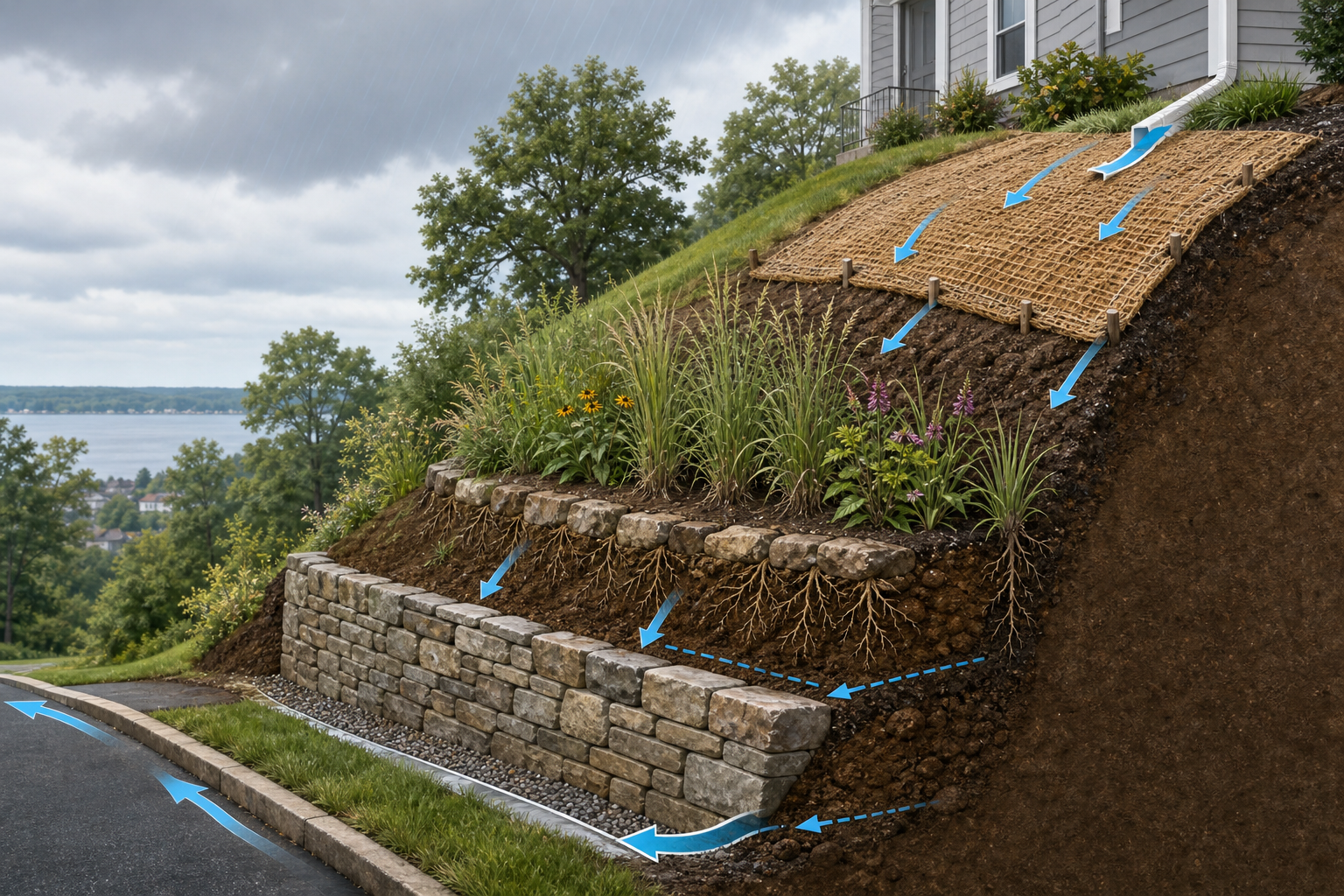
Stepped or terraced walls generally outperform a single tall wall on sharp slopes. By breaking the grade into multiple shorter walls with planted benches between them, you distribute the load, improve drainage, and create usable flat space in the process. Material choices - concrete block, natural stone, or boulder - each carry different structural profiles and aesthetic outcomes. For a detailed comparison, see how to choose the best retaining wall material for your property. What drives cost is mostly wall height, batter, drainage requirements, and site access, not material alone. You can read more about what to expect on the retaining wall cost page.
Drainage solutions that stop erosion at its source
Most slope erosion is not caused by the slope itself - it is caused by water that has nowhere to go. Surface runoff concentrates in low points, cuts channels, and carries soil with it. Subsurface water saturates the slope and reduces the shear strength of the soil, making it prone to slumping. Addressing drainage before or alongside any structural work is essential.
French drains intercept subsurface water and redirect it away from the slope before it can saturate the soil. Surface swales and catch basins manage sheet flow and prevent it from concentrating. On lakefront properties, this is especially important because runoff carrying sediment can trigger regulatory scrutiny in addition to causing physical damage. A drainage solution that works in isolation from the rest of the slope design often fails - the two need to be planned together.
Ground cover, blankets, and vegetation that actually hold
Vegetation is the most durable long-term solution for moderate-to-steep slopes in the 33-50% gradient range, but the species selection matters enormously. Standard turfgrass roots are shallow and provide limited anchoring. Deep-rooted native grasses - little bluestem, switchgrass, purple lovegrass, and river oats - have root systems far sturdier than conventional lawn grass and can hold soil through extreme weather. On slopes greater than 50%, plants that do not require mowing are the practical standard, since operating mowing equipment on that gradient is unsafe.
During the establishment period, bare soil is at its most vulnerable. Erosion control blankets (ECBs) made from jute, coconut fiber, or synthetic material are laid directly over disturbed ground to protect the surface while roots develop. For large exposed areas, hydroseeding - a slurry of seed, mulch, fertilizer, and tackifier sprayed onto the slope - maintains seed-to-soil contact far better than dry seeding. Where permanent reinforcement is needed, turf reinforcement mats (TRMs) provide long-term structural support even after vegetation is fully established.
Terracing and combined systems for the steepest sites
Terracing converts a continuous steep slope into a series of level or near-level steps. Each terrace is cut into the existing grade, with excavated soil used as fill to form a low berm at the front edge. That berm slows water flow and gives it time to infiltrate rather than run off. The flat benches created between walls or berms can be planted, paved, or left as usable outdoor space - which is why terracing is often the right answer for a backyard renovation on a difficult grade, not just an erosion fix.
The strongest defense on the steepest sites combines terracing with engineered geotextiles, structural walls, and vegetative cover. No single method handles everything. A well-designed system layers structural elements that handle immediate forces with biological elements that improve over time. That layered approach is also what makes phased construction feasible - you can stabilize the most critical areas first and add plantings or surface finishes in subsequent seasons.
The most durable erosion fixes solve the water problem underground and upslope before anything visible is built on the surface.
How to approach a steep slope erosion problem
- 1
Assess the slope gradient and drainage
Before choosing any method, measure the actual slope gradient and observe where water moves during and after rain. A slope under 33% may be manageable with vegetation and organic matter. A slope above 33% almost certainly needs engineered support. Note where water concentrates, where channels are forming, and whether the problem is surface runoff, subsurface saturation, or both. Accurate site assessment is what separates a solution that holds from one that fails in the first wet spring.
- 2
Check permit and setback requirements
In Washington, Waukesha, and Ozaukee Counties, work on slopes near shorelines is subject to Wisconsin DNR shoreland regulations, including setback requirements and restrictions on grading and vegetation removal. Even on inland slopes, local grading permits may apply. Identifying permit requirements before design begins prevents costly redesigns and construction delays. A contractor familiar with Wisconsin DNR rules and county-level requirements can navigate this process as part of the project scope - not as an afterthought.
- 3
Get a site-specific design, not a generic plan
Erosion control on a steep slope is not a product selection - it is a design problem. The right combination of walls, drainage, blankets, and plantings depends on your specific gradient, soil type, water sources, and what sits above and below the slope. A design that works on a sandy lakefront bluff will not necessarily work on a clay-heavy suburban grade. Insist on a plan drawn for your site. See landscape stairs as an example of how access and grade change can be integrated into a single coordinated design.
- 4
Select materials and methods matched to the site
With a site-specific design in hand, material selection becomes straightforward. Wall material - concrete block, natural stone, or boulder - should be chosen for structural fit first and aesthetics second. Vegetation species should be matched to the slope gradient: no-mow native plantings for slopes above 50%, deep-rooted grasses and groundcovers for moderate-steep grades. Erosion control blankets or hydroseeding should be specified for any bare soil that will be exposed during construction.
- 5
Phase construction to manage risk and budget
On complex slopes, phasing is often the most practical approach. Structural work - walls, drainage, and terracing - should come first, since these protect the site during subsequent phases. Plantings and surface finishes can follow in later seasons once the structural system is confirmed stable. Phasing also allows budget to be spread across multiple years without leaving the slope unprotected between phases, provided each phase ends with temporary erosion control measures in place.
Three slope scenarios and what actually works
Lakefront bluff losing ground to the water
A lakefront property owner notices the bluff edge retreating each spring, with soil slumping toward the water after ice-out. The slope is steep, the soil is saturated from snowmelt, and the toe of the bluff is being undercut. This scenario calls for a layered response: boulder reinforcement or a seawall at the toe to stop undercutting, drainage management to reduce subsurface saturation, and deep-rooted native plantings on the face of the bluff to anchor soil between structural elements. Wisconsin DNR permits are almost certainly required before any work begins at the shoreline. This is exactly the kind of technically demanding site where a contractor with shoreline experience and regulatory knowledge is not optional.
Suburban backyard with a steep unusable grade
A homeowner in Washington or Waukesha County has a backyard that drops sharply from the house, making the lower portion of the lot effectively unusable and prone to washing out during heavy rain. A terraced retaining wall system - two or three shorter walls rather than one tall one - can convert that grade into a series of level spaces suitable for a patio, plantings, or lawn. The retaining walls hold the grade structurally while drainage behind each wall prevents hydrostatic pressure from building up. The result is both an erosion fix and a genuine expansion of usable outdoor space.
Hillside with drainage washing out a pathway
A slope with an existing pathway or landscape stairs is showing signs of erosion alongside the hardscape: soil washing away from the edges, gravel migrating downhill, and small channels forming after rain. The root cause is usually concentrated runoff from an upslope area that has no managed outlet. A French drain or surface swale installed upslope of the pathway intercepts that water before it reaches the hardscape. Erosion control blankets stabilize the disturbed soil during installation, and native groundcovers planted on the slope face provide long-term protection once established.
Common questions about the best erosion control methods for steep slopes
Ready to stop the erosion before the next season takes more ground
Steep slope erosion does not stabilize on its own - each freeze-thaw cycle and heavy rain event moves more material and makes the repair larger. If you have a slope that is visibly losing ground, the right starting point is a site assessment that looks at gradient, drainage, and any permit requirements before any method is chosen. McGuire Landscape Company works with homeowners across Washington, Waukesha, and Ozaukee Counties on exactly these kinds of technically demanding sites.
Talk to a slope specialist